
How did this unusual project begin?
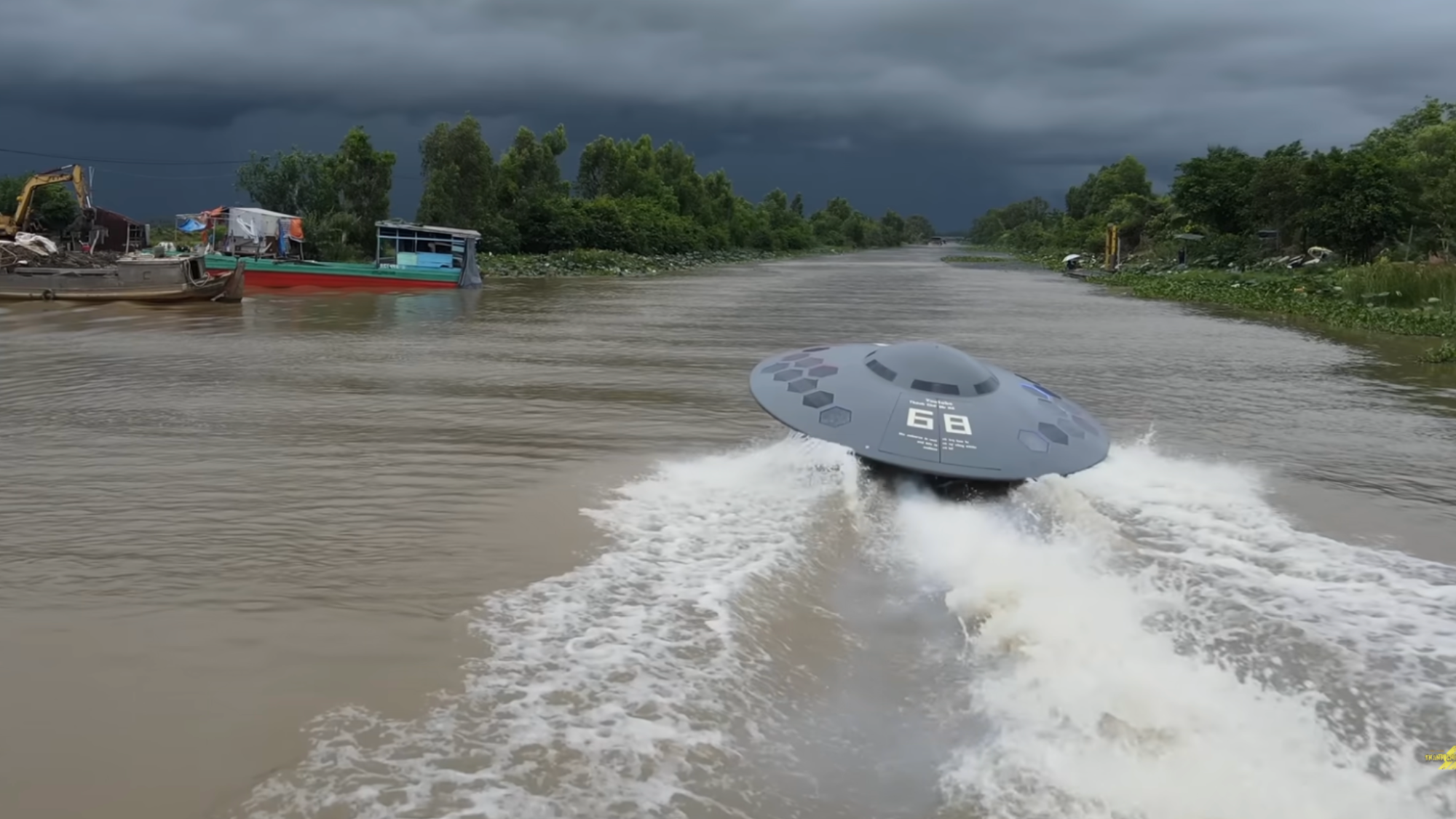
Popular Science reported on the boat in August 2026 and described Ho’s account of a dream that inspired its shape. The construction itself was not new in 2026: its maker had published a video of the process in September 2024. That distinction matters because the recording documents a real project that later attracted renewed press attention. One viral retelling even presented the boat as a “found ”; an independent check showed that the object was Ho’s identifiable vessel.
From a circle on the floor to a hull on the water
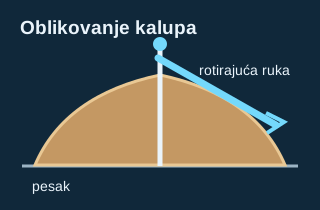
The first challenge was geometry. A large, approximately symmetric disc cannot be made simply by drawing a circle and guessing the height of its rim. Ho marked out the basic shape, piled up sand and mounted a long metal arm on a central support. As the arm rotated, it scraped away excess sand and left an even profile. It worked rather like a compass, except that it shaped a three-dimensional surface instead of drawing a line on paper.
A firm was formed over the sand base, and layers of were then added: fibrous material and a binder that create the outer shell. This produced the familiar saucer outline. Metal parts support the structure and shape the lower section that passes through the water. Sand and concrete were important while forming the shape, but it would be misleading to imagine the entire craft as a massive concrete disc. The published recording shows construction stages; it does not provide complete plans, hull mass or results from standardized tests.
Windows and lights in the upper section emphasize the spacecraft appearance. The driver enters through narrow moving doors and lies back in a highly reclined seat. That position preserves the low silhouette, but restricts movement and makes entry and exit more awkward. A visual design choice therefore immediately becomes a practical issue.
NZM — šematski prikaz · Sources ↗
Why does a disc float at all?
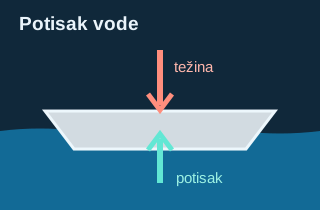
A vessel floats when the surrounding water pushes upward strongly enough to balance its weight. According to Archimedes’ principle, the buoyant force equals the weight of water displaced by the vessel. A closed hull can contain metal and other heavy components yet still float, because it encloses enough air and displaces enough water. In a simple expression, is F = ρgV: ρ is the density of water, g is gravitational acceleration and V is the volume of displaced water.
That explains the first condition, not the whole problem. The craft must also remain stable when the driver climbs in, the motor starts or a wave strikes its side. Mass distribution, the , the submerged hull shape and the width of support on the water all affect its behavior. An unusual silhouette by itself tells us little about stability. The video shows that this particular craft floated and moved during the filmed trial; it cannot show how it would perform in every weather and water condition.
NZM — šematski prikaz · Sources ↗
A personal-watercraft motor beneath the “spaceship”
A gasoline engine taken from a personal watercraft was fitted below the driver. The craft therefore does not advance by spinning its disc. In a typical system, water enters through an intake underneath, a pump accelerates it and a jet exits at the rear. Water is expelled in one direction, and the reaction pushes the vessel the other way. Yamaha describes this principle for its personal watercraft. Ho’s footage shows an installed drive, but not every detail of the pump and transmission, so a precise model or power rating should not be assumed.
When he first applies throttle in the footage, the front rises briefly and the stern sinks. Such a change in attitude can occur when motor thrust and weight distribution do not align ideally with the acting on the hull. Without measurements of thrust angle, speed and load, we cannot identify a single decisive cause in this case. The vessel then continues its run. Steering matters as much as propulsion: in water-jet systems the nozzle redirects the jet, while the boat’s response also depends on speed and mass distribution.
A small is visible on top as an auxiliary electrical source. There is no evidence that it drives the main motor or could replace gasoline during the filmed run. Lights, gauges and moving fittings may need electricity on a quite different scale from propelling a boat. Separating the principal drive from auxiliary electrical equipment helps explain this unusual vehicle without giving it imaginary abilities.
Tran Long Ho / YouTube · Sources ↗
What makes this a “do it yourself” project?
The interesting point is not that anyone could build an identical boat over a weekend. Ho had to combine shaping, work with materials, a metal structure, propulsion, and steering. Every stage raised another question: is the shape sufficiently symmetric, where could water enter, how is motor force transmitted and could the driver escape quickly? The video reveals a process of trying, adjusting and testing, which is much closer to engineering than a finished “trick”.
At the same time, a successful filmed trip does not establish that the construction is safe for routine use. An enclosed cabin with a gasoline engine calls for careful checks of ventilation, fuel, possible leaks and emergency exits. Personal-watercraft makers list such checks before a ride. The available sources contain no independent certification report for Ho’s boat. For students, the best use of the project is therefore to examine its physics and design choices, rather than treat it as a complete building manual.
Key terms
— a shaped form used to create another part; — a material combining fibers and a binder; — the upward force exerted by water; — motion produced by expelling water backward; — the point where an object’s total weight acts; — forces produced by moving water around the hull; — a device that converts light into electricity; — a joint’s ability to prevent water entering; — an unidentified flying object.