
We often compare the to an army that protects us every day from dangerous infections and microbial attackers. Yet no army can survive long on a battlefield without the right logistics and tissue infrastructure. That essential infrastructure is the ; supporting connective-tissue cells build its structure and nourish defensive cells. In addition, act like expert epidemiologists on the front line. They identify the nature of a threat and pass crucial instructions to other in the .
, such as and the , are the birthplace and a kind of academy for our . In the , learn to attack while sparing the body’s own tissues. Developing tolerance toward one’s own body prevents the destruction of healthy organs and the onset of severe . Unfortunately, the is the first organ to begin failing and undergoes from as early as the age of five. By puberty its production of new cells has fallen to only ten percent; in the fifties it is just one percent.
As we age, become less able to multiply quickly and fight infections effectively. Severe infections such as coronavirus can also leave a lasting imprint on in the . Those cells then remain in a heightened state of readiness, which may later contribute to . For many years, scientists assumed that themselves simply aged irreversibly and lost their function.
Yet Professor Nikolić’s team made a dramatic discovery that brought a Copernican shift in . When young were transferred into an old organism, they began dividing just as slowly as old cells. Conversely, old moved into a young organism fully regained their original function and rate of division. This showed that the key to immune ageing lies in the deterioration of the , or the of , rather than in the themselves.
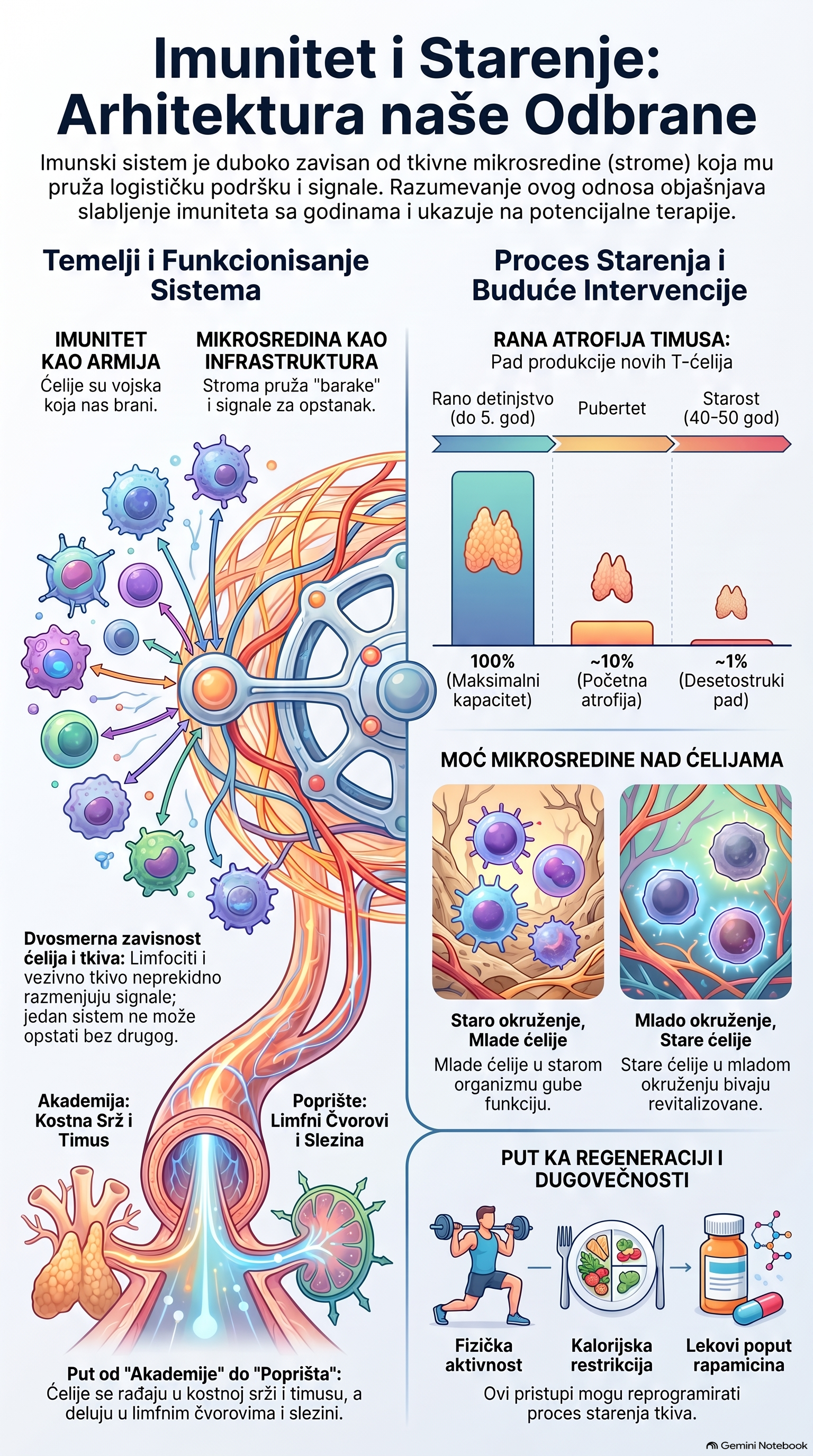
The good news is that the ageing process is remarkably flexible and can be altered. Our cells experience so-called , which directly affects , the lungs of the cell. Physical activity, good sleep, a moderate diet and encourage cells to renew themselves and recycle damaged parts. Alongside a healthy lifestyle, scientists are actively developing pharmacological methods to rejuvenate tissues.
One of the most intriguing substances under study is , a molecule that acts on a crucial metabolic hub and prepares a cell to adapt to stress. Experts nevertheless warn strongly against taking such medicines on one’s own without medical supervision. Recent research also shows that particular , or “bad”, cells can drive the ageing of entire organs. Targeted removal of these old cells opens the possibility of restoring tissue function and significantly extending healthy life.
The chief goal of modern medicine is not merely to add years to life, but to breathe a full life into every year we live. Like the ancient hero Gilgamesh, humanity has always searched for a mysterious herb that restores youth. Although immortality remains in the realm of mythology, the of ageing is finally offering realistic, scientifically grounded ways to improve later life. Until new therapies arrive, it is our responsibility to care for our habits so that our inner army can continue to protect us successfully.