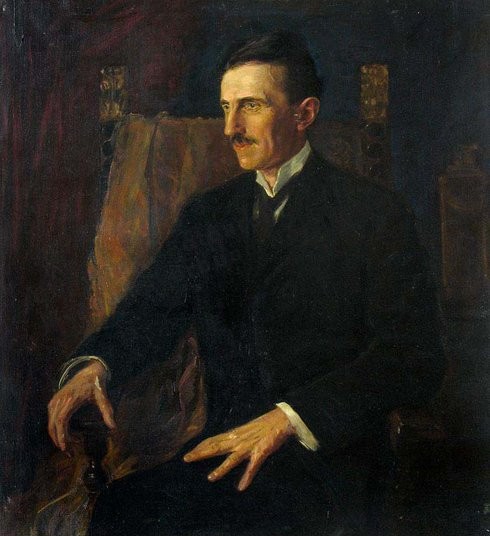
From Smiljan to electrical engineering
Nikola Tesla was born in Smiljan in 1856 to a Serbian family. His mother Đuka made ingenious household devices and his father Milutin was a priest. He studied in Karlovac, began courses in Graz and attended lectures in Prague, but did not gain the degree sometimes attributed to him. He worked in Budapest and Paris before moving to the United States in 1884. Engineers were looking for better ways to transmit electricity and run motors without sparking commutators.
The rotating magnetic field
Several windings carrying alternating currents out of phase with one another create a magnetic field that rotates. The changing field induces current in a conductive rotor and produces torque. Tesla developed this principle through models, experiments and patents, presenting important designs in 1888. It was more than one sudden idea: generators, transformers, protection, insulation, manufacturing and finance were all required to build a working system.
Dickenson V. Alley; restoration by Lošmi / Wikimedia Commons · Sources ↗ · Image terms ↗
Why AC helped transmission
The same power can be carried at higher voltage with lower current. Resistive heating in wires rises approximately with the square of the current, so lowering current cuts losses. Transformers raise AC voltage for transmission and lower it near users. They do not create energy. Direct current remains essential to electronics, batteries and some long-distance links, so the history is more nuanced than a total victory of one “good” current over another.
Westinghouse and the battle of systems
George Westinghouse purchased Tesla’s patents and supported further development. The “War of Currents” mixed engineering, business rivalry and real safety questions. The 1893 Chicago World’s Fair and Niagara Falls power projects made AC highly visible. Neither installation was Tesla’s solitary creation: teams designed and constructed the infrastructure. His contribution matters within that wider network of engineers and workers.
High voltage and wireless experiments
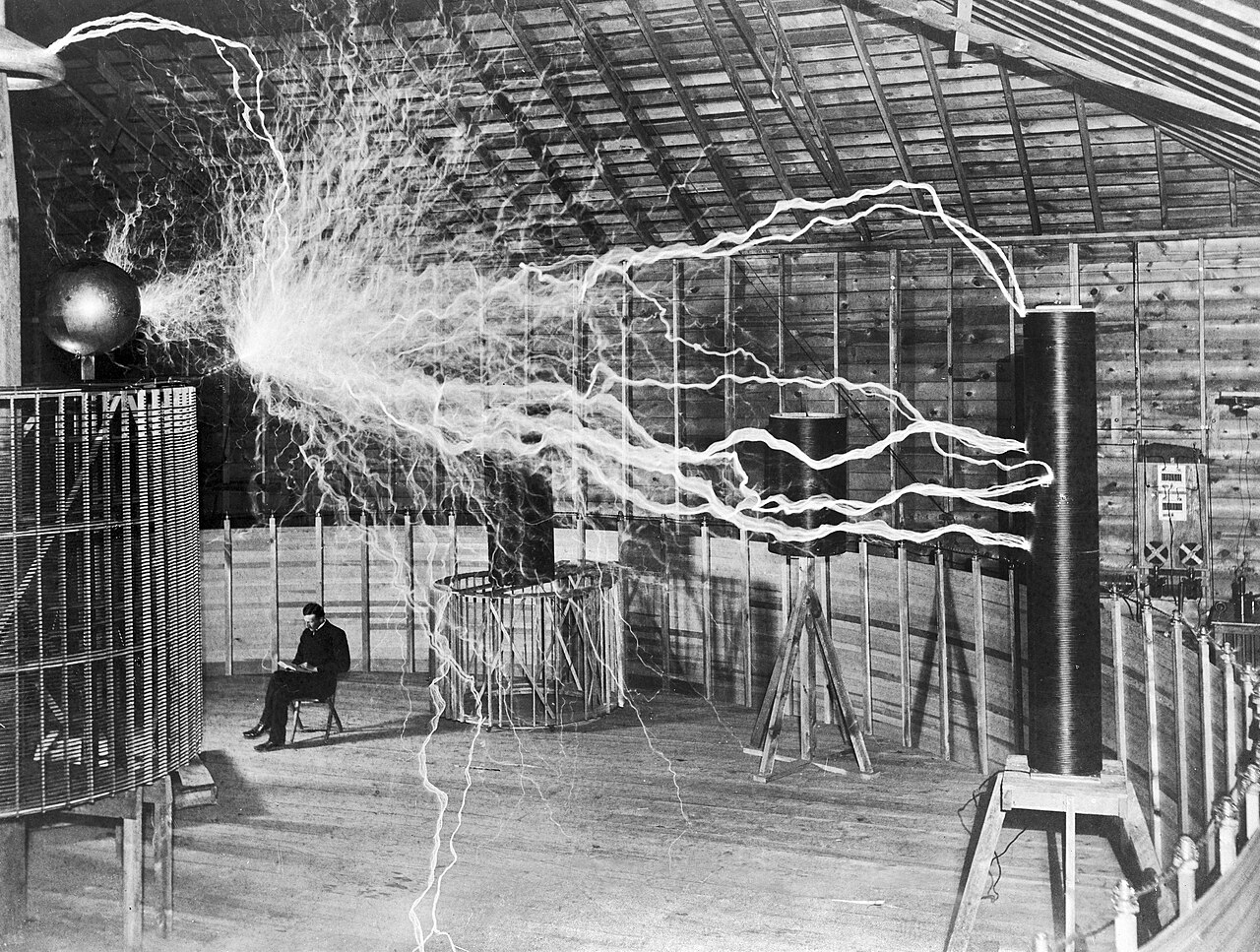
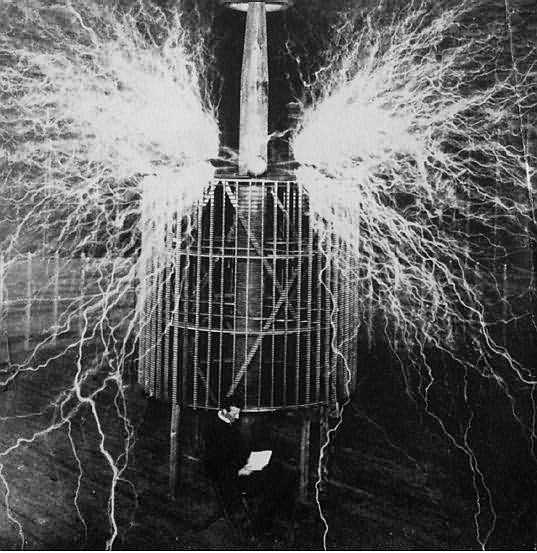
Tesla studied resonance, high-frequency currents and wireless signalling. His coil creates very high voltages and dramatic electrical arcs. Famous Colorado Springs photographs record the scale of the experiments, although dramatic composite images require careful explanation. Radio, too, arose from contributions by several inventors. Tesla played a part, but later Wi-Fi was not a device he personally designed.
Photographer Dickenson V. Alley / Wikimedia Commons · Sources ↗ · Image terms ↗
Wardenclyffe and an unrealised ambition
On Long Island Tesla began Wardenclyffe, a station envisaged for worldwide wireless communication and perhaps power. Funding ran out and it never became a functioning global network. Short-range wireless charging exists today, but does not establish that enormous amounts of electricity can be sent everywhere without losses. Any ambitious scheme must pass tests of efficiency, cost and safety.
The person and the legacy
Tesla enjoyed literature and knew how to present experiments to an audience. He died in New York in 1943 after less prosperous later years. The unit of magnetic flux density bears his name. His story is richer when working motors and patents are separated from mythology and when the teams who built, tested and used the technology remain visible.
From patents to a working power system
Alternating current reverses direction many times a second. Transformers can raise voltage for transmission and lower it near users; for the same power, a lower current along a line reduces heating losses. Yet the benefit did not come from one isolated invention. Generators, motors, insulation, measuring equipment, safety practice and people building networks all mattered. Tesla’s contribution to the polyphase motor was especially important: a rotating magnetic field can turn the rotor without the mechanical commutator required by some earlier motors.
A patent is not the same as a completed power station. Westinghouse acquired Tesla’s patents, while engineers in several fields adapted the system for manufacturing and everyday use. The Niagara Falls power project became a famous example of the wider shift to alternating current. Direct current did not disappear; it remains essential in electronics, batteries and some long-distance connections. A fair comparison states the job, distance and engineering constraints before declaring one system better.
Tesla’s public demonstrations made electricity vivid to audiences, while his later ambition for worldwide wireless power did not become a proven general solution. Unfinished projects are part of his life, alongside genuine breakthroughs. We should distinguish a patent, a repeatable experiment, a functioning network and an attractive proposal. That distinction lets us appreciate his remarkable engineering imagination without adding modern myths that give him credit for every technological secret.
Key terms
— a motor whose changing stator field induces current in the rotor and produces torque.