
Molecules in the mirror
Imagine your left and right hands. They look like a matched pair in a mirror, but you cannot place one on top of the other so that all the fingers coincide. The molecular world contains the same kind of spatial distinction. We call it , and two molecules that are non-superimposable mirror images are called . They contain the same atoms and bonds, but their arrangement in space differs.

École Polytechnique · Sources ↗ · Image terms ↗

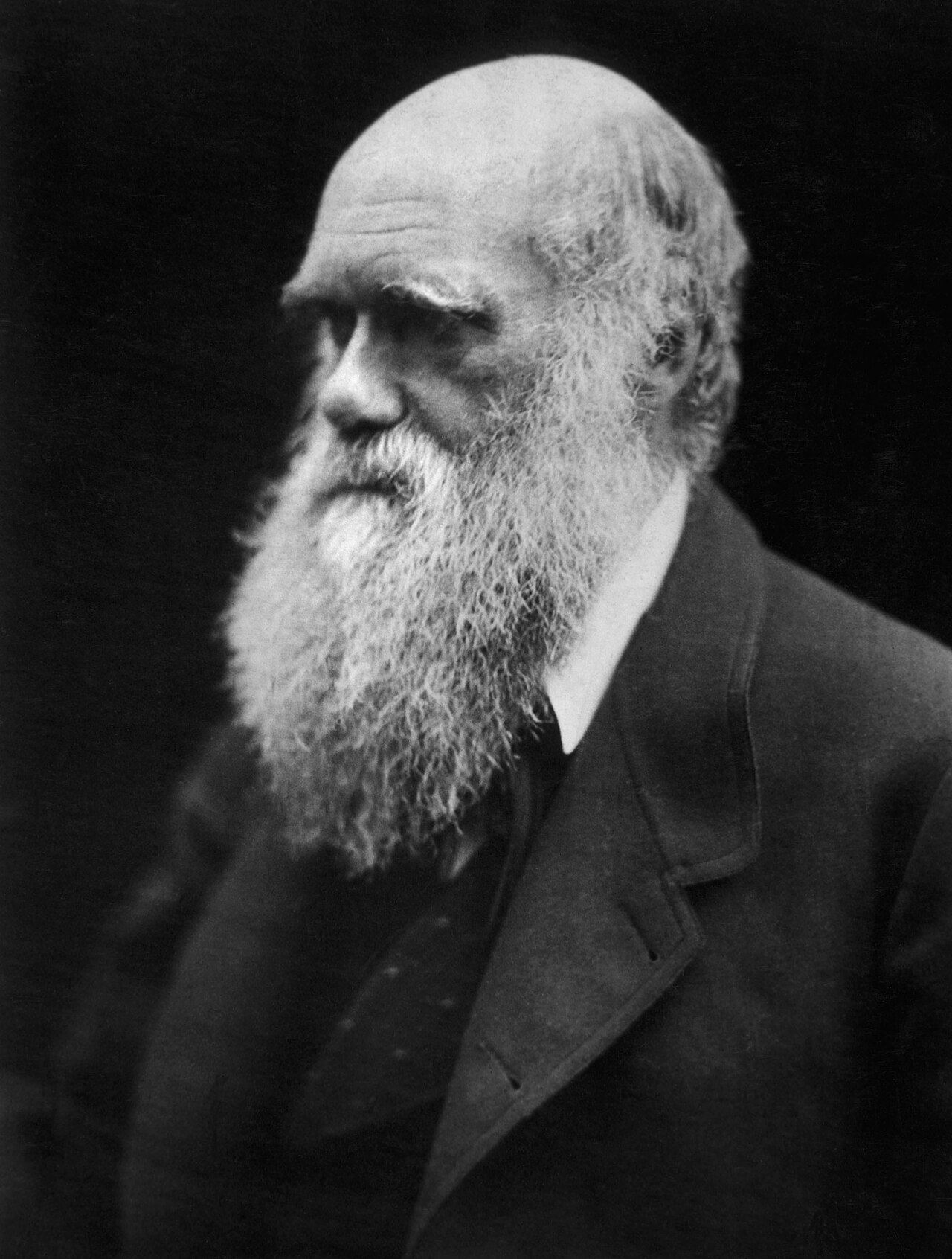
The Japan Times · Sources ↗
This difference is more than a geometrical curiosity. Proteins, enzymes and cellular receptors also have three-dimensional shapes, so two may bind to them differently. The familiar rule that “one works and the other does not” is not universal: the effect depends on the particular substance and biological target. Controlling a molecule’s “hand” therefore matters in drug development.
How Pasteur began the story
In 1848, the young chemist Louis Pasteur noticed that crystals of a particular tartrate could be separated into two groups that were mirror images. After dissolving them, he found that their solutions rotated the plane of in different directions. This connected crystal shape with a substance’s optical behavior. His work opened a path toward stereochemistry, the study of how atoms are arranged in three dimensions.
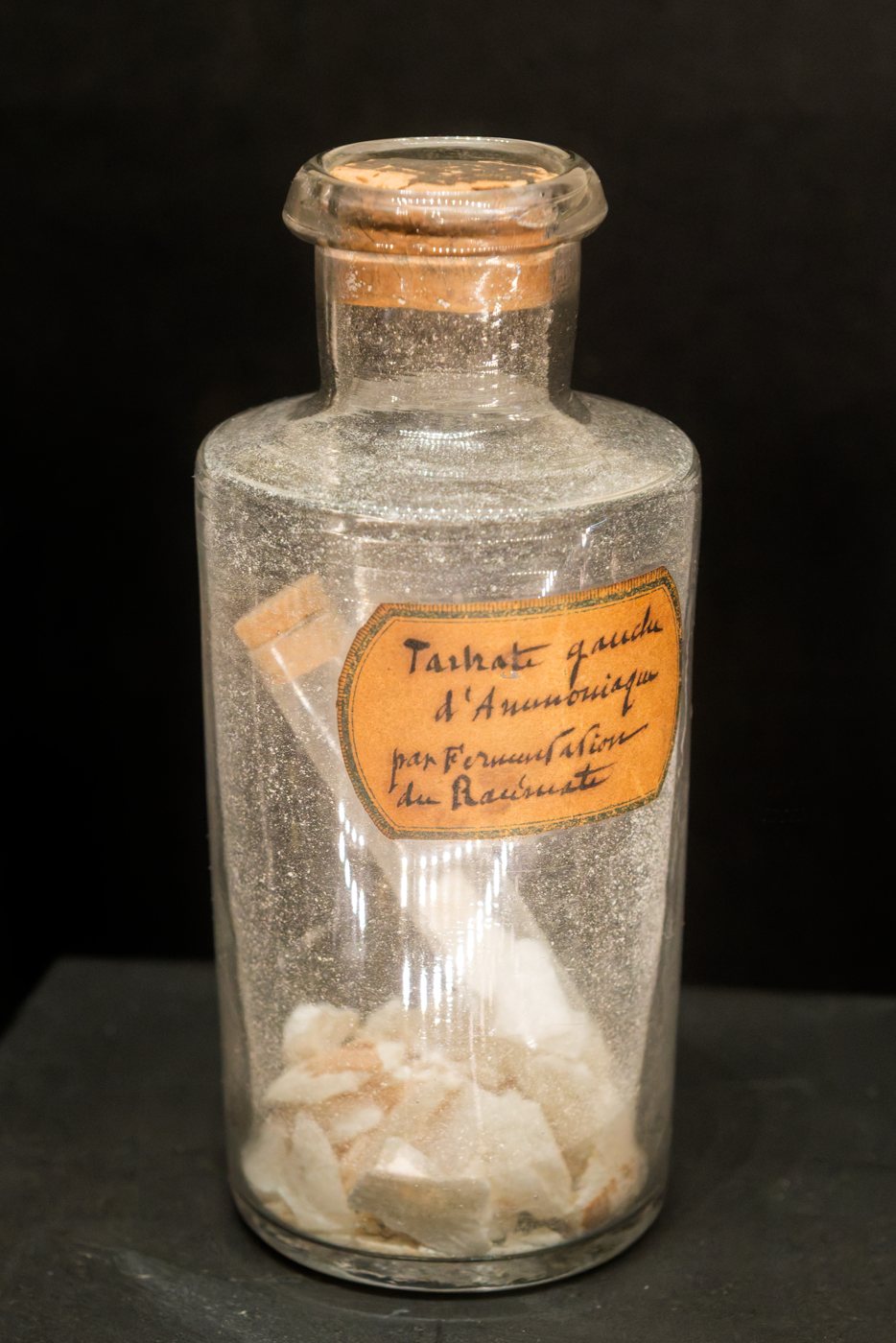
Marie-Lan Taÿ Pamart · Sources ↗ · Image terms ↗
Living systems display pronounced . Proteins are built almost entirely from L-amino acids, while the ribose and deoxyribose in RNA and DNA have the D configuration. This does not mean that no other forms occur in biology. Glycine has no center, for instance, and D-amino acids occur in the walls of many bacteria. A major open question is how such a strong preference for one “hand” arose in life’s essential molecules.
When two form from achiral starting materials in a symmetrical environment, they often form in nearly equal amounts. Such a mixture is a . In nature and in the laboratory, however, a pre-existing substance, a mineral surface, light or the reaction mechanism itself can disturb that balance. It is more precise to ask how a small initial bias can grow than to claim that laboratory synthesis always gives an exact 50–50 split.
The same formula, a different encounter with the body
Smell offers a memorable example, but it needs care. The of carvone are often described as follows: (R)-carvone evokes mint, whereas (S)-carvone evokes caraway. The popular claim that one form of limonene smells exactly like orange and the other exactly like lemon is far less secure. Citrus-peel oils contain other compounds, and perception also depends on how the nose and brain process their signals. Limonene is therefore not an infallible classroom demonstration.
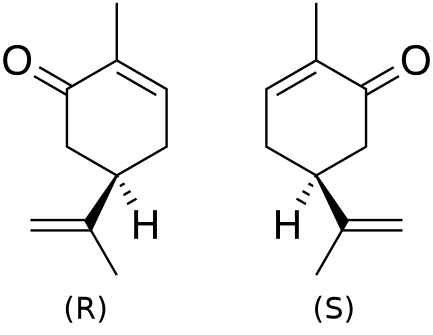
Walkerma i Karlhahn · Sources ↗ · Image terms ↗
The drug thalidomide showed how serious the consequences of three-dimensional structure can be. Its use during pregnancy in the late 1950s and early 1960s caused severe harm to many children. Simplified accounts sometimes say that one was “safe” and the other dangerous. That is misleading: the forms can interconvert in the body, so isolating only one would not simply have removed the risk.
Ibuprofen supplies another useful nuance. Many preparations contain a mixture of two . The S form contributes more strongly to inhibition of the COX enzyme, while the body converts some of the R form into S. None of this makes the medicine entirely safe; it has known adverse effects and limits on use. Ketamine also resists a simplistic story: both can act as anesthetics and can produce psychoactive effects.
Kagan: a small advantage can become large
Chemists use a to speed up a reaction and influence its course. If the is , it may favor one of the product. For a long time, researchers expected the product’s purity to roughly follow the ’s purity. A small excess of one “hand” would then give a similarly small excess of the corresponding product “hand”.
In 1986, Henri Kagan demonstrated that the relationship can be . In some reactions, the product has a larger than the itself. One possible explanation is that molecules join into or larger assemblies. Pairs made from like and unlike can differ in stability and catalytic activity. If some of the minority form becomes trapped in less active mixed assemblies, the remaining active is more strongly one-handed than the original mixture.
This is not a universal recipe in which every like-handed pair is always fast and every mixed pair inactive. The mechanism and even the direction of the effect depend on the reaction. Kagan’s contribution was to reveal that the system itself can amplify a starting asymmetry, or in other circumstances diminish it.
Soai: a product helps make more product
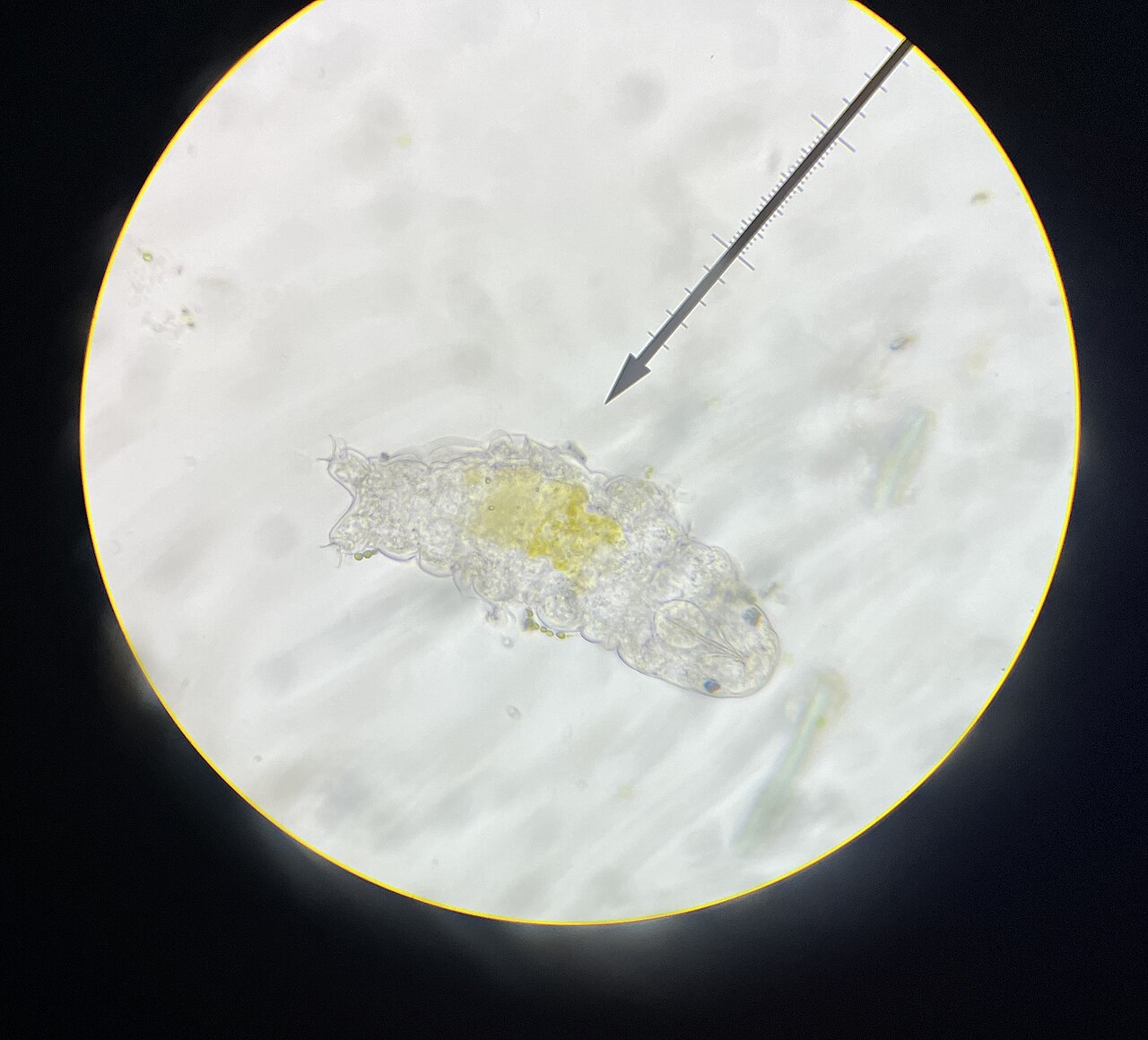
In 1953, the theoretical physicist Frederick Charles Frank described conditions under which a tiny random difference could grow into dominance by one molecular “hand”. Production must reinforce itself, favor the same hand and suppress the opposite one. Self-reinforcing production is called . It is a positive feedback loop: the more of a substance that forms, the more it can accelerate its own further formation.
Yongrenjie · Sources ↗ · Image terms ↗
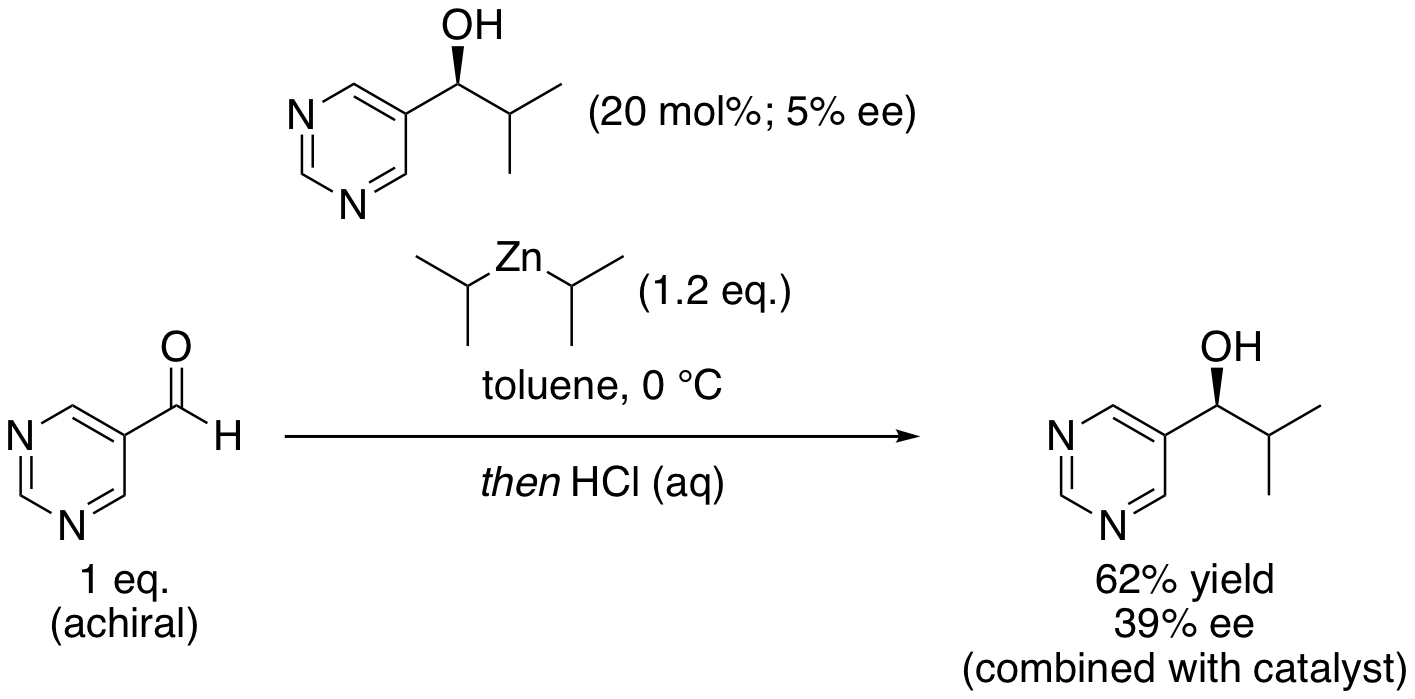
Kenso Soai found a suitable experimental system. Diisopropylzinc reacts with a particular pyrimidine aldehyde, and the alcohol produced, as a zinc alkoxide, accelerates production of still more of that alcohol. It especially favors the same three-dimensional form. The essential point is that the product is not just the outcome of the reaction: it changes the rate at which the next batch of product forms.
What does a starting of 5% mean? It means a 52.5% to 47.5% ratio, not five percent of the total amount. In an experiment reported in 1995, the first product had 55% , the next round 87%, and repetition brought it to about 90%. Each round uses the product of the previous one, passing on and amplifying the spatial bias. is the absolute difference between R and S amounts divided by their sum: a 75-to-25 mixture therefore has an excess of 50%.
In a later experiment published in 2003, the initial difference was just 0.00005% ; after three successive cycles it exceeded 99.5%. That initial percentage does not literally mean “one molecule in two million.” It describes a relative difference among many molecules, not an isolated single molecule. The actual number of molecules would depend on the sample size.
Can chemistry “choose a hand” by itself?
Soai’s system also allowed tests without an intentionally added trigger. Across one series of 37 experiments, the R form prevailed 18 times and the S form 19 times. Final excesses ranged from 15% to 91%. The outcome did not reveal a hidden rule that always selects the same side. It showed that a tiny, random initial departure can be amplified. Researchers call this .
Did the Soai reaction itself make the first biological molecules one-handed? We do not know. It uses particular organic reagents and conditions that are not a simple model of the watery environment of early Earth. Its value lies in experimentally demonstrating the possibility of chemically amplifying a minute asymmetry. The origin of biological remains an open research question.
Kagan and Soai also advanced the broader understanding of asymmetric synthesis: their work shows ways to favor production of a desired . In pharmaceutical chemistry, that knowledge helps with the design and control of manufacturing. It does not mean that the Soai reaction itself is used to mass-produce medicines, or that selecting a single automatically removes every adverse effect. The 2026 Nobel Prize recognizes a fundamental insight into chemical systems: a small molecular advantage can become a large one.