
What is happening?
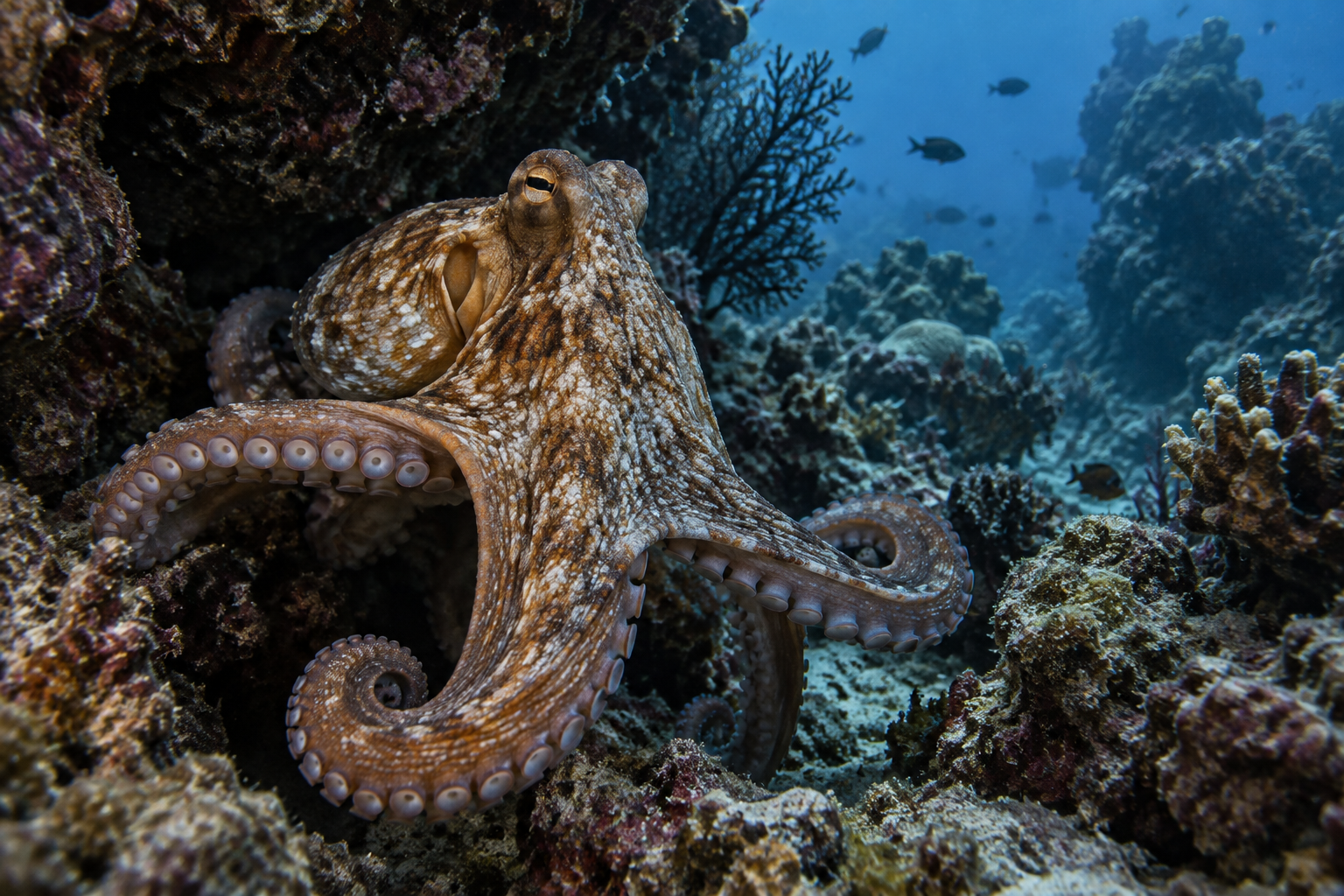
Octopuses are cephalopods. Their circulation uses three hearts with different jobs.
An octopus is a cephalopod, related to squid and cuttlefish. Its circulation has two branchial hearts and a third heart serving the rest of the body. These are not three completely separate circulatory systems: the hearts work within one connected network of vessels. Blood first travels through the to take up oxygen from water, then carries it to organs and muscles.
How and why?
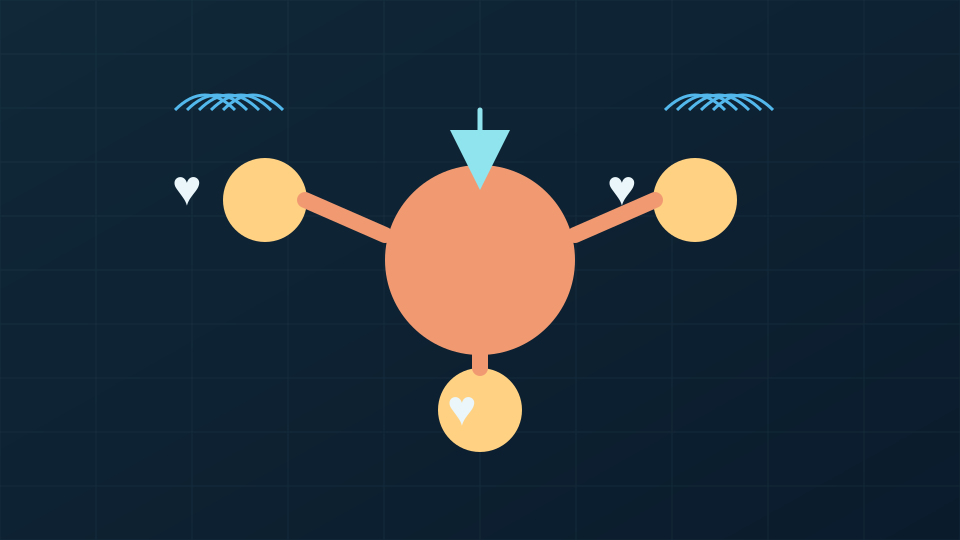
Two branchial hearts move blood to the , where it picks up oxygen. A third heart pumps blood through the body.
The two smaller hearts push oxygen-poor blood towards the . Once it has taken up oxygen, the larger systemic heart pumps it around the body. Cephalopods are active animals that need a steady oxygen supply. Their blood is blue because it uses a copper-containing molecule called hemocyanin to carry oxygen, whereas human blood uses iron-containing haemoglobin.
How do we know?
Scientists study cephalopod anatomy directly and compare species; Smithsonian Ocean describes these heart functions.
Smithsonian Ocean describes the cephalopod circulatory system and the jobs of its three hearts. Scientists study them through anatomy and by measuring blood flow and organ function. Comparing cephalopod species helps separate features shared by the group from features of one species. The number of hearts is therefore part of a broader explanation of how the body receives oxygen.
Why does it matter?
It is one example of how different animal groups adapted to life in water.
Octopuses have complex nervous systems, move skilfully and live in varied marine habitats. Their circulation shows that evolution does not have to arrive at the same solution as in humans. Studying such differences helps us understand the many ways organisms meet the same basic needs: breathing, movement and delivering energy to cells.
Three pumps in one circulation
An octopus has a closed circulatory system: blood travels through a network of vessels rather than freely bathing organs. Two smaller branchial hearts beside the pump blood through them. There it picks up oxygen dissolved in seawater. A larger systemic heart then sends oxygenated blood to the muscles, brain and other organs. This arrangement maintains enough pressure after blood has passed through the tiny vessels in the .
Octopus blood also uses a different oxygen-carrying pigment. Instead of iron-containing haemoglobin like ours, most cephalopods use copper-containing haemocyanin; when oxygenated, the blood looks bluish. This does not mean that blue blood is always superior. Oxygen delivery depends on temperature, water chemistry and the animal’s needs. Octopuses are active predators, so their muscles and large nervous system need a dependable supply.
Why three hearts? Evolution did not design the body from scratch; it modified structures inherited from mollusc ancestors. Comparisons with other cephalopods and observations of beating hearts help biologists reconstruct how this circulation evolved. It is often said that the systemic heart may work less effectively during swimming, making swimming tiring; the details depend on the species and conditions. It is more useful to study the physiology of a particular octopus than to assume one simple rule fits them all.
Original NZM illustration · Sources: Smithsonian Ocean
A further detail
Three hearts do not make an octopus “three times more alive” than another animal. The number of pumps reflects the arrangement of its circulation; energy needs cannot be estimated by counting organs alone. Octopuses also have an extensive nervous system, with many neurons in their arms, which perform complex movements. Blood supply and nerves must work together to support movement. Species live from shallow warm water to cold depths, so their physiology can vary. When researchers compare them, they consider temperature, body size, activity and available oxygen rather than focusing only on the memorable fact of three hearts.
Key terms
— organs that take oxygen from water.