
What is happening?
An ice cube floats because the same amount of water takes up more space when solid.
Most substances become denser when they change from liquid to solid. Water is unusual. If we compare the same mass of water before and after freezing, the ice takes up more space. Its mass has not disappeared; it is spread through a larger volume, making its lower. An object less dense than the liquid around it can float.
How and why?
Water molecules form a more open, orderly structure in ice. That lowers its .
Hydrogen bonds arrange water molecules into an open crystal lattice in ice. In liquid water, molecules keep moving and can, on average, sit closer together. That difference makes ice roughly nine per cent less dense than liquid water. It also explains why a completely full, sealed bottle of water may burst if left in a freezer.
How do we know?
is measured by comparing mass and volume. The says ice is roughly nine per cent less dense than liquid water.
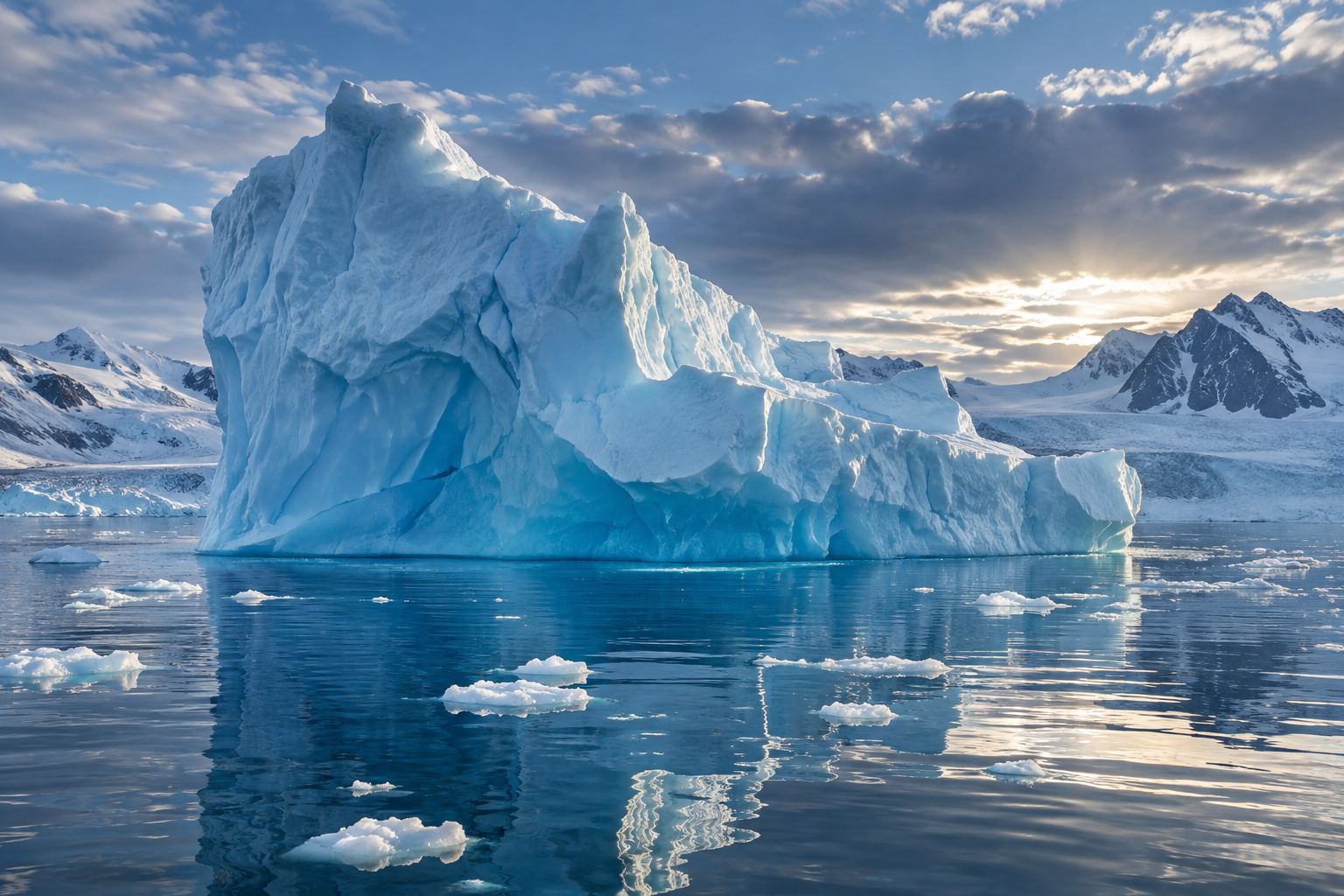
Imagine a simple test: measure the mass and volume of some water, freeze it and measure again. The mass stays nearly the same while the volume grows. The also explains that about nine tenths of an iceberg lies below the sea surface. Its visible tip gives a misleading impression of its full size.
Why does it matter?
Ice on a lake slows further cooling below the surface, helping aquatic life survive winter.
When a lake begins to freeze, ice remains on top and slows heat loss from the water beneath it. This helps fish and other organisms survive winter. If ice sank, lakes would cool in a very different way. A property of individual molecules thus has large consequences for life in nature.
Water’s unusual behaviour
Most substances are denser as solids because their particles pack more tightly. Water is an important exception. Its molecules are polar and connect through hydrogen bonds. Freezing creates a crystal lattice with more open space than liquid water has. The mass stays the same, volume increases and falls. Archimedes’ principle tells us that an ice cube floats when it displaces liquid whose weight equals its own.
Simply saying “ice is lighter” misses the point: a kilogram of ice and a kilogram of water have the same mass. They occupy different volumes. Liquid water reaches its greatest at about four degrees Celsius; as it cools further towards freezing it expands a little. In winter, colder water stays near the surface and ice forms there first, while deeper lake water may remain liquid. Ice and snow further slow heat loss.
This property shapes lakes, rivers and the polar climate. In a sealed pipe, expanding water can create enough pressure to damage the material when it freezes. Outdoors, floating ice changes the exchange of heat and light between water and air. Sea ice is different from an iceberg: an iceberg breaks from a land glacier, whereas sea ice freezes at the ocean surface. Melting them therefore does not have the same immediate effect on sea level.

Original NZM illustration · Sources: USGS
A further detail
Archimedes’ principle describes floating more precisely. As an ice cube enters a glass of water, it displaces more liquid and the buoyant force increases. It stops sinking when that force balances its weight. Because ice is less dense, the whole cube need not be submerged to reach balance; its top stays above the surface. With an iceberg, most of its volume can be hidden underwater, making it dangerous for ships. Saltwater is slightly denser than freshwater, so ice sits a little differently in the two. The difference is measurable, although the basic principle is unchanged.
Key terms
— the mass of a material per unit of volume.