
What is happening?
Telescopes have found thousands of planets beyond our Solar System. Some orbit where liquid water might exist.
We rarely see an as a clear globe in a photograph. Often we detect one because its star briefly dims when the planet passes in front of it. Researchers then estimate the planet's size, distance from its star and possible atmosphere. Those measurements identify promising places to study, but they do not show that anything lives there.
How and why?
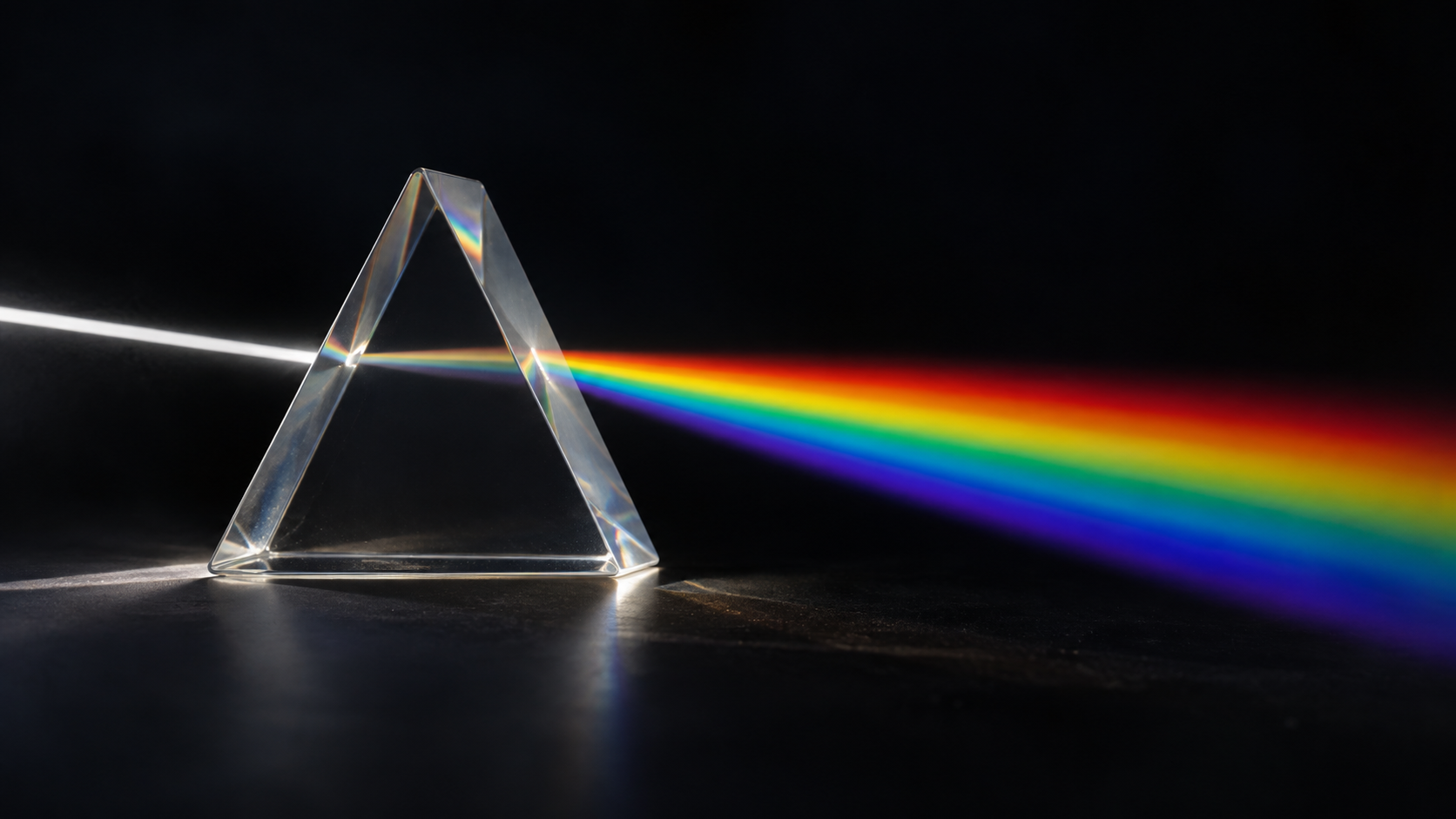
Starlight passing through a planet’s atmosphere carries clues about its gases. A spectrum helps us study that atmosphere.
As a planet crosses its star, some starlight may pass through the planet's atmosphere. Different gases absorb different parts of that light, leaving a pattern in the spectrum rather like a barcode. Scientists look for water vapour, carbon dioxide and methane, among other gases. They need to consider combinations of gases and the planet's wider conditions: the same substance can also form without life.
How do we know?
and other teams compare telescope measurements with atmospheric models. A single gas cannot prove that life exists.
On Earth we know living things can change an atmosphere, but Earth remains our only confirmed example of a living planet. There is no single magic signal. Researchers test whether chemistry, geology or a measurement error could explain the data, compare repeated observations and weigh the possible explanations. Even an exciting result would be a reason to investigate further, not an instant announcement of alien life.
Why does it matter?
The search also helps us understand what makes Earth special.
The search is not limited to distant planets. Within our Solar System, researchers study Mars and icy moons that may hide oceans below their crusts. Future telescopes may examine atmospheres in greater detail. Learning whether we are alone would be momentous, but a reliable answer will take several independent lines of evidence rather than one striking image.
What would count as convincing evidence?
A planet’s position in the so-called habitable zone is only a first filter. Its surface might still be too cold even at a promising distance from its star: atmospheric pressure and composition, radiation, clouds and geology also matter. Mars reminds us that distance from the Sun alone does not guarantee stable liquid water on the surface. Life unlike Earth’s organisms might even have different requirements.
When a planet crosses in front of its star, a tiny fraction of starlight passes through the planet’s atmosphere. Gases absorb particular wavelengths, so a spectrum may reveal water vapour, carbon dioxide or methane. This is a difficult measurement: the atmospheric signal is faint, while spots on the star can distort it. Researchers repeat observations and compare several models before drawing conclusions.
Neither oxygen nor methane alone would prove life. Volcanoes, reactions in rocks and starlight can produce some of the same gases without biology. A stronger case would combine gases that are hard to maintain together without a continuing source, plus information about temperature and atmospheric conditions. Scientists therefore discuss possible biosignatures and probabilities rather than announcing aliens from one spectrum.
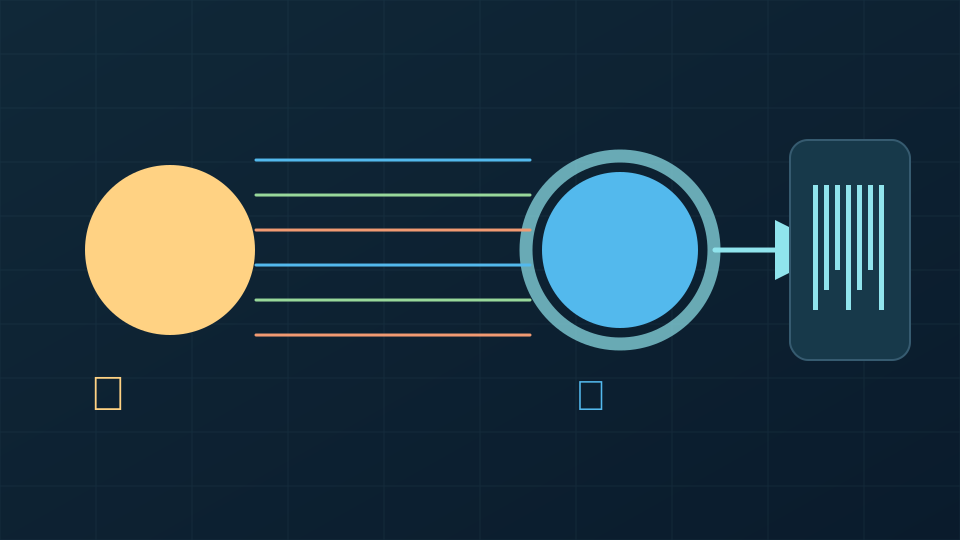
Original NZM illustration · Sources: NASA
A further detail
Selection bias is another challenge. Large planets close to their stars are easiest to discover, not necessarily worlds most like Earth. Even for a promising target, a telescope may collect too little light to identify every important gas reliably. Observers therefore choose systems with a better signal-to-noise ratio, particularly planets around smaller stars. Yet small stars can flare strongly and alter a planet’s atmosphere. Future instruments should expand the range of targets. For now the honest answer to the title’s question is that we can seek increasingly strong clues, but we do not yet know whether they will amount to unambiguous evidence.
Earth’s atmosphere is a useful control: we know life exists here, so we can calculate how our planet would appear to a distant observer. This also shows how faint biosignatures might be. Even the best telescope must be interpreted within its instrumental limits.
Key terms
— a planet orbiting a star beyond our Solar System.