
What is happening?
Sunlight contains many colours. As it enters the atmosphere, it meets air molecules.
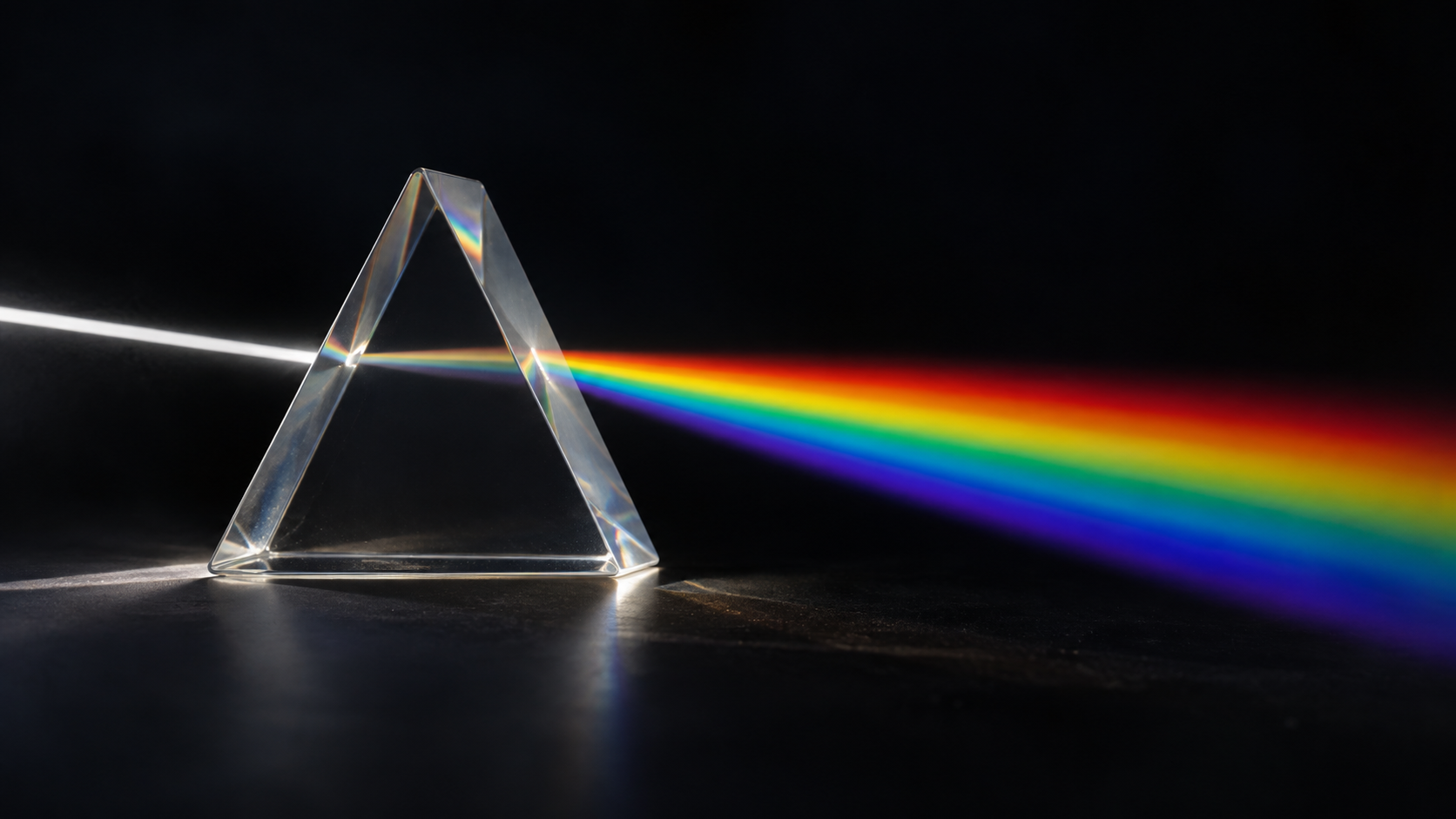
Sunlight looks white, but it contains a range of colours. Raindrops can separate them into a rainbow. As sunlight travels through the atmosphere it meets nitrogen and oxygen molecules. These molecules are much smaller than the wavelengths of visible light, and they scatter some colours more strongly than others.
How and why?
Shorter wavelengths, including blue light, scatter more strongly than red light. Blue light therefore reaches us from many directions.
Blue light has a shorter wavelength than red light and scatters more strongly in clear air. So when we look away from the Sun, blue light reaches us from many directions across the sky. Violet has an even shorter wavelength, but there is less of it in sunlight and our eyes are less sensitive to it. We therefore usually see a blue sky.
How do we know?
can be measured, and the same explanation predicts reddish sunsets.
This explanation is more than a description of what the sky looks like. Physicists can measure how changes with wavelength and calculate which colours should dominate. The same model explains many orange or red sunsets: sunlight travels through more atmosphere near the horizon, so much of its blue light scatters away before the direct beam reaches us.
Why does it matter?
The principle also helps us interpret light passing through other planets’ atmospheres.
Dust, smoke and water droplets also change the sky's appearance because they scatter light differently from individual air molecules. Understanding these effects helps meteorologists and astronomers interpret light measurements. When researchers observe another planet's atmosphere, similar principles can reveal clues about its gases and particles.
Why does sunset look different?
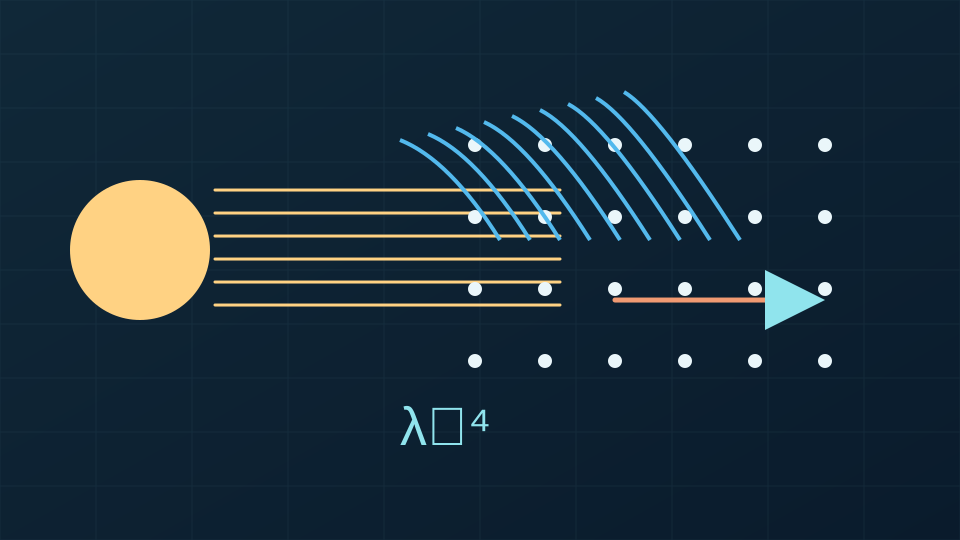
White sunlight mixes the wavelengths our eyes interpret as different colours. Nitrogen and oxygen molecules are much smaller than a wavelength of visible light. In this regime, called Rayleigh , strength rises approximately as the inverse fourth power of wavelength. Blue light is therefore scattered far more strongly than red. Violet scatters strongly too, but sunlight supplies less of it and our eyes are less sensitive to it.
When we look away from the Sun, light reaches us after changing direction at air molecules; shorter wavelengths dominate that scattered light. At sunrise and sunset, rays travel through a much thicker layer of air. Much of the blue is scattered out of the direct beam, leaving it orange or red. Dust, aerosols, clouds and pollution can further change the shades, but the underlying mechanism is the same.
We can test this explanation with calculations and spectra measured in different directions. Comparing a clear day, a hazy day and a sunset shows why particle size matters: larger droplets and dust scatter colours differently from molecules. That is why clouds usually look white rather than blue. Similar reasoning helps astronomers infer the particles and gases in the atmospheres of other worlds from changes in their light.
Original NZM illustration · Sources: NOAA
A further detail
Skies on other planets need not be blue. Their colour depends on starlight, gases and the sizes of particles in an atmosphere. Very thick clouds, for example, may hide blue even when air molecules scatter short wavelengths. On Earth the difference is already visible between a clear and a hazy day. A simple demonstration using a beam of light and a little milk in water can show changing colour through a cloudy liquid, but milk droplets are not identical to air molecules. The demonstration is an analogy, not a replica of our atmosphere. A good scientific explanation states where the analogy stops working.
Key terms
— a change in the direction of light when it meets particles.