
A mirror that reveals a hidden target
Imagine a mirror in front of you and food behind your back that you cannot see directly. You look at the reflection, work out which side the food is on and walk toward it instead of toward the glass. To us this is routine. For an animal that has not grown up with mirrors, the task is harder: the visible image is in one place and the real target in another.
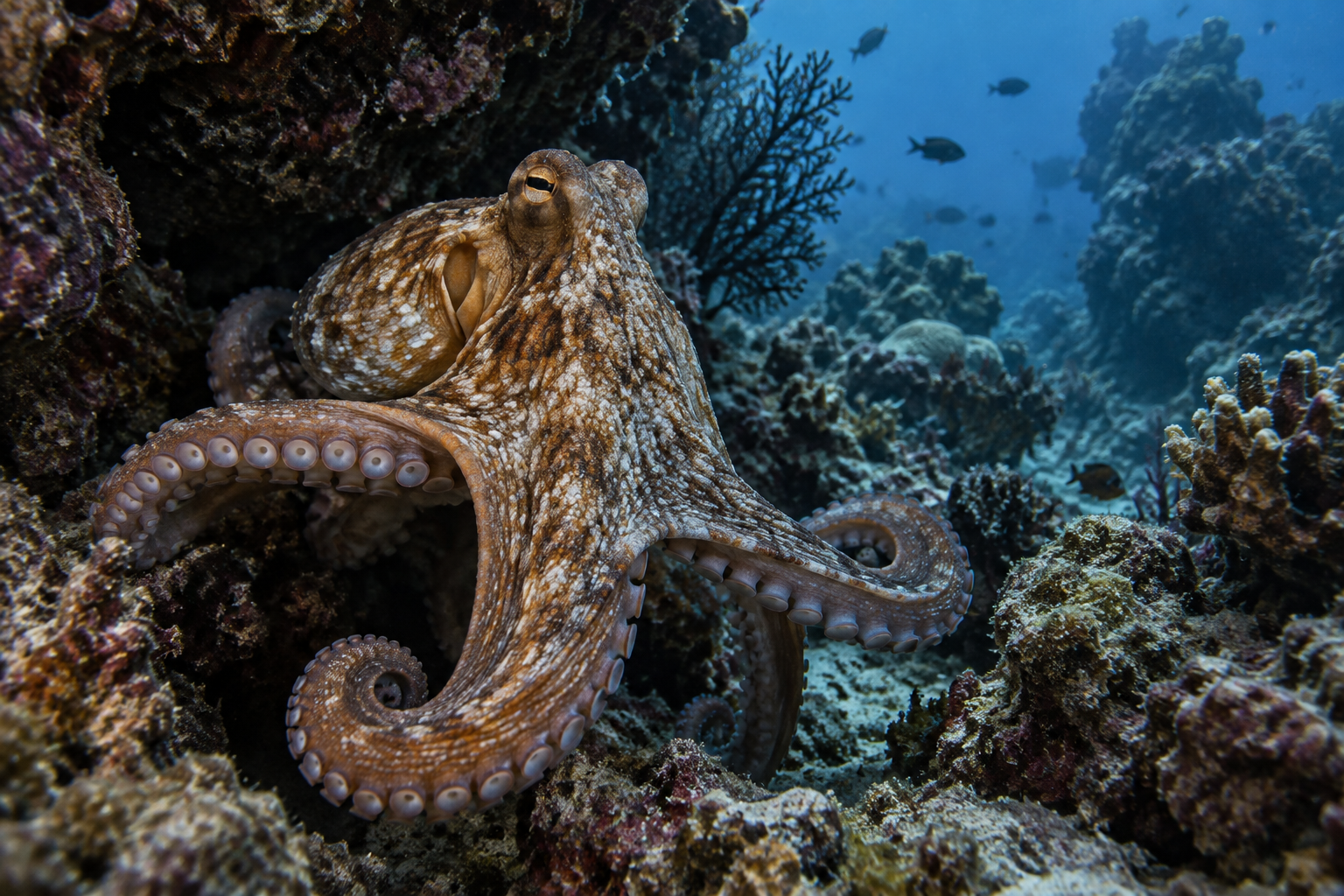
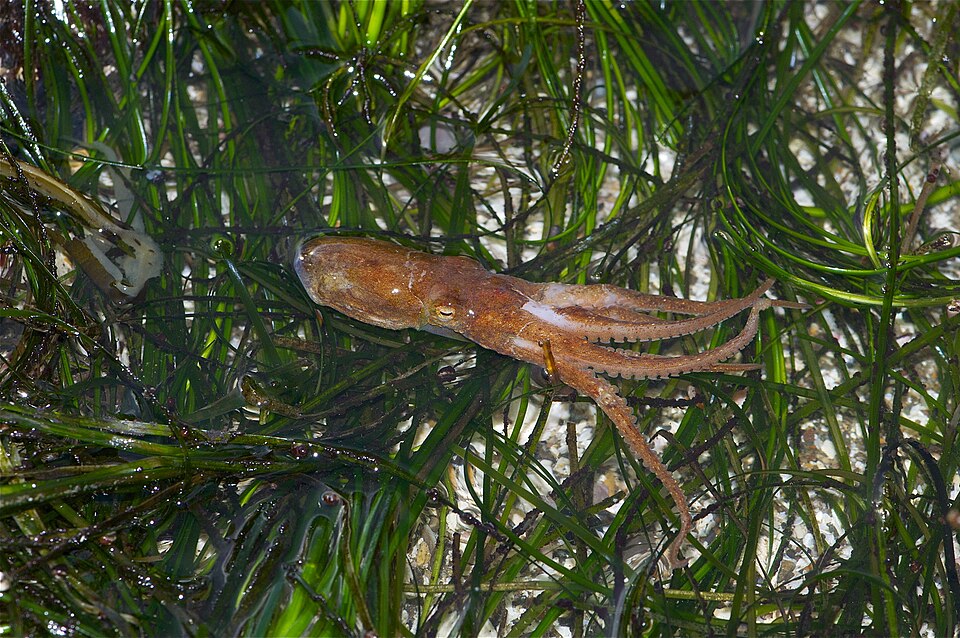
In a 2026 Current Biology study, a team led by Mary Kieseler tested this ability in the (Octopus bimaculoides). Popular Science described the finding as a striking example of mirror use by an invertebrate. The crucial result is not merely that an octopus looked at a reflection. It used that reflection to locate a target hidden from direct view.
First the octopuses had to learn what a mirror shows
Three octopuses in a Dartmouth College laboratory were first allowed to get used to a mirror. This mattered because an animal might treat its reflection as a rival and become agitated. Training began only after they relaxed and resumed feeding in front of the glass.
Researchers placed a live crab in a glass container around a corner. The octopus could see its reflection but not the crab itself. At first it approached the mirror, as though the prey were in the glass. Over roughly ten to twelve attempts, each animal learned to turn and travel to the real crab. This prepared them for a stricter test that would remove smell and touch as alternative guides.
The decisive test: a crab that existed only as an image
Next, an octopus started in one compartment of a tank facing a large mirror. A moving picture of a crab was projected on an opposite wall, sometimes left and sometimes right. The projection wall was hidden from direct view. To choose the correct side, the animal had to leave the starting compartment, turn around and travel through the tank.
Why use an image instead of a live crab? Octopus arms carry that detect chemical traces in water and on touched surfaces. A live crab behind the octopus might have been found with these senses, without any mirror. The projection removes that alternative cue. Real food arrived only afterward as a reward for choosing the correct side.
Across the tests, the three octopuses chose the crab side in about 73 percent of trials. Random choice between left and right would produce around 50 percent. In 59 percent of successful trials they did more than use the designated passage. They climbed a side barrier to shorten the route toward the position signaled by the reflection.
Crossing the barrier matters because it is movement toward a place outside the animal’s immediate view. The octopus was not simply pressing against a shiny crab image. One task cannot prove that it has a human-like mental map. The result shows that it can link a reflection with a direction and with the layout of a familiar tank; the precise internal representation remains unknown.
What was actually demonstrated? The three tested animals learned to use a mirror to reach a hidden location marked by a food cue. That is evidence of learning and spatial use of a reflection in this setup. Three animals are a small sample. The result needs testing with more octopuses and different arrangements.
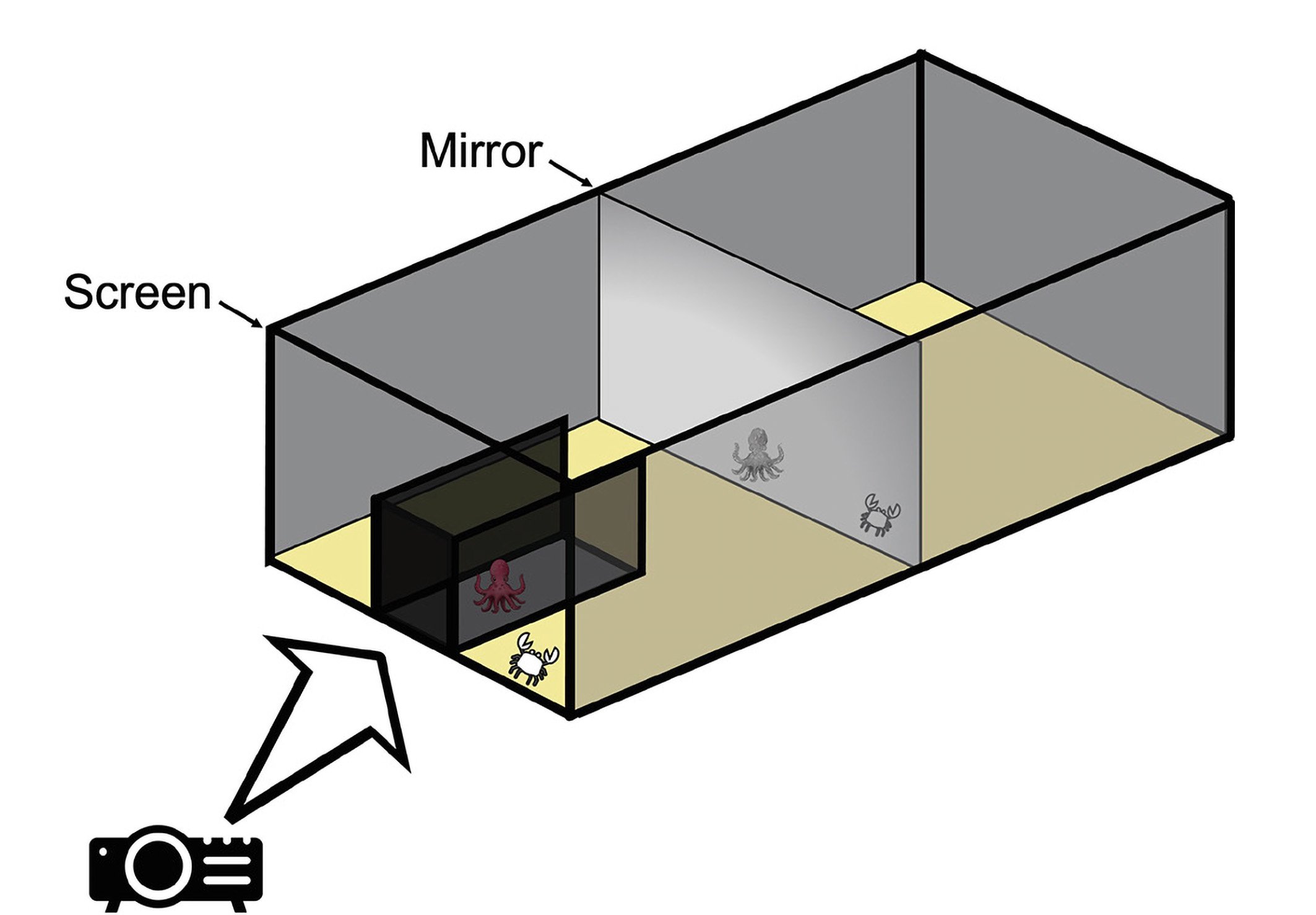
Kieseler i saradnici, Current Biology (2026) · Sources ↗ · Image terms ↗
Using a mirror is not the same as recognizing oneself
“An octopus uses a mirror” can easily sound as though it recognized itself. The study did not test that. In a , researchers put a mark on a part of an animal’s body it cannot usually see, then ask whether it touches the mark on its own body after seeing the reflection. That task differs from using a reflection to find food.
A is especially difficult with octopuses: their sensitive skin might detect the mark without a mirror, and working underwater adds practical problems. Kieseler’s team instead asked a clearer question: can an octopus learn how a reflection relates to a location behind it? For three animals under controlled conditions, the answer was yes. The study does not answer whether octopuses recognize themselves.
Why the result matters and what remains open
Octopuses are mollusks, far from mammals and birds on the evolutionary tree. Their ability to solve a mirror-guided task is therefore intriguing. One possible context is : distant animal groups can independently develop similar solutions to similar challenges. That does not mean their brains are built alike or that they think in the same way.
Wild octopuses hunt among crevices, rocks and the seafloor while avoiding predators. In such places it helps to relate what they see to locations reached by a detour or a climb. The experiment did not show that wild octopuses use natural reflections as mirrors. It showed that laboratory animals can learn a connection between a visible reflection and a hidden goal.
There are reasons for caution. Only three individuals participated, and repeated trials with the same individuals are not equivalent to many independent animals. A later commentary by Cambridge researchers highlights statistical and methodological subtleties and the need to distinguish levels of mirror understanding. Experiments with more octopuses and different obstacles will show how well the learned skill transfers to new situations.
The lesson is not that an octopus is a “small person with eight arms.” Its senses, body and movement differ greatly from ours. Yet it can use information about a hidden crab to choose a route. We understand animal abilities best through problems the animals can actually solve. Careful experiments require equally careful interpretation.
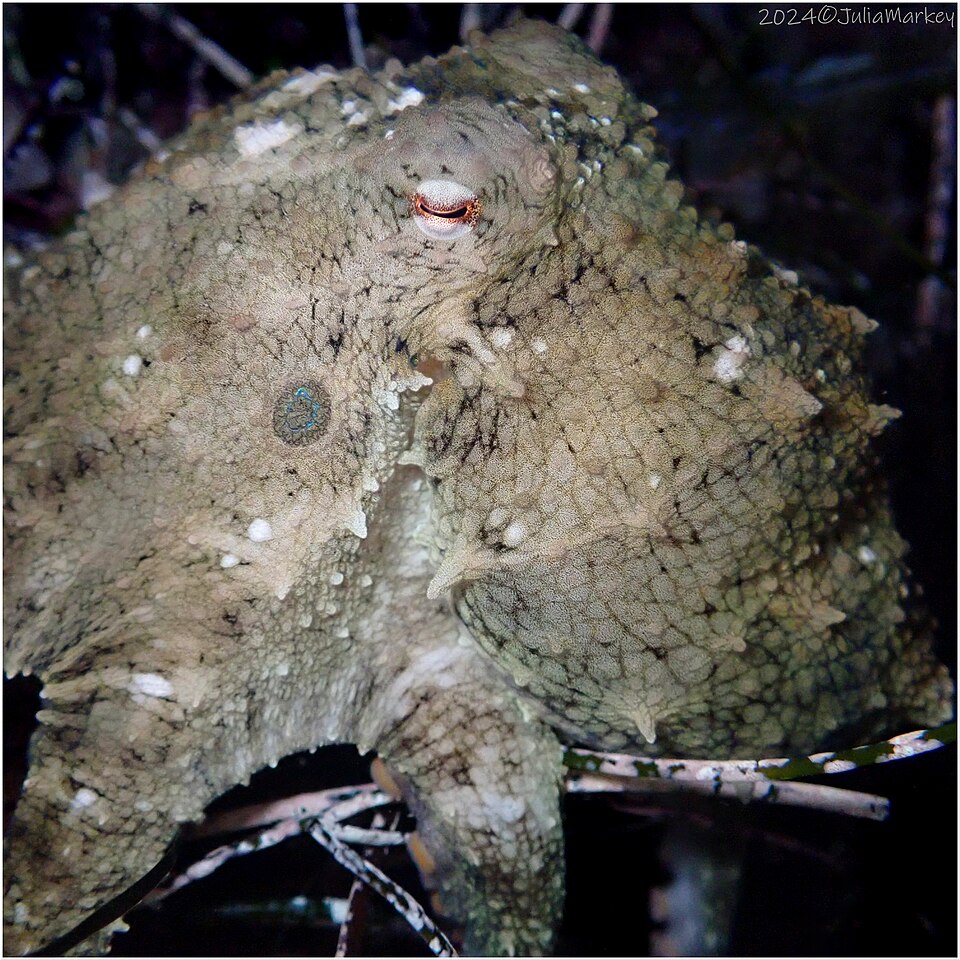
Julia Markey · Sources ↗ · Image terms ↗