
A curious child and a patent office
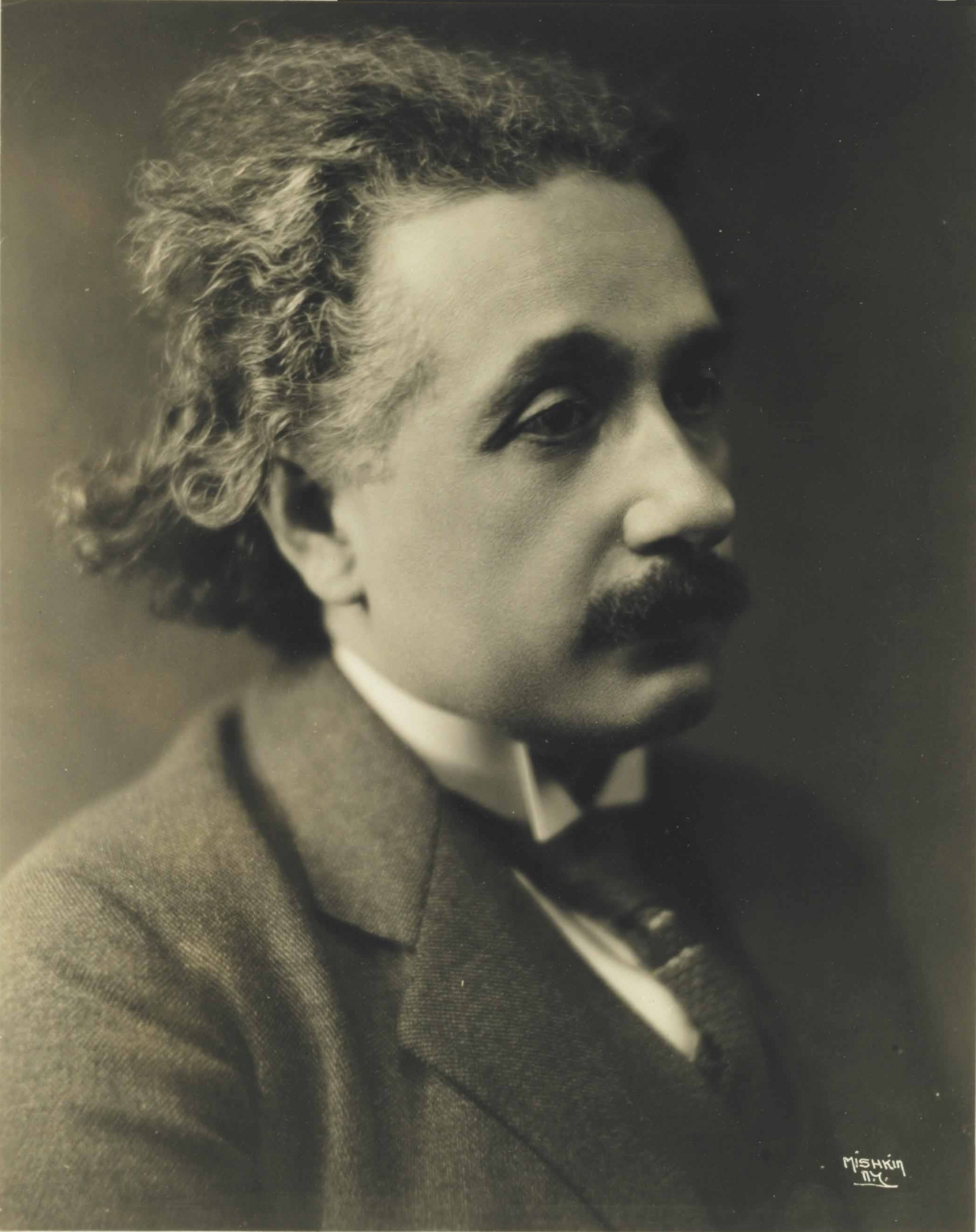
Albert Einstein was born in Ulm in 1879 and grew up across Germany, Italy and Switzerland. A compass, geometry and questions about nature fascinated him. The familiar claim that he failed mathematics is false. After studying in Zurich, he struggled to find an academic post and worked at the patent office in Bern. He kept reading physics and debating ideas with friends. His work grew from earlier research and discussion, rather than from an isolated flash of genius.
Three problems in 1905
Einstein explained the jittery Brownian motion of tiny particles as a result of collisions with molecules, strengthening the case for atoms. He explained the photoelectric effect by treating light as packets of energy: a metal emits electrons only above a threshold frequency. Special relativity started from the same physical laws for uniformly moving observers and the same measured speed of light in a vacuum. Each line of work made predictions that others could test.
Frank Watson Dyson / Arthur Eddington / Charles Rundle Davidson / Wikimedia Commons · Sources ↗ · Image terms ↗
Why clocks disagree
Two flashes simultaneous to someone on a platform need not be simultaneous to a passenger in a fast train. At high speeds observers also measure different intervals of time and lengths along the direction of motion. The effects are tiny in ordinary traffic but measurable with fast particles and precise clocks. The relation E = mc² connects mass and energy; it does not say matter casually turns all its mass into useful energy.
Gravity becomes geometry
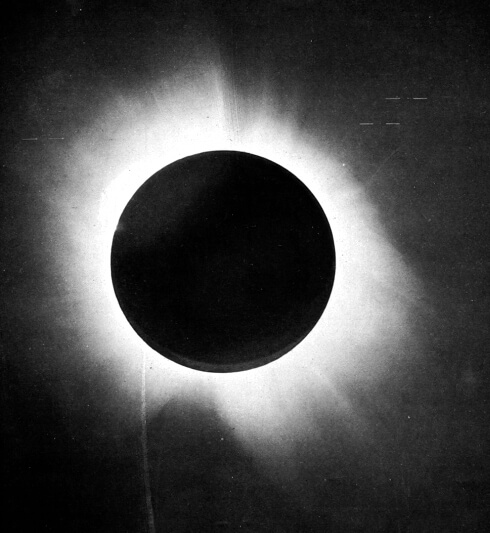
Thinking about a person in free fall led Einstein towards the equivalence principle. With mathematical help, including that of Marcel Grossmann, he developed general relativity. Mass and energy affect the geometry of , which guides the motion of bodies and light. The theory accounted for a small irregularity in Mercury’s orbit and predicted bent starlight near the Sun. An eclipse in 1919 supplied an early test, followed by far more precise tests.
The Nobel Prize and quantum theory
The 1921 prize especially recognised Einstein’s explanation of the photoelectric effect. A photon carries energy E = hν, increasing with frequency. Below the threshold, simply shining more low-frequency light does not eject electrons. Einstein helped found quantum theory, then challenged some interpretations of its probabilities. His debates with Niels Bohr and later questions about quantum correlations stimulated work that continues today.
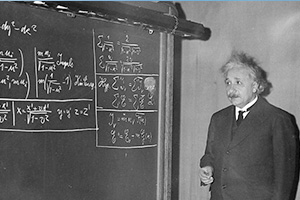
Unknown photographer / Wikimedia Commons · Sources ↗ · Image terms ↗
The person beyond the formulas
Einstein enjoyed playing the violin. He left Germany as Nazism rose and continued his work at Princeton. He signed a letter warning the US president that nuclear weapons might be possible, but he did not design the atomic bomb. After the war he argued for arms control and international cooperation. His scientific achievements do not make every public opinion of his infallible.
Legacy and limits
Relativity matters to satellite navigation, black holes, cosmology and gravitational waves. The photoelectric effect is fundamental to sensors and to understanding light interacting with matter. Reconciling gravity with quantum physics remains unfinished. Einstein’s example shows how a precise question about an everyday word such as “simultaneous” can transform science when followed by calculations, measurements and criticism.
From a bold idea to a testable theory
In 1905 Einstein explained the photoelectric effect: light can eject electrons from a metal, but the energy of an individual electron depends on light frequency rather than merely on brightness. He proposed that light transfers energy in quanta. That did not erase the wave behaviour seen in interference experiments. Understanding how both kinds of evidence fit together became a central task of quantum physics. The Nobel Prize specifically recognised his explanation of the photoelectric effect, rather than awarding him a prize for relativity.
Special relativity connects measurements of space and time to the motion of observers under precise rules. It does not say that facts are whatever someone wishes them to be. General relativity later described gravity through the geometry of . Light bending near the Sun could be checked during a solar eclipse in 1919, although that historical observation was neither the only test nor the end of the story. Planetary motion, gravitational lenses and gravitational waves have offered independent tests at very different scales.
The person behind the equations also matters. Einstein played the violin, wrote for broad audiences and left Germany after the Nazis came to power. His political and ethical choices have a separate history from the mathematical claims of his theories. His discoveries grew from earlier experiments and ideas, careful calculation, debate with colleagues and later independent checks. That history is more interesting than the picture of one isolated genius arriving at a complete answer in a single flash.
Key terms
— a unified mathematical description of three spatial dimensions and time.