
A mathematician from Syracuse
Archimedes lived approximately from 287 to 212 BCE, mostly in Syracuse on Sicily. We know far less about his private life than about his mathematical work. Ancient writers recorded various stories, but they wrote after his death and do not always agree. It is more reliable to begin with the surviving treatises, problems and proofs. He studied geometry, balance, fluids and very large numbers. Mathematics was already advanced in the Greek world, and Archimedes built on it with exceptionally inventive and rigorous results.
What is buoyancy?
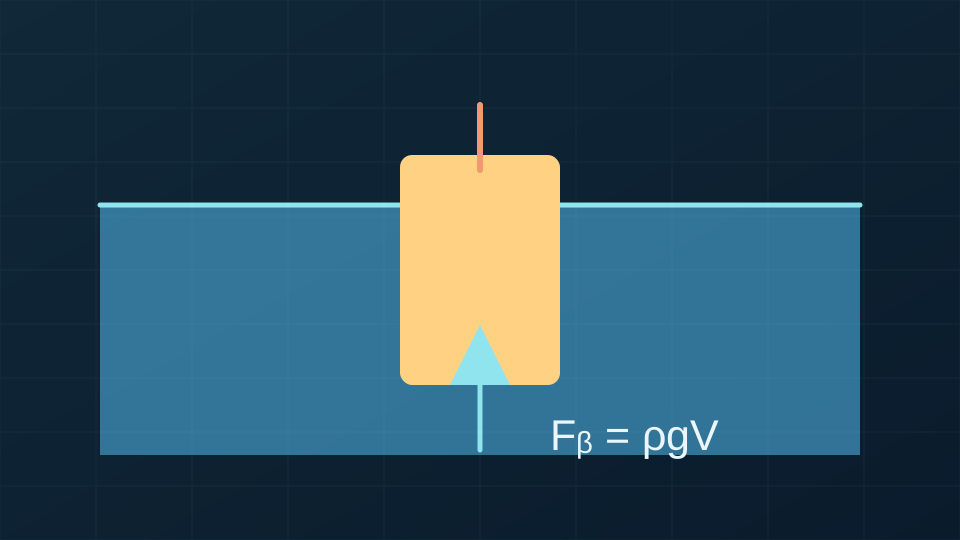
Put a stone in a bowl of water. Even while it sinks, the water pushes it upwards. Water pressure on the stone’s lower surface is greater than on its upper surface because pressure increases with depth. The net effect is buoyant force. Archimedes’ principle states that this upward force equals the weight of the displaced fluid. If the object weighs more, it sinks; if it can displace enough water before becoming completely submerged, it floats. That is why a steel ship can float while a solid lump of steel usually sinks: the hull contains much air and displaces a large volume of water.
NZM — originalna edukativna ilustracija · Sources ↗
Density and the crown
A famous story says a ruler asked Archimedes to test a gold crown without damaging it. If it had the same mass as a pure-gold object but occupied more volume, its average density would be lower and it might contain a lighter metal. Submerging an irregular object can connect its volume with displaced water. The physical idea makes sense, but no precise contemporary account of Archimedes’ actual procedure survives. Modern experiments also show how difficult it can be to measure small differences in a large crown. A classroom demonstration should therefore be distinguished from a claim that we know exactly how he discovered the principle.
How reliable is “Eureka”?
The story that Archimedes ran from a bath shouting “I have found it!” was recorded much later by the Roman author Vitruvius. We have no first-person account from Archimedes. The legend need not be wholly fictional for us to be cautious: a real problem could have turned into a memorable anecdote over time. What matters more to the history of science is what can be checked in his work and in later applications of the law. Curiosity and sudden insight play roles, but a precise conclusion usually requires calculation, testing and criticism.
The lever and equilibrium
Archimedes studied a lever, a rigid bar turning about a pivot. If a force F₁ acts at distance d₁ on one side and F₂ at distance d₂ on the other, ideal equilibrium occurs when F₁ × d₁ = F₂ × d₂. Force multiplied by its distance from the pivot is a turning effect called torque. Lengthening one arm allows a smaller force to balance the same load. This is not free energy: the end of the longer arm must move farther to lift the load. Real levers have friction, mass and material limits, so the ideal equation is a starting model.
“Give me a place to stand” and reality
Archimedes is credited with saying that a long enough lever and a place to stand would let him move Earth. It expresses mechanical advantage beautifully but is not a workable engineering plan. An enormous arm would need impossible strength, and its end would have to travel an enormous distance for a tiny movement of the load. Physics separates idealized models from the limits of real materials. The principle nevertheless works in scissors, pliers, seesaws and many machines. Choosing the pivot’s position is often as important as choosing how hard to push.
YouTube · Sources ↗
A circle and the number pi
Without a modern calculator Archimedes bounded π by comparing a circle with regular polygons drawn inside and outside it. As the number of sides grows, their perimeters squeeze the circle’s circumference between lower and upper bounds. He used polygons with as many as 96 sides, obtaining bounds of 3 10/71 and 3 1/7. This was more than a useful approximation: it showed how to prove that an unknown quantity lies in an ever narrower interval. Mathematicians call the wider strategy a method of exhaustion, a precursor of later ideas about limits.
The surface and volume of a sphere
One result of which Archimedes was especially proud concerned a sphere and the cylinder surrounding it. He proved that the sphere’s volume is two-thirds of that of the smallest enclosing cylinder, with a related surface-area ratio when the cylinder’s ends are included. The result is easy to picture but difficult to prove without modern integration. Archimedes used geometric comparisons and exhausted the possible difference step by step. That style of reasoning later influenced integral calculus. The story that he requested a sphere and cylinder on his tomb comes from ancient accounts, not a first-person record.
Huge numbers and scientific models
In The Sand Reckoner, Archimedes showed how to name numbers large enough to describe even a hypothetical number of grains of sand filling the universe. He did not claim to have counted those grains. His point was that mathematical notation could go beyond everyday number words. He had to state assumptions about the size of the universe and a grain. This is a recognizably scientific move: define a model and its assumptions, calculate their consequences, and distinguish an estimate from a direct observation.
Why Archimedes still matters
His results remain useful for understanding floating, ship stability, hydrometers, levers and balance. His method is just as important: he turned complicated questions into geometric relationships he could prove. Modern physics adds experiments, fluid theory and more precise models, but the basic law still works. A historical biography need not rely on a myth of a solitary genius. Science grew within communities of mathematicians and engineers. What we can most securely attribute to Archimedes is the reasoning preserved in his works, not perfectly staged scenes from a later legend.
Buoyancy can be calculated
For a fully submerged body in a fluid of density ρ, the volume of displaced fluid equals the body’s volume V. The buoyant force is F = ρgV, where g is gravitational acceleration. If an object floats partly submerged, only its submerged volume enters the equation. Comparing with weight mg gives the condition for floating. This is an ideal model for still fluid; a ship in waves also faces questions of hull shape, stability, moving cargo and dynamic forces. The equation cannot replace engineering checks, but it tells us how much water an object must displace.
Stability is different from floating
An object may float yet capsize easily. The positions where its weight and buoyant force act matter, as does how those positions change when the object tilts. A wide hull or ballast can improve stability, while a tall load may make it worse. Archimedes’ principle describes the total upward force, but designing a vessel also requires turning moments. This connects two of his major interests: hydrostatics and levers. A classroom activity with differently shaped pieces of clay in water tests both flotation and stability, not just material density.
The Archimedean screw and attribution
A device called the Archimedean screw lifts water by turning a spiral channel inside a sloping tube. Similar machines have been used for irrigation and drainage, and the principle remains useful in some pumps. The name does not prove Archimedes was the first person to invent such a device. Historians examine earlier technologies and later written accounts. Here again, the machine’s operation can be checked experimentally, while a claim about its original inventor needs historical evidence. Technical ideas often emerge through improvements made by several people.
Proof, estimate and experiment
Archimedes connected ideal geometry with physical problems. A mathematical proof can show a relationship holds for every object meeting clearly stated conditions. An experiment then shows how closely real water and materials fit those conditions. If a result differs, we check friction, air bubbles, irregular volume and measurement error. This relationship between theory and testing remains familiar in modern physics. A school experiment using a spring scale can demonstrate that an immersed object appears lighter by the weight of the water it displaces, provided the limits of the instrument are acknowledged.
How the works reached us
Archimedes’ treatises did not survive as original manuscripts written by his own hand. They were copied and studied over centuries, and some knowledge comes through later Greek, Arabic and Latin traditions. The history of mathematics therefore includes scribes, translators and other scholars, not only a single author. When examining a text, historians separate an original proof from a later commentary and compare surviving manuscripts. This care matters because even a small change in a geometric diagram can alter how an argument is understood. The preserved works let us check much more than the legends about his life.
Key terms
— the upward force of a fluid on a submerged body, equal to the weight of fluid displaced by that body.