
What exactly is a wave?
The general theory of relativity, completed by Albert Einstein in 1915, describes gravity as the geometry of spacetime. Massive bodies change that geometry, and it affects their movement. In a 1916 paper, Einstein showed that a change in the distribution of masses can be transmitted in the form of waves; In 1918, he developed a method of calculating the radiation that occurs during certain types of movement. It is not a wave of matter through air, like sound. The distances and time relations themselves change as the wave passes.
Let's imagine free particles arranged in a circle. A wave passing perpendicular to that circle would alternately increase the gap in one direction and decrease it in the perpendicular direction, and then vice versa. This description is called , or , and is written as h = ΔL/L. The letter L denotes the initial distance, and ΔL its change. When a strong wave from a distant cosmic catastrophe reaches Earth, h is of the order of 10⁻²¹: the difference on a four-kilometer arm is only a tiny fraction of the diameter of a proton. Therefore, it cannot be recorded by an ordinary telescope or seismograph.
How does a cosmic signal form?
Waves are most efficiently created by systems whose mass distribution changes rapidly and asymmetrically: two black holes or two neutron stars orbiting each other. Their movement carries energy. The orbit is gradually narrowing, the bodies are orbiting faster and faster, and the frequency and strength of the waves are increasing. On the graphics, that final phase looks like an accelerating whistle and is therefore called a chirp. The graphic is sometimes converted into sound to make it easier for people to understand, but the cosmic wave itself is not a sound in the air.
From circumstantial evidence to the first measured wave
In 1974 Russell Hulse and Joseph Taylor discovered a PSR B1913+16. They carefully followed the regular radio pulses of one of the two stars and found that the orbital period was decreasing. The amount of orbital energy lost was consistent with the prediction that the system was emitting gravitational waves. It was strong indirect evidence, for which they received the Nobel Prize in 1993. They did not then directly measure the wave that passed through the Earth.
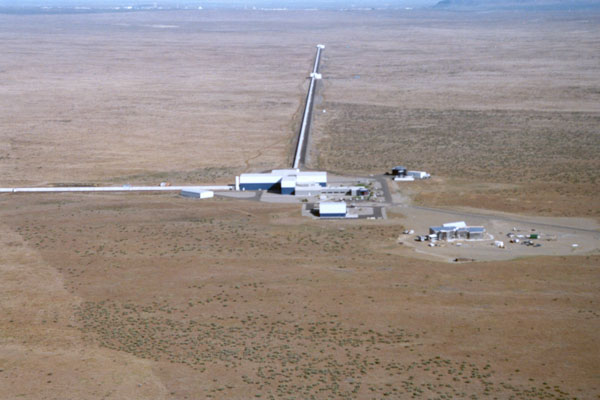
That required , the US Laser Interferometer Network at Hanford and Livingston. In each instrument, the laser beam splits and travels through two vacuum arms at right angles. The rays bounce off the mirror, meet again and form an . If the wave momentarily changes the length of the arms in a different way, the light pattern on the detector will also change. The mirrors are isolated from ground shaking, and the researchers track numerous sources of noise, from thermal motion to local vibrations.
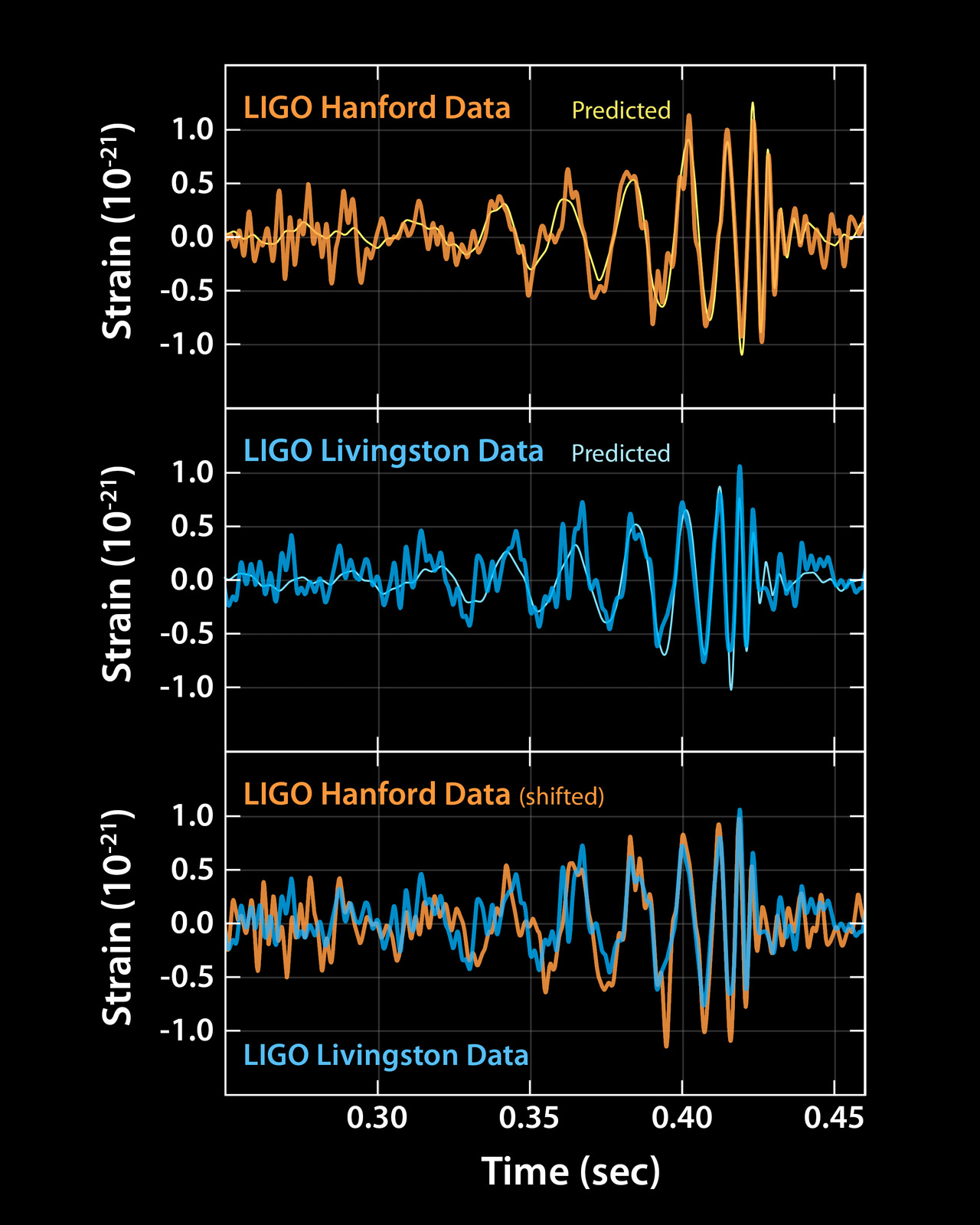
On September 14, 2015, both detectors recorded the same transient signal, with a difference of about seven milliseconds. It is named GW150914. Its shape corresponded to the merging of two black holes of approximately 36 and 29 solar masses, about 1.3 billion light-years away. The resulting black hole had about 62 solar masses: the difference, approximately three solar masses, was released in the form of gravitational waves. The discovery was publicly presented in February 2016. For their key contributions to , Rainer Weiss, Barry Barish and Kip Thorne received the 2017 Nobel Prize in Physics.
Measuring in two separate places was not only a useful confirmation that it was not a local earthquake. The difference in arrival time tells from which part of the sky the wave could have arrived. When several detectors participate in the observation, among them the European Virgo and the Japanese KAGRA, it is possible to narrow the search area and look for a light signal in it. Thus, the waves created by the merger of neutron stars in 2017 are also connected with astronomical observations of light. Gravitational waves, therefore, do not replace telescopes: they provide another way to examine the same event.
Caltech/MIT/LIGO Laboratory · Sources ↗ · Image terms ↗
Why is the observatory moving into space?
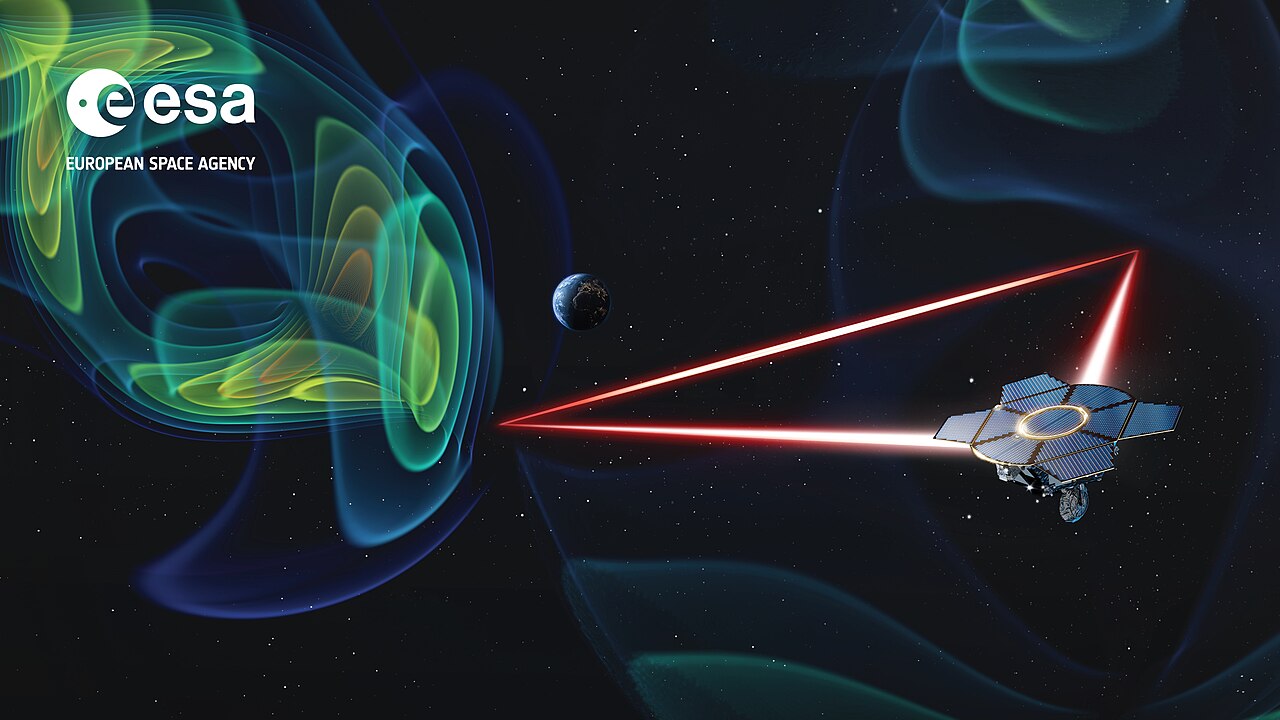
Short ground arms and ground noise limit what frequencies we can reliably measure. The long, slow rotation of very massive black holes produces waves of lower frequency, one cycle of which can last much longer than the waves registered when smaller black holes merge. The European Space Agency is therefore preparing — Laser Interferometer Space Antenna — in cooperation with . It is a special space mission that works on a similar principle to ; was not literally moved into orbit.
The three spacecraft are supposed to fly around the Sun behind the Earth, arranged roughly in a triangle with sides of 2.5 million kilometers. They will exchange laser beams and monitor very small changes in distance between free test masses in spacecraft. The structure will have to protect these masses from unwanted forces, while the aircraft themselves precisely follow their free fall. The Pathfinder mission has already examined key techniques in space. was formally approved in 2024, and is currently planning a 2035 launch; the schedule of future missions is subject to change.
While and related detectors will monitor the rapid terminations of mergers of stellar remnants, will be able to monitor slower systems: pairs of white dwarfs in our Galaxy, approaching massive black holes, and the fall of a smaller dense body into the field of a supermassive black hole. This opens up the possibility of observing the same phenomenon in different phases and different "tones". From a mathematical idea to a laser between three spacecraft took more than a century — and we have yet to see what the longest wavelengths will tell us.
European Space Agency · Sources ↗ · Image terms ↗