
What did the telescope detect?
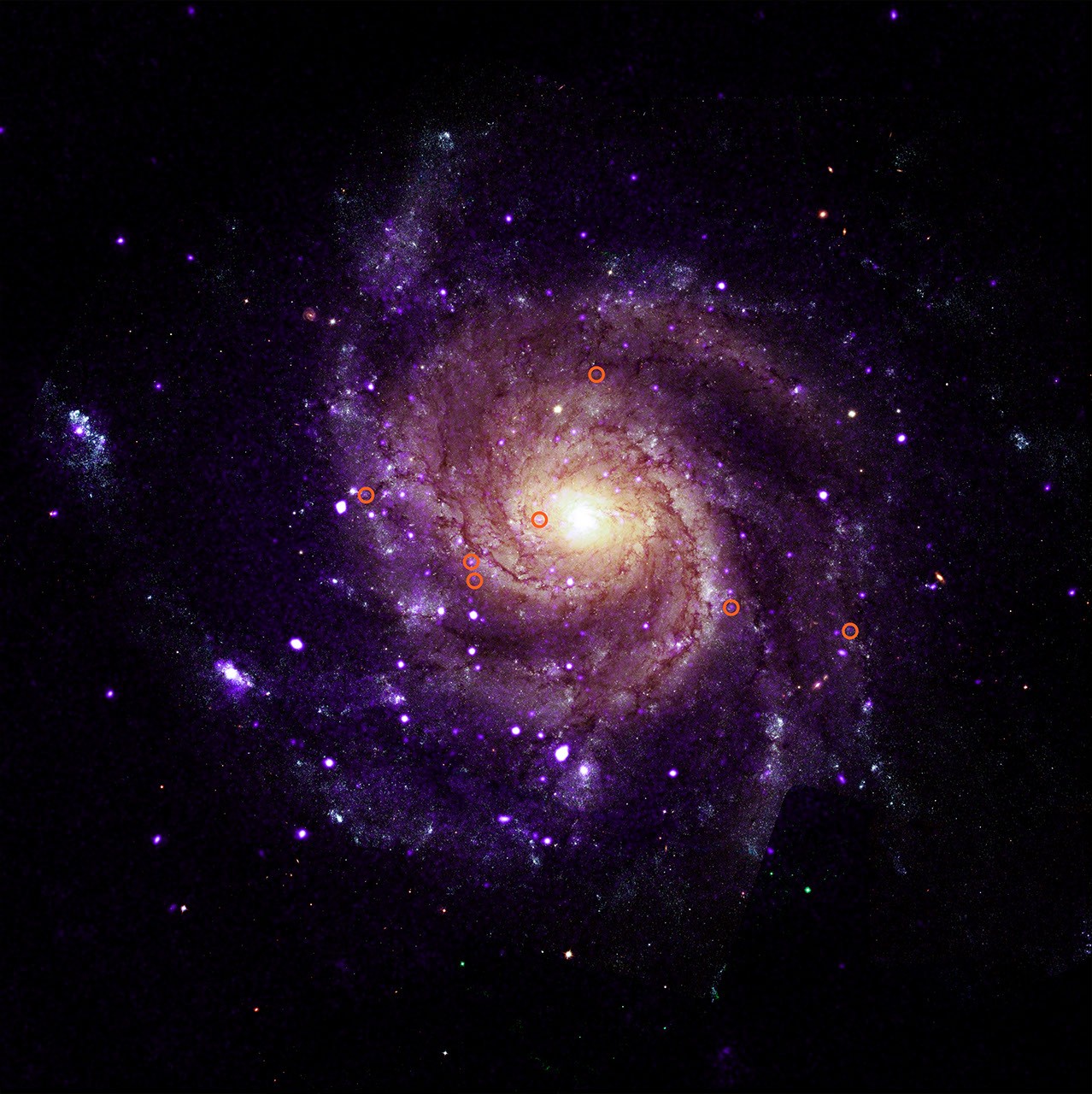
The Chandra space observatory measured X-rays from six nearby galaxies. Researchers selected 84 sources unusually bright at the lower-energy end of the X-ray spectrum. They call them hypersoft sources. They compared their positions with ultraviolet observations to see whether several kinds of light come from the same regions.
The accompanying graphic starts with an ordinary optical view of a galaxy and adds the positions of X-ray sources. The orange marks are not colors a person would see through a telescope. Astronomers combine parts of the electromagnetic spectrum because each reveals different physical processes.
What might the objects be?
One possibility is a binary system where a white dwarf pulls gas from a neighboring star. As the gas gathers and heats, it can radiate strongly. A white dwarf is the dense remnant of a star that exhausted its fuel, not an ordinary small star. Such systems are interesting because some may relate to type Ia supernovae.
The signal alone cannot identify every one of the 84 objects. Distance, dust between us and a galaxy, and limited image resolution can hide details. Further observations are needed, especially changes in brightness over time and clearer spectra.
Why does ultraviolet light matter?
If the sources are very hot systems, they might emit abundant ultraviolet light as well as . That energy can ionize surrounding gas, knocking electrons off atoms and changing how the gas glows. Comparing X-ray and ultraviolet data tests whether a proposed physical model fits the observations.
This is how scientists reason from several clues. X-rays signal energetic processes, while ultraviolet and visible light tell us about their surroundings. Agreement among data types strengthens an explanation, though it does not prove that no alternative exists.
What remains unknown?
The survey has produced a catalogue of candidates for future observations. New measurements will help establish how common these sources are and what role they play in galaxies. The possible supernova connection is an intriguing hypothesis, but this news does not predict an explosion in any of the observed galaxies.
How do we interpret X-ray energy?
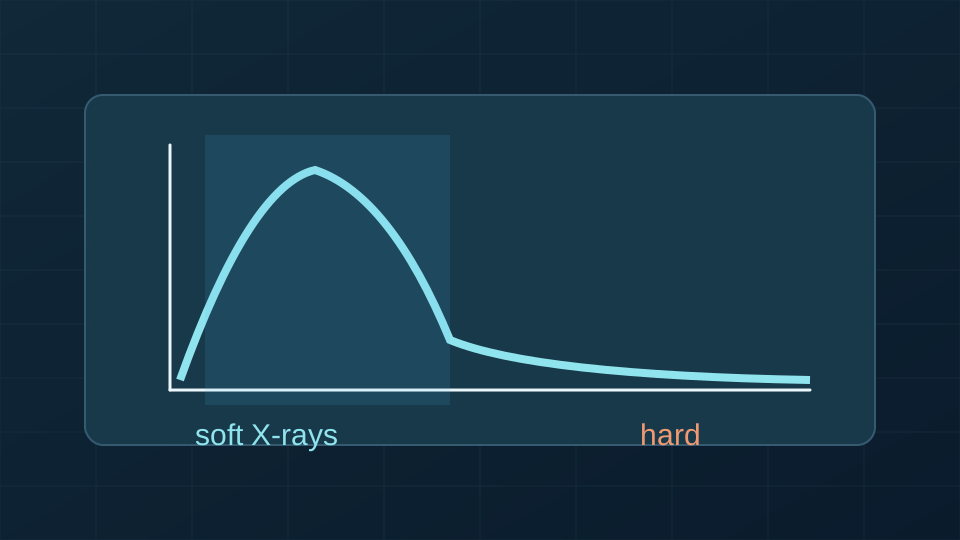
X-ray photons carry more energy than visible light, but some X-rays are softer and others harder. A “very soft” source emits mainly at the lower-energy end of the X-ray range. This could fit a very hot white dwarf surface or gas falling onto a compact system. Gas and dust between the source and telescope absorb some radiation and change what we see. Researchers must therefore model both the source and the light’s journey.
A white dwarf is the remnant of a Sun-like star compressed into roughly Earth’s volume. In a binary system it may receive gas from its companion. Accumulating, heating gas can produce a strong signal in parts of the spectrum. Some models link such systems with type Ia supernovae, but that does not make every soft X-ray source a future supernova. Changes in brightness, the surrounding environment and possible companion stars must be examined.
A catalogue of 84 objects is a starting point, not a list of 84 identically explained stars. An individual candidate might instead be a supernova remnant, a more distant galaxy or another type of object. Follow-up observations matter precisely because they distinguish competing explanations. Researchers compare spectrum, position and variability over time before deciding which group a source probably belongs to.
Original NZM illustration · Sources: NASA
A further detail
X-ray astronomy almost always relies on instruments above the atmosphere because Earth’s air absorbs X-rays, protecting life at the surface. Chandra counts photons and measures their energies from particular directions. A distant galaxy can provide a faint signal, so observations take time and must be separated from background radiation. An X-ray dot is not automatically the same object as a nearby visible star: instrument resolution and crowded fields permit false matches. Researchers compare positions and estimate the probability of coincidence. If a candidate changes brightness over time, that may reveal gas accretion or orbital motion in a binary system, although variability also has other causes. An intriguing question is whether these sources produce enough ultraviolet photons to change gas in their galaxies. Answering it requires estimates of their total numbers, lifetimes and true luminosities, not just discovery of the most striking cases.
Key terms
— X-ray radiation with lower energy than so-called hard X-rays.