
What is happening?
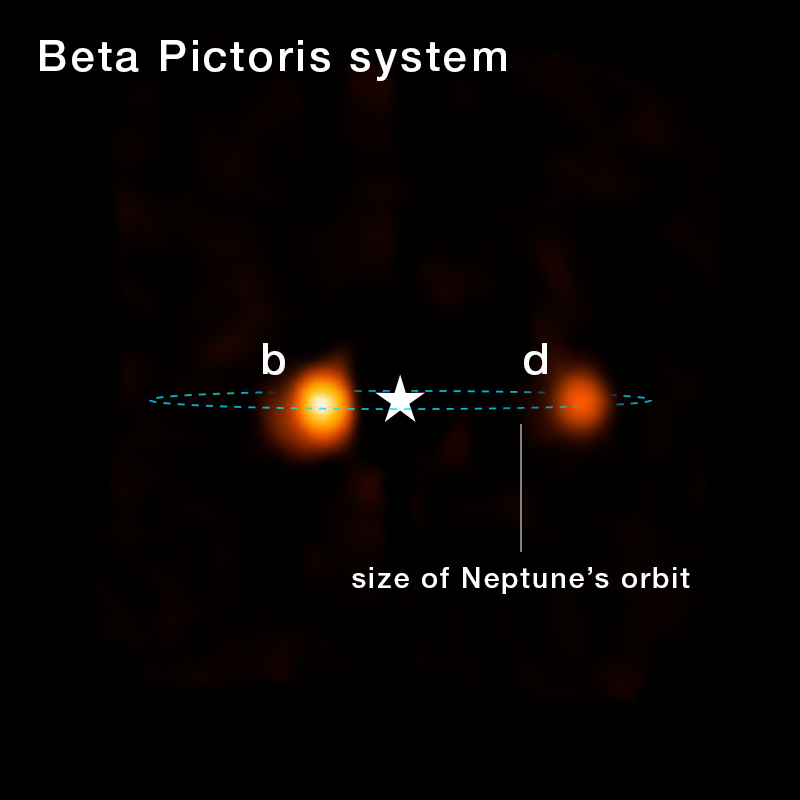
Astronomers identified a new planet, Beta Pictoris d, in the Beta Pictoris system.
Beta Pictoris is a young star about 63 light-years away. A disk of dust and debris left over from planet formation surrounds it. Two large planets, b and c, were already known. Researchers estimate that the new planet d has at least twice Jupiter's mass and orbits at roughly a Neptune-like distance. This is only the second known planetary system with at least three directly imaged planets.
How and why?
A Webb instrument picked out the signature of carbon monoxide in its light instead of relying only on a bright point.
The team was not searching for another planet. Webb's NIRSpec instrument was examining the atmosphere of the already known planet b when an unexpected pattern of carbon monoxide absorption appeared in the data. That pattern helped separate the planet's light from light scattered by dust in the disk. The revealed more than an unusual object: it gave clues about the atmosphere's chemistry and motion.
How do we know?
The team checked the and motion; separate observations independently confirmed the find.
A bright patch in an image could be an instrument error or a structure in the disk. Astronomers therefore compared the object's position, speed and with what they expected from a planet orbiting Beta Pictoris. Further Webb observations found water vapour and methane, while separate observations with other instruments independently supported the discovery. Those multiple checks matter more than a striking picture alone.
Why does it matter?
The method could reveal planets that are hard to spot through ordinary imaging.
Dusty disks can conceal planets that ordinary imaging struggles to distinguish. Searching for a chemical fingerprint in a offers a way to find and study such worlds. Beta Pictoris is especially useful because it is young: astronomers can investigate how a planetary system develops. The new planet may also help explain the disk's unusual inner edge, though further observations are needed.
How do we check that the dot is a planet?
Directly imaging an exoplanet is exceptionally hard because its star overwhelms the nearby world’s faint light. Astronomers use instruments that suppress starlight and observe in infrared wavelengths, where young, large planets may stand out better. In the TWA 7 system researchers spotted a candidate at a position consistent with the surrounding dust disk. Its location is a useful clue but not enough: a background star or another source of noise could look similar.
The next step is to test whether the object moves with the star and whether its brightness fits a young planet. Further observations are needed, and the mass estimate depends on cooling models and the system’s age. Dust disks are valuable because they can preserve signs of the gravitational influence of unseen bodies. If a planet carves a gap or shapes a ring, its position helps test ideas about how planetary systems form.
This is a candidate identified with Webb’s sensitivity, not a photograph of a surface with continents. The image combines processed measurements at different wavelengths. Colours are chosen to separate the signal from the background, not to reproduce what an eye would see up close. It illustrates how astronomy advances by combining an image, motion and physical models while stating what remains unconfirmed.
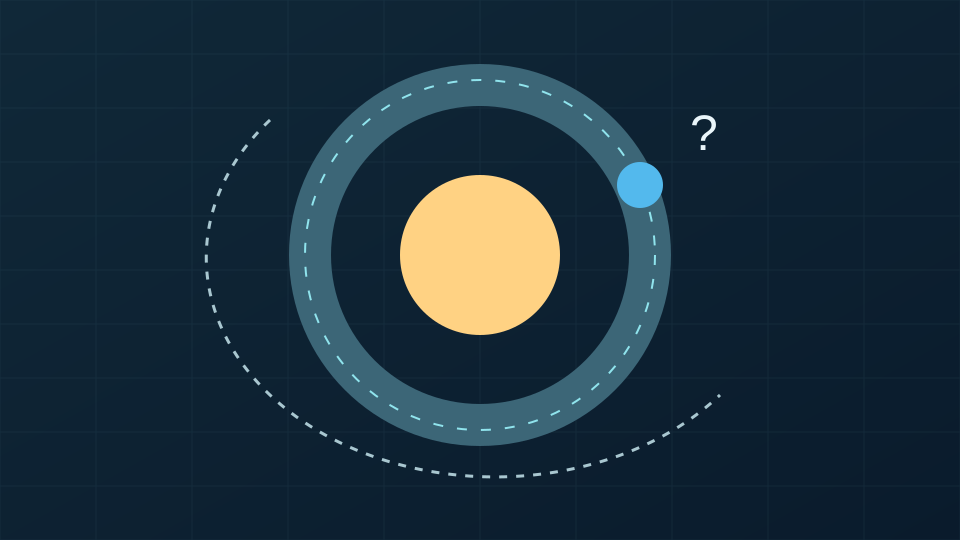
Original NZM illustration · Sources: NASA
A further detail
If confirmed, the candidate’s orbit and estimated mass will help explain how rings form in the disk. A planet’s gravity can redirect small bodies and gather material in some regions, but other processes also shape dust. Predictions from different models must therefore be compared with the observed light distribution. Webb’s finding is more than a new entry in a catalogue: it shows which smaller, cooler planets we might directly image. An instrument’s sensitivity does not remove the need for confirmation at later observing dates. Astronomers especially test whether the tiny point moves as a body bound to the star should.
Webb does not travel to the planet: it measures photons that reach us. The enormous distance makes the apparent gap between star and candidate very small. Optics, image processing and estimates of background noise therefore matter alongside mirror size.
Key terms
— light separated by wavelength.