
What did Euclid find?
The Euclid space telescope, built to survey the large-scale universe, found 31 quasars from its early history. Twelve have of at least seven, meaning their light comes from when the universe was younger than a billion years. Two record sources, at 7.77 and 7.69, are seen as they were roughly 670 million years after the Big Bang.
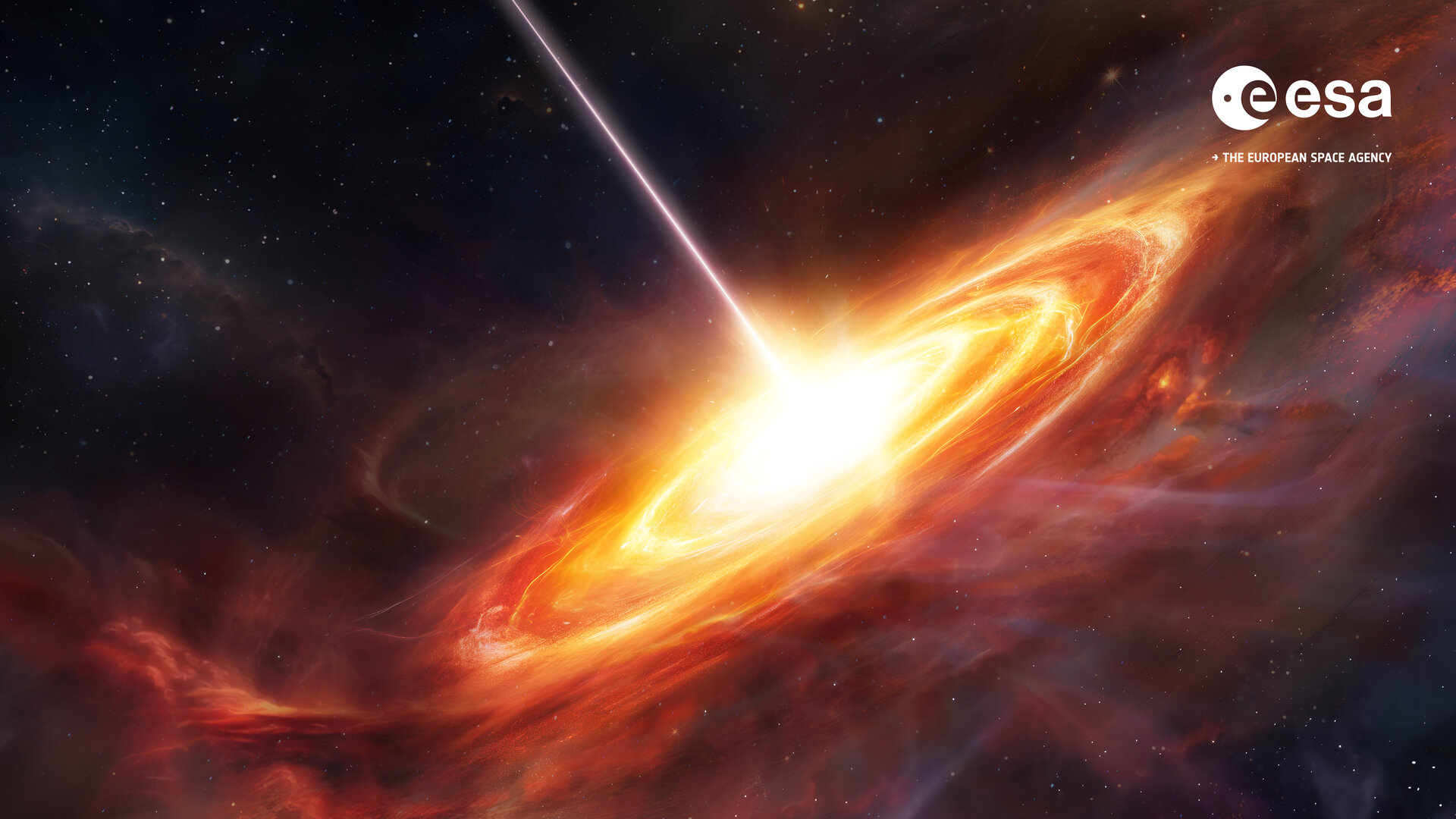
In real observations they look like tiny points, not giant science-fiction whirlpools. Their brightness at such distances is remarkable. The top image is an artist’s impression of how a quasar might appear up close; the collage below contains actual observation data. Keeping illustration and measurement distinct matters.
What is a quasar?
Many galaxies contain a supermassive black hole at their center. Gas falling toward it forms a hot disk before crossing the black hole’s boundary and emits enormous light. An exceptionally bright active galactic nucleus is called a quasar. We see the matter around the black hole, not the black hole itself.
Quasars are beacons of the early universe. Their light has travelled for billions of years, so viewing a distant quasar is also looking into the past. indicates how much space expanded meanwhile. It does not tell us that the object remains in the same state today.
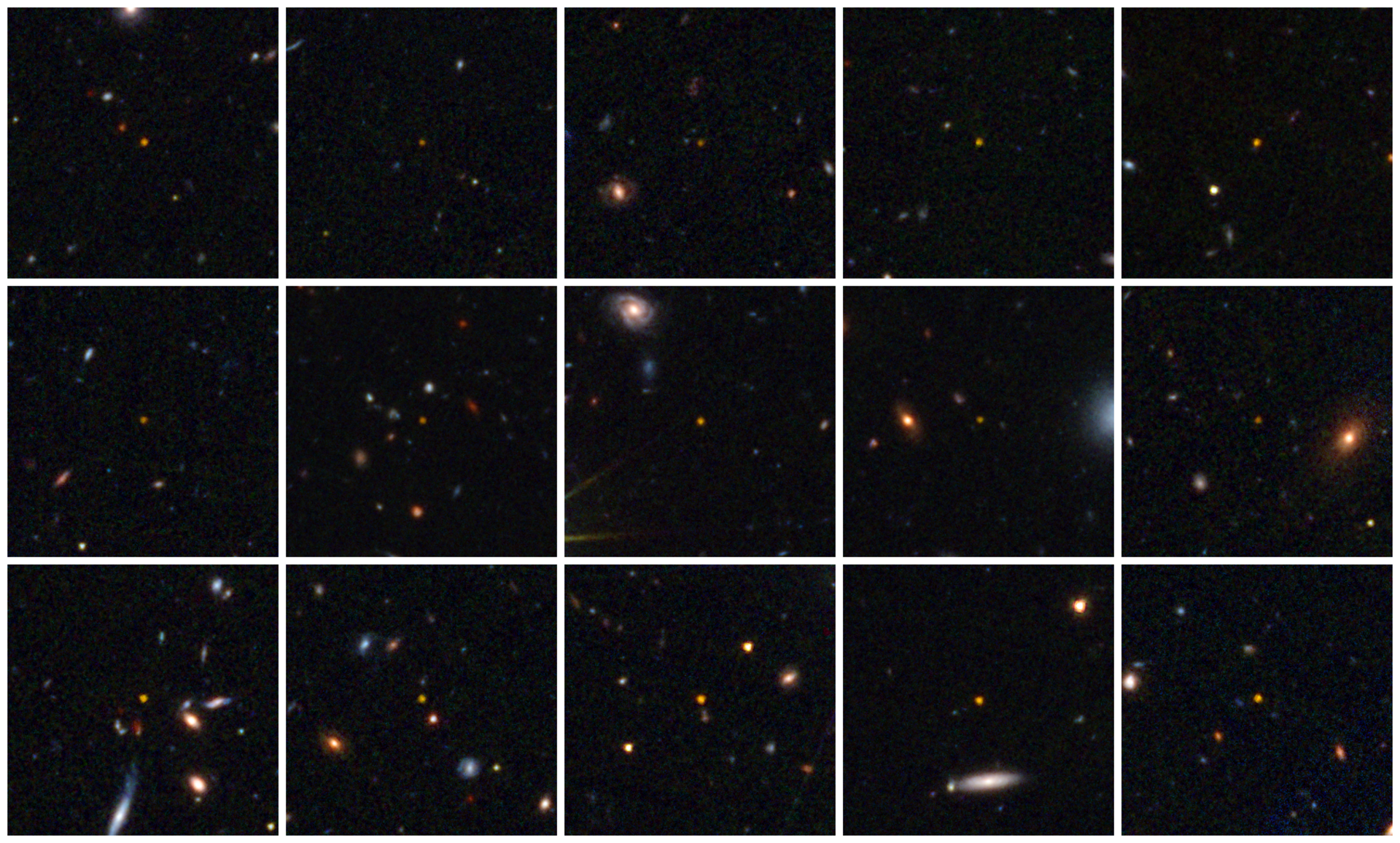
ESA/Euclid/Euclid Consortium/NASA; image processing: Euclid Science Ground Segment and Antoine Basset (CNES) · Sources ↗ · Image terms ↗
Why are early quasars puzzling?
If a black hole became very massive within the first few hundred million years, it needed a starting point and a way to gain matter quickly. Astronomers consider several explanations: large initial seeds, exceptionally rapid feeding or a combination. A sample of 31 objects gives them more examples against which to test their models.
This discovery alone does not solve how the first supermassive black holes formed. Spectra and further observations are needed to estimate their masses and surroundings. Science moves forward when a remarkable find becomes a measurable test of competing explanations.
How were they found?
Euclid scans wide areas of sky and selects candidates from the distribution of their light across wavelengths. Promising objects are then checked with more detailed measurements. Combining a broad search with careful confirmation can reveal rare objects that narrow telescope views might miss.
How does redshift become a time?
As light travels through the universe, expanding space stretches its wavelength. tells us how much it has stretched relative to light from the same process measured in a laboratory. A value near 7.7 does not simply mean an object is seven times farther than another: the relation between distance and age depends on the expansion history of the universe. Astronomers use a cosmological model to estimate how old the universe was when the light was emitted.
Finding a bright point is not the end of confirmation. A cool star in our galaxy can have broad colours similar to a very distant quasar. Spectroscopy divides light by wavelength and reveals characteristic absorption and emission from gases. For very distant sources, intergalactic hydrogen suppresses part of the light. Euclid’s wide search combined with targeted confirmation reduces the chance of mistaking a nearby object for a record holder.
Early quasars test how rapidly black holes grew. Their brightness implies intense inflow of gas, but brightness is not a simple direct mass measurement. Estimates depend on disk geometry and emission properties. To distinguish massive starting “seeds” from rapid growth of smaller ones, astronomers need a population with reliable masses and environmental data. A larger sample moves the question beyond individual exceptions and toward statistics.

Original NZM illustration · Sources: ESA
A further detail
A quasar is not an ordinary star with an exceptionally bright surface. Energy comes from gas spiralling toward a supermassive black hole: gravitational energy becomes heat and radiation before the material crosses the event horizon. We see distant quasars as they were, not as they are today. Their light travels through gas between galaxies, carrying evidence of the environment it crossed. One spectrum can therefore inform us about both the quasar and early intergalactic space. Yet the early growth of massive black holes remains an open problem: radiation pushing gas outward can limit rapid feeding, and the starting mass of a black-hole “seed” is not directly known. Models propose different growth paths. Euclid’s wide survey lets astronomers compare observed numbers with predictions. If the counts disagree, assumptions about formation, gas supply or the duration of a bright phase may need revision.
Key terms
— the stretching of light’s wavelength as the universe expands; it helps estimate a source’s distance in space and time.