
Which planets really came first?
The answer depends on what we consider "first". In 1992, astronomers Aleksander Wolszczan and Dale Frail published convincing evidence for two planets orbiting the pulsar PSR B1257+12. A pulsar is the remnant of an exploded star and emits extremely regular radio pulses. The gravity of the planets moves the pulsar back and forth, so the pulses arrive at Earth with small but regular deviations. It was the first confirmation that planets exist outside the solar system, albeit around a very unusual type of stellar remnant.
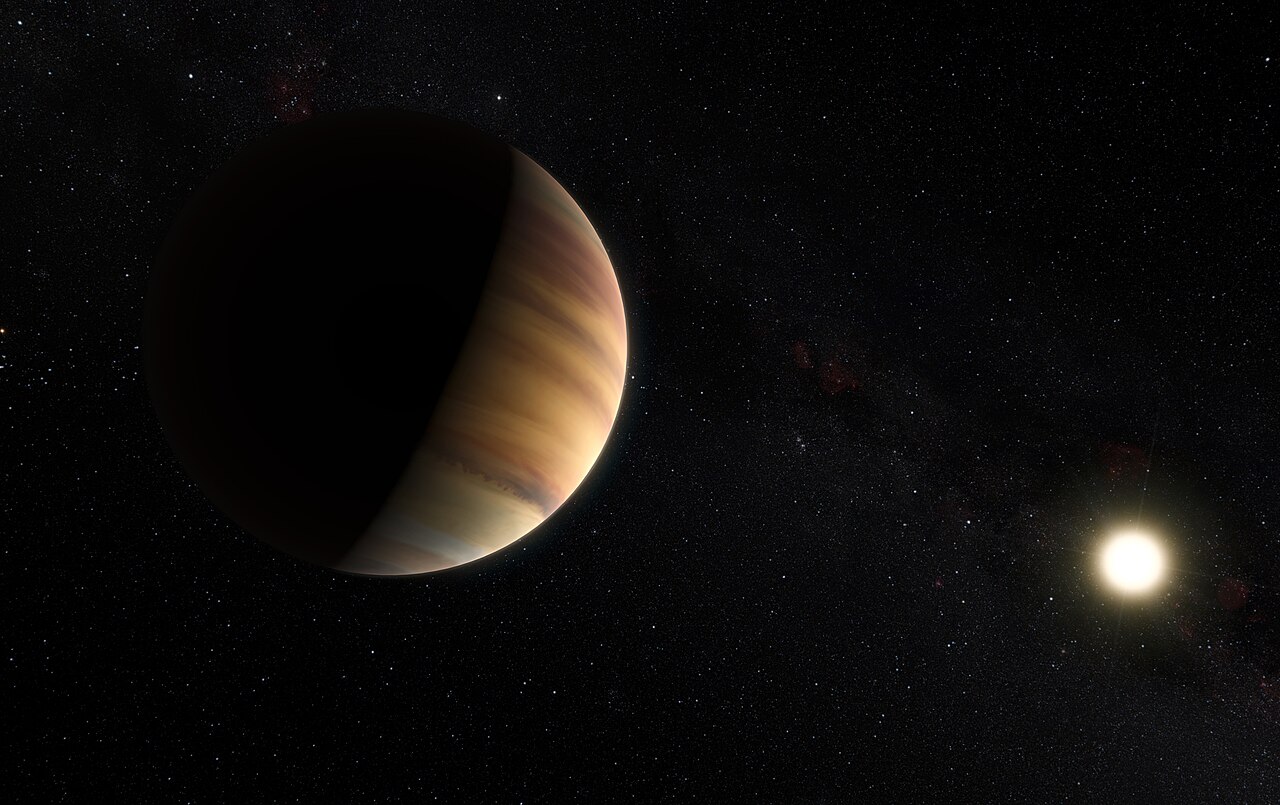
Three years later, Michel Major and Didier Queloz found 51 Pegasi b, the first confirmed planet around a Sun-like star. They announced the news in October 1995. The planet orbits its star in approximately 4.2 days, much faster than Earth orbits the Sun. Its mass is at least about 0.46 Jupiter masses. The discovery came as a surprise at the time: conventional theories expected gas giant planets to form far from their stars. Later, the development of models of showed how the orbit can change during the formation of the planetary system.
The 2019 Nobel Prize in Physics was not awarded for "the first exoplanet at all". One half of the prize went to James Peebles for theoretical cosmology, and the other was shared by Mayor and Queloz for the discovery of an exoplanet orbiting a Sun-type star. The distinction between the pulsar planets of 1992 and 51 Pegasi b of 1995 is important precisely because both discoveries are historically real, but they are not the same kind of first.
A "stumbling" star: the radial velocity method
A planet and a star are gravitationally attracted to each other. They actually orbit around a common center of mass. The star makes a much smaller circle, but periodically approaches us and moves away from us. Then the lines in its spectrum shift slightly due to the . Measuring that displacement gives the , that is, the part of the velocity directed along our line of sight. That's how Mayor and Queloz discovered 51 Pegasi b: they didn't see a bright point of the planet, but a rhythmic shift of the star's light.
From the period of the change in speed, we get the period of the revolution, and from the amplitude and data about the star, we estimate the planet's mass. However, if we do not know the inclination of the orbit, we usually only get the smallest possible mass, often written as m sin i. A system viewed almost "from above" may contain a more massive planet than the alone indicates. Starspots and activity can also produce planetary-like signals, which is why long-term monitoring and independent confirmation are important.
A small drop in brightness reveals the radius
If the orbit is favorably turned towards us, the planet occasionally passes in front of the star's disk. It's called transit. The star then briefly appears a little fainter. In a simple case, the depth of that drop is approximately (Rp/Rz)²: the ratio of the surface of the planet's disk to the star's disk. If we already know the radius of the star, we calculate the radius of the planet from the decrease in brightness. The transit itself, however, does not give us a reliable mass.
Once we have both the mass and the radius, we can calculate the mean density: ρ = M/(4πR³/3). A low density indicates a gas-rich world, and a higher one indicates a more compact composition; however, the same overall density may correspond to different mixtures of rocks, water, and gases. Therefore, it does not automatically follow from the formula that we have found out the exact internal structure. Some worlds are at an angle that does not allow transit, so for them this method is not available at all.
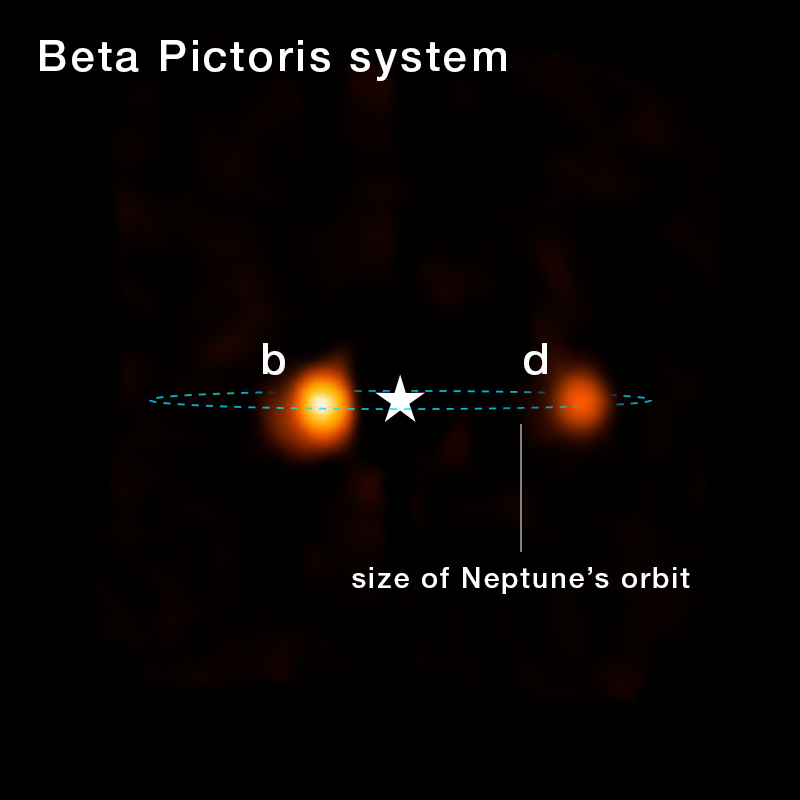
There are other techniques. Direct imaging can pick out the light of large, hot planets far from the star, with instruments that suppress its glow. Precise measurement of a star's position in the sky—astrometry—reveals a lateral "wobble." Gravitational microlensing uses the amplification of light from a distant star when a system with a planet passes in front of it. Each method selects a different type of system; therefore, the set of discovered planets is not an unbiased census of all worlds in the Galaxy.
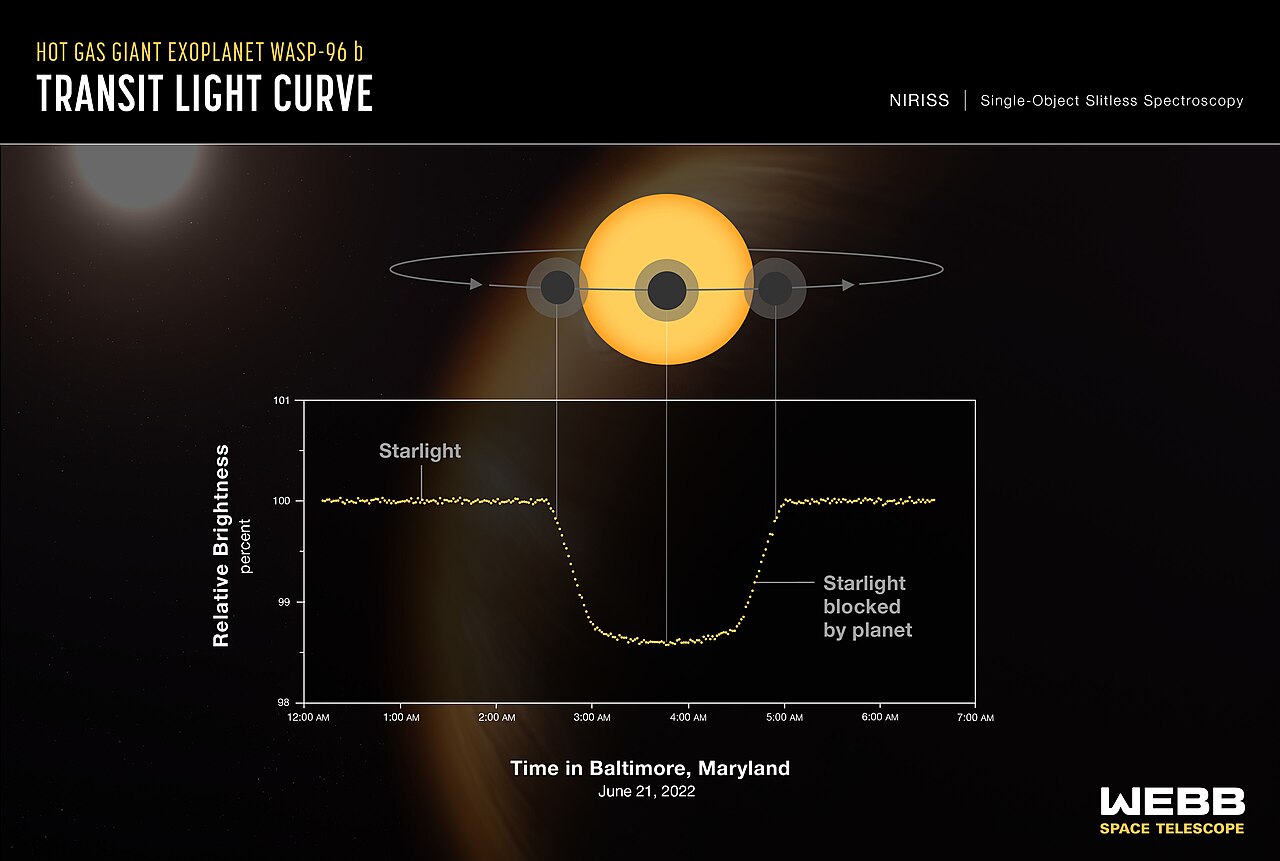
NASA/ESA/CSA/STScI · Sources ↗ · Image terms ↗
How do we read the atmosphere from the light?
During the transit, a small part of the star's light passes through the upper layers of the planet's atmosphere. Atoms and molecules absorb certain wavelengths, so the planet appears slightly larger in those "colors". By comparing the light during and outside the transit, the is obtained. The James Webb telescope, for example, recorded characteristic traces of water vapor for the gas giant WASP-96 b. It is the result of a measurement of that particular planet, not a photo of a water cloud or evidence of life.
Interpreting spectra requires models of temperature, clouds, nebula, chemical reactions, and stellar activity. Some molecular markers may overlap; clouds can hide deeper layers of the atmosphere. For cooler small planets, the signal is particularly weak. Finding an individual gas is therefore not the same as proof that a planet is habitable. Even a potential "biological trace" would have to be viewed along with the atmosphere, the star, and possibly non-living processes that generate the same gas.
A story that began with irregular radio pulses of pulsars and slight shifts in spectral lines today includes thousands of confirmed worlds. The most important change is not only in numbers. From the question "are there?" we arrive at a much more difficult question: "what are they like?" The answer is built from multiple independent measurements, carefully distinguishing what is directly observed from what the model just allows.
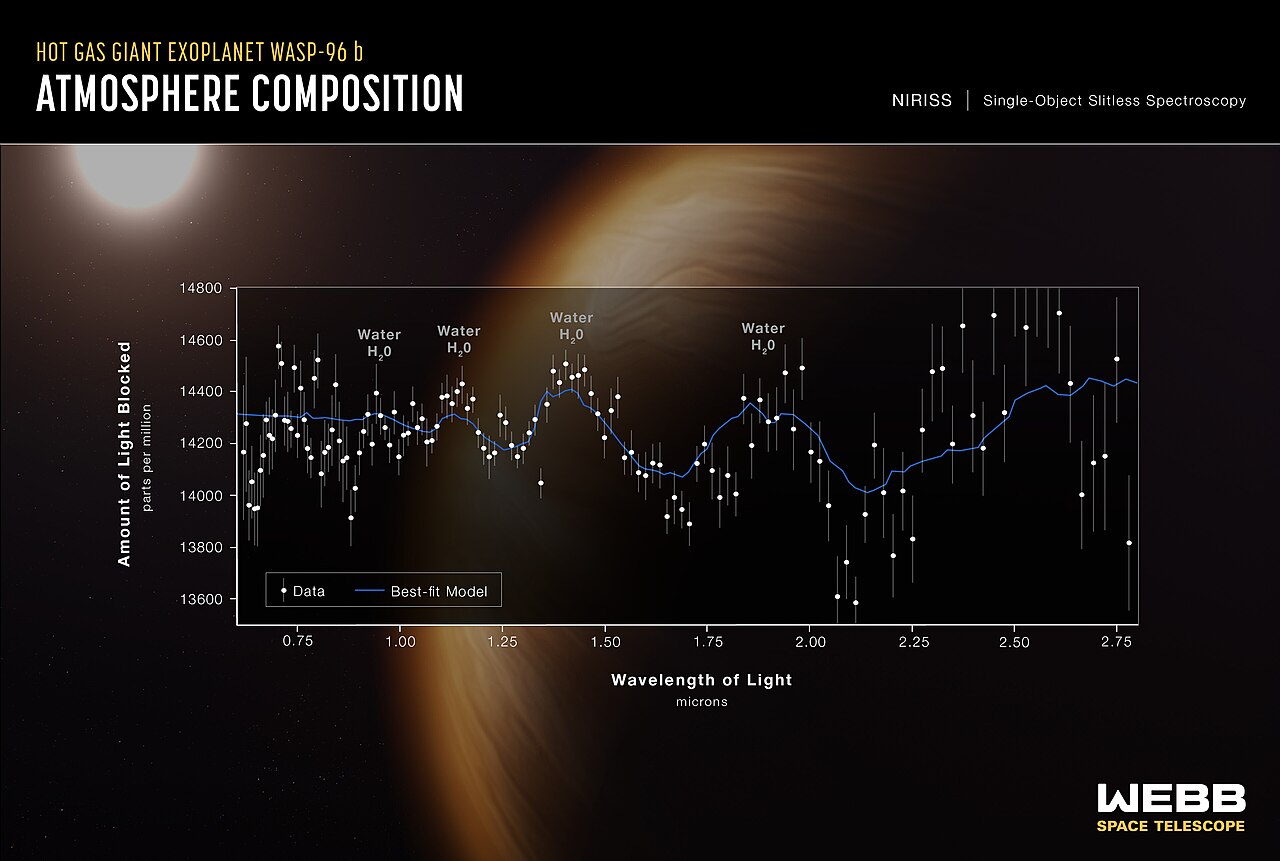
NASA/ESA/CSA/STScI · Sources ↗ · Image terms ↗