
What can we even see?
A black hole is not a black ball of solid matter. In the general theory of relativity, it is the region of space-time from which, after crossing the , light cannot reach a distant observer. The horizon itself does not light up. If there is hot gas around a black hole, it can radiate before falling in. It is its radiation, together with the dark region created by strong gravity, that allows us to recognize a black hole.
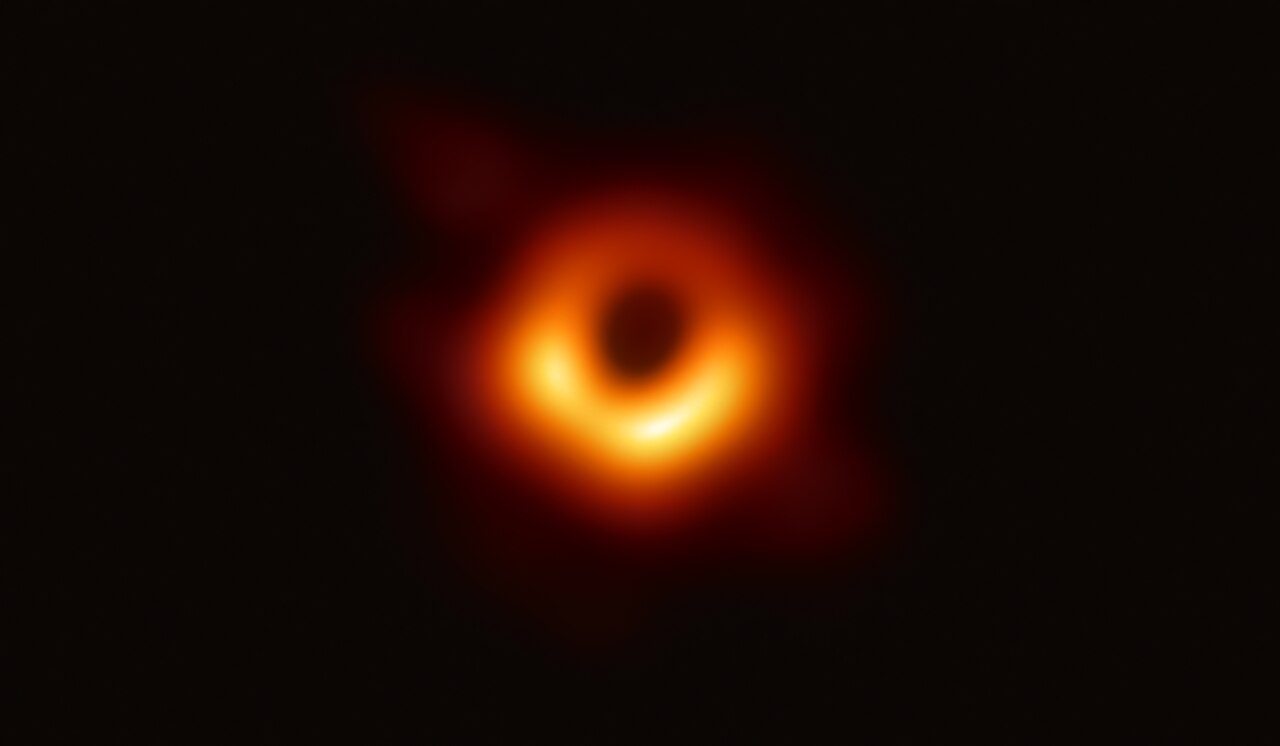
At the center of the Messier 87 galaxy, about 55 million light-years away, is the object M87* with a mass of approximately 6.5 billion solar masses. The bright ring shown originates from glowing material near the black hole, including light deflected by its gravity. The dark environment is the shadow: an area from which much less radiation reaches us, because part of the light is trapped and the paths of photons are strongly curved. The shadow is not the same as the itself; its apparent size is approximately 2.5 times the size of the horizon in the appropriate comparison.
The ring is not even a properly colored tube. Its underside appears brighter in the first image of M87*. One important reason is the relativistic amplification of light from the part of the gas moving towards us. The exact appearance also depends on the plasma distribution, magnetic fields, viewing angle and data processing. The around a black hole does not have to be a neat thin disk like Saturn's rings.
A telescope as big as Earth — but only "virtually"
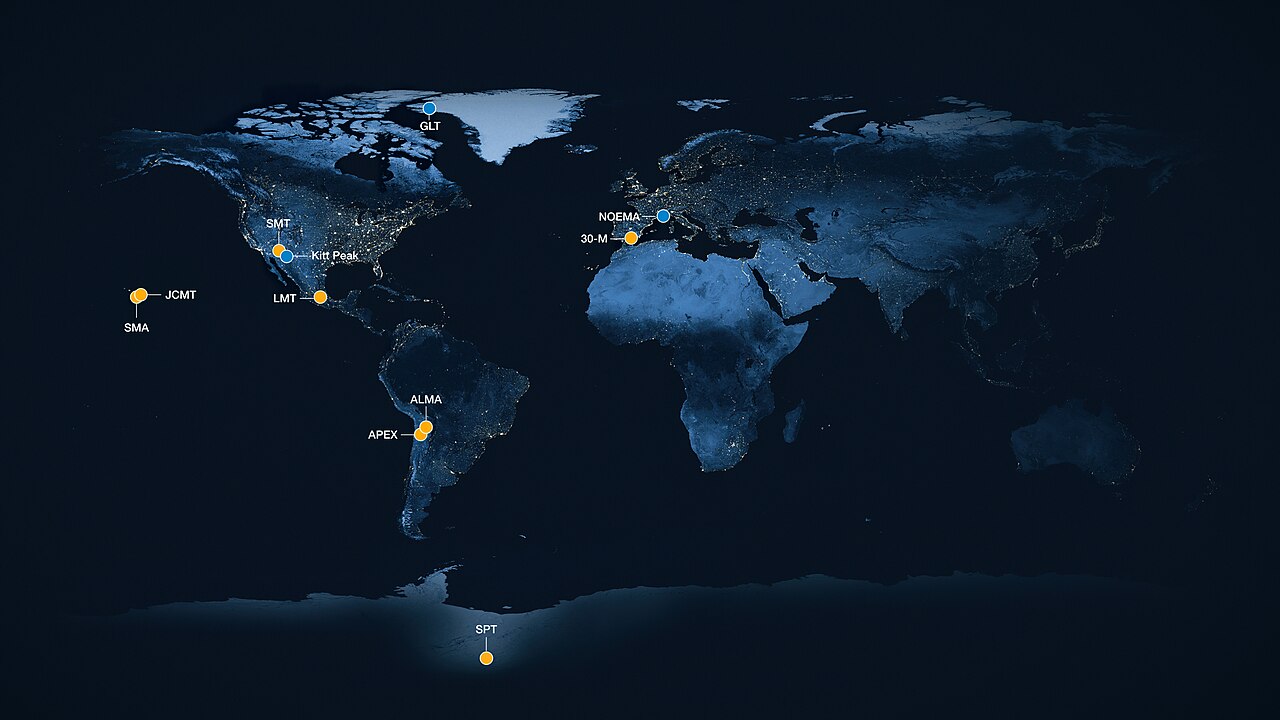
Even a supermassive black hole at a great distance occupies a very small angle of the sky. To separate parts of its ring, astronomers needed the sharpness of an Earth-sized telescope. The Telescope () project therefore connected eight radio observatories on different continents during the 2017 observations, among them ALMA in Chile and the telescope at the South Pole. They observed at a wavelength of about 1.3 millimeters.
This method is called Very Long Baseline Interferometry, VLBI for short. Telescopes do not send images to each other in real time. Each records the radio signal and the precise time of its reception, with atomic clocks. Huge amounts of data are then physically delivered to computer centers, where the signals are matched and compared. Different distances and directions between pairs of telescopes provide different pieces of information about a tiny source in the sky. The grid achieves exceptional angular resolution, but does not receive as much light as a full plate the diameter of the Earth would collect. That is why gaps remain in the data.
Scientists had to reconstruct the picture from those incomplete measurements. Multiple independent teams applied different algorithms and checked that they all yielded the same basic structure. They compared the data with simulated images, calibrated the telescopes and examined what changes if the processing method is changed. The published ring is not a free computer drawing: it is constrained by observations. But it's not an ordinary photo like the one your phone takes with one press of a button. The orange color was chosen to represent the strength of radio radiation, which the eye cannot see directly.
ESO/M. Kornmesser · Sources ↗ · Image terms ↗
Two dates, two black holes
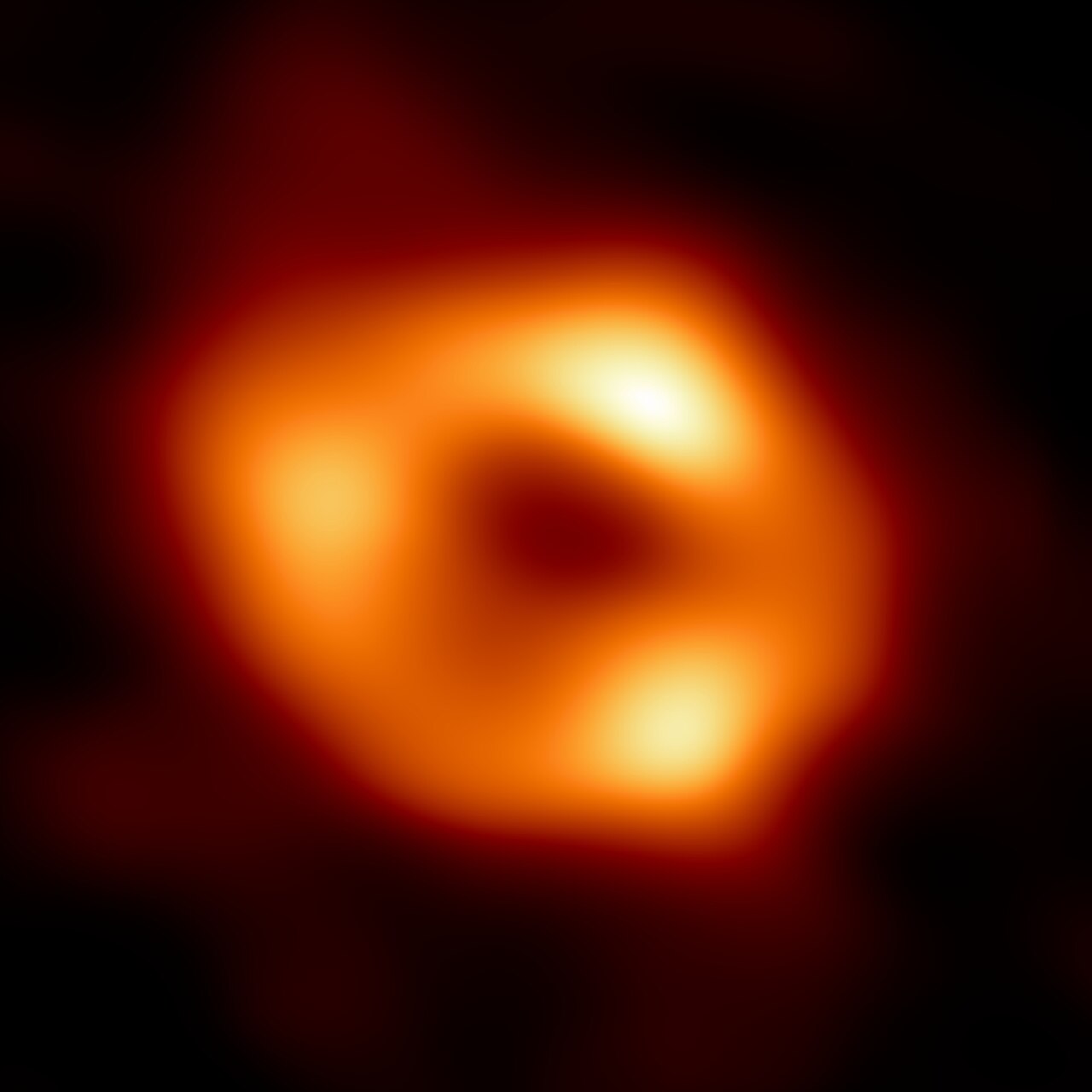
The first image, M87*, was released on April 10, 2019, based on the 2017 campaign. The second, the black hole Sagittarius A* at the center of our Milky Way, was released on May 12, 2022, also from data collected in 2017. It has about four million solar masses and is approximately 27,000 light-years away. So it is much closer to us, but it is also much smaller than M87*. That is why both rings in the sky have a comparable apparent angular diameter.
Why was the closer black hole harder to show? The material around the smaller Sagittarius A* is changing much faster, on a time scale comparable to the duration of a nightly observation, while M87* is slower on that scale. When trying to stack data from multiple telescopes, a changing source looks like a person moving during a long exposure. In addition, radio waves from the galactic center pass through interstellar gas that can obscure the signal. The team therefore analyzed numerous possible images for Sagittarius A* and singled out what they have in common. The dark region and the circular ring are shown to be persistent, but the details of the tiny bright spots should not be read as stationary "blobs" on the black hole.
Event Horizon Telescope Collaboration / ESO · Sources ↗ · Image terms ↗
What does the image verify and what does it not prove by itself?
The size of the shadow can be compared to the mass independently estimated from the motion of the stars or the surrounding gas. The shape of the ring is a powerful test of the theory of gravity under extreme conditions. However, the image alone does not reveal the entire internal structure of the object, does not show what is "behind" the horizon, and does not automatically tell how fast the black hole is spinning. Additional measurements and models are needed for these questions. Particularly valuable are polarization measurements, which provide clues about the arrangement of the magnetic field and how the material flows or participates in the formation of jets.
The greatest achievement is not that we have "illuminated the darkness." With measured radio waves and a well-verified analysis, we were able to show the light trail that gravity shapes at the very edge of what can be seen. It is precisely the clear line between perception, reconstruction and interpretation that makes these images so convincing.