
The man behind the familiar legend
When Galileo Galilei is mentioned, the first thing that comes to mind is the story of the scientist who claimed that the Earth revolves around the Sun, for which the Church condemned him and forced him to renounce his beliefs. The famous sentence is often added to that story: "And yet it moves." The real story, however, is much more interesting – and much more complex. Galileo was not only an astronomer. He was a mathematician, physicist, inventor, experimenter, writer and one of the people who contributed the most to changing the way we study nature.
He did not invent the telescope, he was not the first to say that the Earth revolves around the Sun, and there is no reliable evidence that he uttered the famous sentence attributed to him after the trial. Nevertheless, his contribution to science was enormous. Galileo did something that would become one of the foundations of modern science: instead of being satisfied with the answer given by the great authorities of the past, he asked nature. He watched. He measured. He experimented. He calculated.
And when what he saw didn't match what had been held to be true for centuries, he was ready to say that maybe the problem was the old theory, not the new observations. This is exactly why the story of Galileo is not just the story of one man and one telescope. It is the story of the birth of modern science.
From medicine to questions about motion
Galileo Galilei was born on February 15, 1564 in Pisa, Italy. His father Vincenzo Galilei was a musician, composer and music theorist. The family wasn't poor, but they didn't have enough money either to allow Galileo to spend his life carefree doing what interested him. The father wanted his son to have a secure and well-paid occupation. In 1580, Galileo enrolled at the University of Pisa. According to the wishes of the family, he should have studied medicine. But medicine did not keep him for long. He was increasingly attracted to mathematics, geometry and problems of motion.
He was particularly interested in the work of the ancient Greek mathematician Archimedes. Unlike many scholars of the time, who primarily tried to explain nature with philosophical discussions, Archimedes connected physical problems with mathematics. Galileo liked that way of thinking. He never finished his medical studies. He left the university without a degree, but with a completely different life path ahead of him.
In Galileo's time, European universities were still strongly dominated by the philosophy of Aristotle. Aristotle lived almost two thousand years earlier and was one of the greatest thinkers in history. The problem was not that people read Aristotle. The problem arose when his claims were accepted as an almost infallible description of nature. If Aristotle said that a heavier body moves towards the earth faster than a lighter one, the student could learn it and repeat it. Galileo wanted something else. He wanted to check what was really going on.
A famous story is associated with his name, according to which he threw balls of different masses from the Leaning Tower of Pisa in order to show that they do not fall as the simple Aristotelian explanation dictates. It is possible that he performed various experiments with falling bodies, but for the dramatic experiment from the top of the tower we have no certain historical evidence. What we do know is that Galileo studied motion seriously. Experiments with balls rolling down a slightly inclined plane were especially useful to him. Why an inclined plane? Because free fall is too fast.
In the 16th and 17th centuries, there were no electronic sensors or precise digital clocks. If you slow down your movement by rolling the ball down a gentle slope, you can measure time and distance much more easily. Galileo was thus able to observe the mathematical regularities of accelerated motion. It was one of the big steps towards physics as we know it today.
Mathematics, the pendulum and the years in Padua
For Galileo, mathematics was not just a convenient tool for calculation. He believed that nature can be understood precisely with the help of mathematics. Body movement can be measured. The trajectory of the projectile can be described. Time can be compared. Speed can be studied. Instead of asking, "What is the natural place of this body?" the question becomes more and more important: "How fast is the body moving and how does its speed change?" Today, such an approach seems quite normal to us. But at the beginning of the 17th century it represented a great intellectual change. Galileo helped make physics a science in which nature is described by numbers, relationships, and mathematical rules.
Another famous story from Galileo's life is related to the pendulum. According to a story later recorded by his student and biographer Vincenzo Viviani, the young Galileo observed a swinging lamp in the cathedral of Pisa. He is said to have observed that the time required for one swing is about the same even as the swing of the lamp decreases. He could compare the time using his own pulse. The historical details of this story are not entirely certain, but Galileo did seriously investigate the pendulum.
The observation of their approximate isochronity - the property that oscillations of the same length last approximately the same for small angles - was very important for the later development of precision clocks. Galileo himself did not make a practical pendulum clock. This will be done successfully by others later. But the idea that proper physical movement could be used to measure time fit perfectly into his way of thinking.
After a period of work in Pisa, in 1592 Galileo was appointed professor of mathematics at the University of Padua. He stayed there for eighteen years. He later described that period as one of the happiest in his life. Padua belonged to the Republic of Venice, one of the most important commercial and maritime centers of Europe. Galileo was not just a university professor. He gave private lessons, built instruments and solved practical technical problems. He developed a geometric and military compass that could be used for various calculations. He worked on water lifting devices and other mechanical problems.
And then, in 1609, news reached him about an unusual device made in Holland. With it, distant objects could appear as if they were much closer. This device would change Galileo's life.
The telescope and a new sky
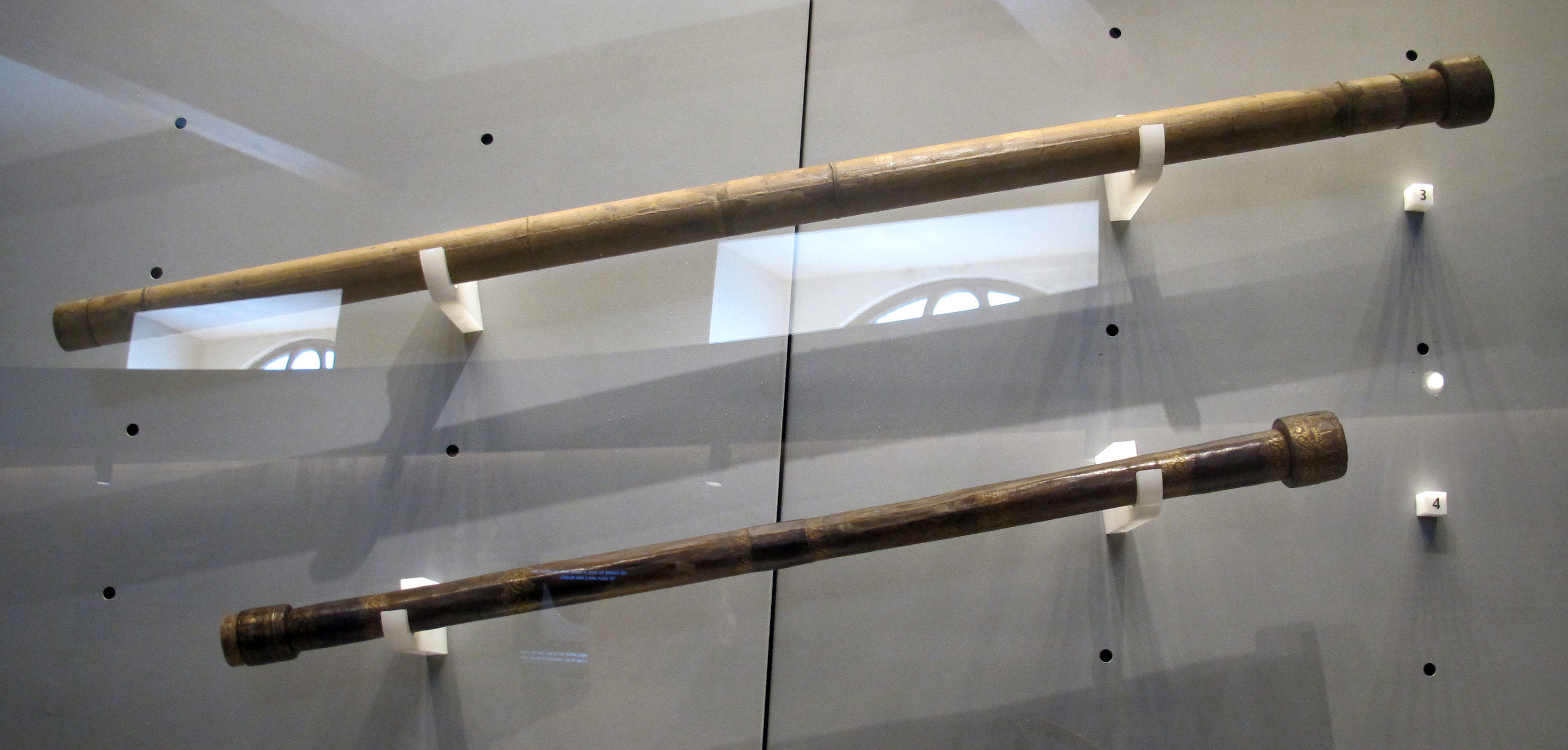
One of the most common misconceptions about Galileo is that he invented the telescope. It's not. The first known telescopes appeared in the Netherlands in 1608. Galileo heard about them the following year. He didn't even have to see the original device. Based on the description, he began experimenting with lens combinations and created his own version. The first instruments were not particularly powerful. But Galileo quickly perfected them. He built telescopes that magnified much higher than the first Dutch models and began demonstrating them to the Venetian authorities. The military and commercial benefits were obvious.
From the top of the tower, a distant vessel could be spotted long before anyone could see it with the naked eye. But Galileo then did something that would change history. He turned the telescope to the sky.
Before Galileo, the sky was often seen as a realm of perfection in the traditional Aristotelian picture of the world. Earth was a world of change, decay, and imperfection. The heavens were meant to be different. Galileo looked at the moon through a telescope. He saw light and dark surfaces. More importantly, he looked at the way shadows change along the boundary between lit and unlit areas. He concluded that the surface of the Moon is not perfectly smooth. There are elevations and depressions on it. In other words – mountains and rough terrain. The Moon suddenly began to look more like Earth. The celestial body was not a perfect geometric sphere as expected by the simple Aristotelian representation.
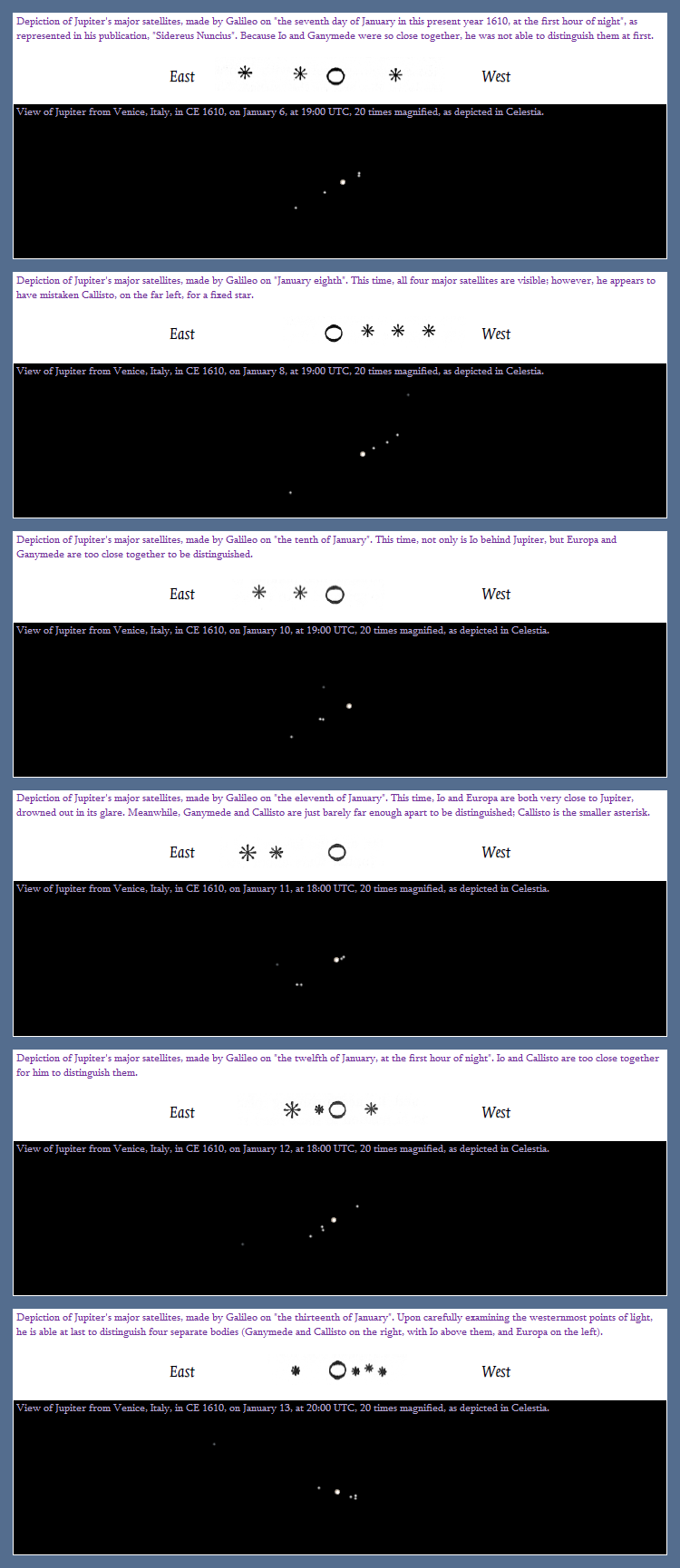
In January 1610, Galileo observed Jupiter. Next to the planet he noticed several small bright spots. At first he thought they were stars. But the next night their situation was different. He continued to watch them. It became clear that these points were moving around Jupiter. In the end, he determined that there were four of them. Today we know them as Io, Europa, Ganymede and Callisto – the four large Galilean moons of Jupiter. For the discussion at the time, this was extremely important. If the four heavenly bodies obviously revolve around Jupiter, then it is not true that everything in the sky must revolve around the Earth.
Galileo published his discoveries in 1610 in a short, highly influential book, Sidereus Nuncius, or "Starry Messenger." He named his new satellites of Jupiter the "Medici stars", in honor of the powerful Medici family. It wasn't just science. It was also a very smart policy. The Medici were the rulers of Tuscany. Galileo soon became their court mathematician and philosopher.
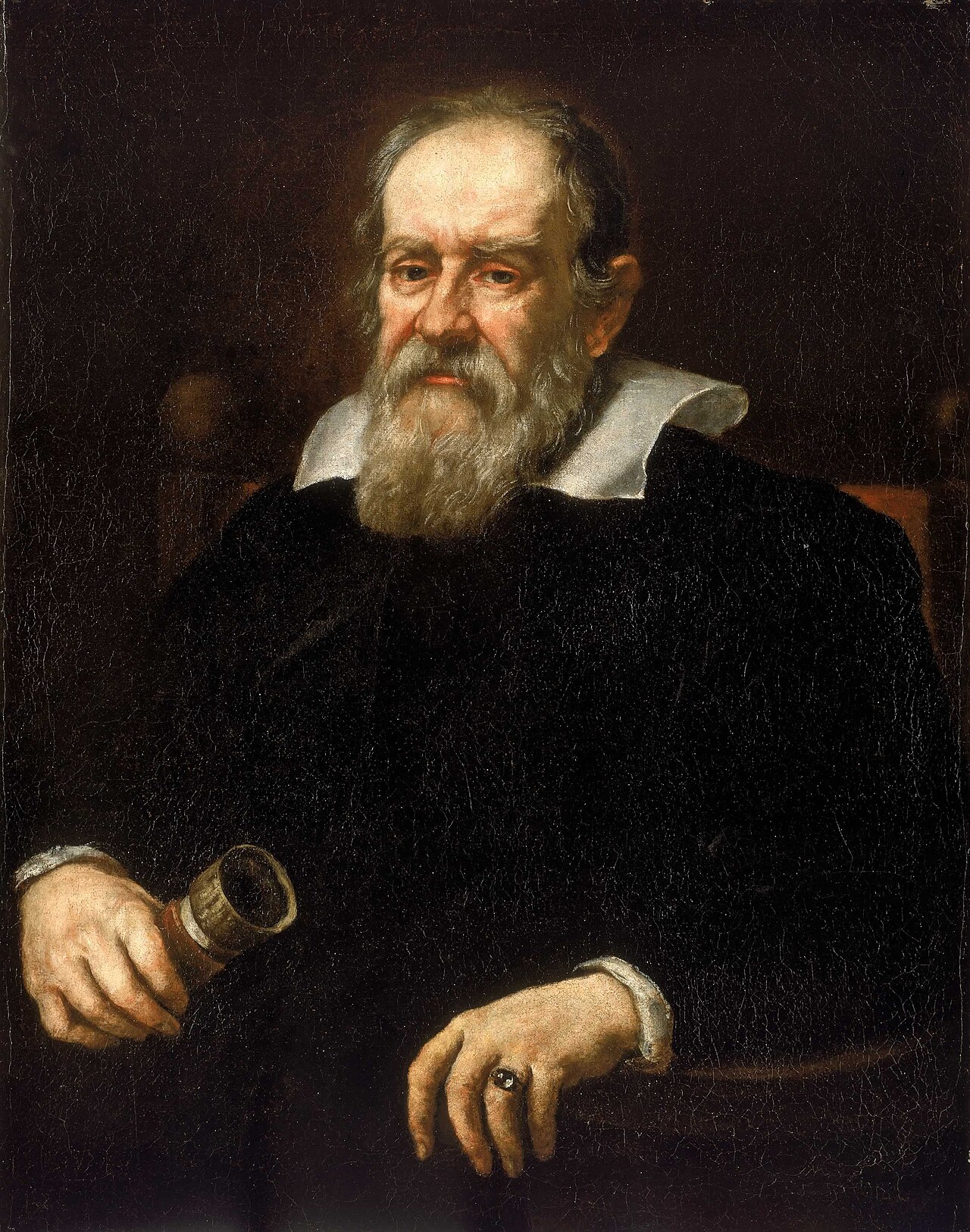
Sailko / Wikimedia Commons · Sources ↗ · Image terms ↗
Venus, Copernicus and the arrangement of the planets
One of Galileo's most important telescopic observations concerned Venus. Venus, the telescope showed, goes through different phases much like the Moon. It may look like a crescent, but it may also show a much larger illuminated area. It could not easily fit into the classical Ptolemaic geocentric system. If Venus orbits the Sun, its phases become understandable. This did not in itself prove that the Earth also revolved around the Sun - there were other models that could explain the phases of Venus - but the old Ptolemaic system was seriously shaken. The telescope continued to reveal skies that did not fit the simple traditional picture.
Galileo also observed sunspots. The sun, another supposedly perfect celestial body, was showing changes. Observations also indicated that the Sun rotates. He saw a huge number of stars that the human eye without a telescope could not register. The Milky Way no longer looked like a vague bright mist. The telescope showed that it was made up of many stars. He also observed Saturn, although his telescope was not good enough to make out its rings properly. He saw something unusual around the planet, but he couldn't determine what exactly he was looking at.
The idea that the Earth moves around the Sun was not Galileo's. In 1543, the Polish astronomer Nicolaus Copernicus published the work On the Revolutions of the Celestial Spheres. Copernicus proposed that the planets, including the Earth, moved around the Sun. By the time Galileo started using the telescope, Copernicus had already been dead for decades. The problem was that the Copernican system initially did not have enough obvious observational evidence for all astronomers to simply abandon geocentric models. Some questions remained open. If the Earth is moving, why don't we feel it? Why doesn't a bird that flies from a tree stay behind the moving Earth?
Why does a stone thrown straight up fall approximately where it was thrown from? Why then could not the expected change in the position of distant stars - stellar parallax - be observed? Galileo had to think about movement, not only about astronomy.
Celestia / Wikimedia Commons · Sources ↗ · Image terms ↗
Why do we not feel Earth moving?
Galileo used a very interesting comparison. Imagine that you are below the deck of a ship that is moving calmly and steadily. Flies fly in the cabin. Fish swim in a bowl. Drops of water fall into another container. You can throw items to a friend. If there are no windows and the ship is not accelerating or changing direction, it is very difficult to determine whether the ship is at rest or moving steadily based on those experiments alone. Everything in the cabin participates in the movement of the ship. Similarly, Galileo argued, the fact that we do not feel the Earth moving does not prove that it is at rest.
This idea became very important in the development of the principle of relativity of motion. Centuries later, physics would go much further, but Galileo's ship remained one of the most beautiful thought experiments in the history of science.
Debate with Church authorities
Galileo's telescopic discoveries quickly became known throughout Europe. Many astronomers confirmed his observations. The telescope could no longer simply be ignored. But the question of the movement of the Earth soon fell out of astronomical discussion. It also became a theological question. Some parts of the Bible have traditionally been interpreted to imply a stationary Earth and the movement of the Sun. If an astronomer says that the earth moves, the question arises as to how to interpret such passages of Scripture. Galileo did not think that science and faith had to be enemies. His argument was different.
If reliable observation of nature shows how some physical process works, then perhaps a biblical text about nature should not be interpreted as an astronomy textbook. In his opinion, the Bible was supposed to guide people in matters of faith and salvation, while the movement of the planets must be investigated by observation and mathematics. This attitude also had supporters among people within the Church itself. Galileo's story is therefore not a simple story in which there were "scientists" on one side and "the Church" on the other. Among the churchmen there were astronomers who accepted his telescopic observations, as well as those who opposed his conclusions.
But the dispute was becoming more and more serious.
In 1616, the question of heliocentrism was discussed in Rome. Experts of the Holy Office assessed the claim that the Sun stands motionless in the center of the world as unacceptable in the philosophical and theological framework of the time, and the movement of the Earth as contrary to the accepted interpretation of faith. Cardinal Robert Bellarmine warned Galileo not to accept, teach, or defend Copernicus' teaching as a true description of the world. An important nuance is that Galileo did not then go through the great formal trial that we usually imagine when we talk about his process. Therefore, he received a serious ban regarding the advocacy of heliocentrism, the interpretation of which will be important in the later process.
Copernicus's work was simultaneously suspended until appropriate corrections were made. Galileo withdrew from open discussion for a time.
The Dialogue and the trial of 1633
The situation changed in 1623 when Maffeo Barberini, who took the name Urban VIII, was elected pope. Barberini had previously had a good relationship with Galileo and appreciated his abilities. Galileo therefore believed that a space had opened for a new debate on the organization of the world. He didn't just want to say, "Copernicus is right." He wanted to present the arguments of the different systems and show why the heliocentric explanation was more convincing in his opinion. The result was one of his most famous books.
In 1632, the Dialogue on the Two Main Systems of the World was published. The book is written as a conversation between three people. Salviati mainly advocates new, Copernican ideas. Simplicio defends the traditional Aristotelian-Ptolemaic view. Sagredo listens to the arguments of both sides and participates in the discussion. Such a form made the book much more accessible than a dry professional treatise. Galileo was a very good writer. He wrote in Italian, not just the Latin language of the learned, so his book could be read by a much wider audience. And that's exactly where a big problem arose.
Although the work was formally a debate between different systems, it was not difficult for the reader to see which side was winning the better arguments. Simplicio often appears to be the weaker interlocutor. Things became even more unpleasant because in his mouth there was also an argument advocated by Pope Urban VIII - the idea that God's omnipotence means that people should not claim that there is only one possible way in which God could order the phenomena of nature. The extent to which the Pope personally experienced the book as an insult and how significant it was for later events is a matter of historical debate.
But relations between Galileo and Rome deteriorated dramatically. The book was retracted, and Galileo was called before the Inquisition.
Galileo was then almost seventy years old. His health was not good. He was trying to postpone the trip, but he could not ignore the call from Rome. At the beginning of 1633 he arrived in Rome. The central question was what exactly he was ordered to do back in 1616, and whether by publishing the Dialogue he violated the restrictions of that time. Galileo was trying to prove that in the book he did not represent the Copernican system as an established fact. He even claimed that his intention was to show the weaknesses of the Copernican arguments. That wasn't a particularly convincing explanation to anyone who read the book.
The process was not a modern scientific debate in which two sides presented the results of experiments, and independent experts decided who had the better evidence. It was an ecclesiastical legal proceeding in which theology, authority, prior prohibitions, and Galileo's published text were intertwined. On June 22, 1633, Galileo was declared "strongly suspected of heresy." He had to publicly renounce the views that were imputed to him.
The sentence, house arrest and a famous legend
In popular versions of the story, Galileo is sometimes portrayed as a man who ended up in a dungeon and was brutally tortured for claiming that the Earth revolved. This is not what the historical sources show. The formal threat of torture appeared in the proceedings, which was part of the inquisitorial procedure at the time in certain situations, but there is no evidence that Galileo was actually physically tortured. He didn't even spend the rest of his life in a prison cell. His prison sentence was soon commuted to a much milder form of restraint.
For a time he stayed with the archbishop of Siena, and then he was allowed to live in his villa in Arcetri near Florence. He was under house arrest. It certainly didn't mean he was free. His movements and contacts were restricted, and his most famous astronomical work was banned. But the reality is different from the popular image of a scientist thrown into a dark dungeon for years.
And what about the famous: "Eppur muove." "It turns around, though." According to legend, after publicly renouncing heliocentrism, Galileo quietly uttered those words. The story is perfect. The old scientist is forced to say something he does not believe in front of authority, and then quietly announce that nature will not change just because human judgment has made a different decision. The problem is that we have no reliable proof that Galileo actually said that sentence. The earliest known records attributing those words to him appear much later. It is very likely that the legend was created after his death.
But the legend has survived because it describes so well what people want to see in Galileo's story. A judgment can ban a book. It can force a man to change his publicly spoken words. But it cannot change the motion of the planets.
Work under house arrest
House arrest did not mean the end of Galileo's science. On the contrary. In the last years of his life, he returned to some of the problems that interested him long before the telescope - motion, mechanics and the properties of materials. The result was his great work Discourses and Mathematical Proofs of the Two New Sciences, published in 1638 outside Italy. The book summarized decades of his thinking about the movement of bodies and the solidity of materials. Many historians of science consider this work to be one of the foundations of modern physics. The paradox is striking. The man whose name is most often associated with astronomy and the telescope made perhaps an even deeper contribution to the understanding of motion.
His ideas about accelerated fall, the trajectory of a projectile, and the relativity of motion would become part of the foundation upon which Isaac Newton would later build.
Galileo's health was deteriorating. By 1638, he was completely blind. For a man who became famous for seeing what others could not, the loss of his sight carried an almost symbolic weight. Nevertheless, he continued to think and talk with students and colleagues. Among the young people who visited him was Vincenzo Viviani, who would later preserve many stories about his life. Galileo died on January 8, 1642 in Arcetri. Isaac Newton was born later that year according to the then English, Julian calendar; according to today's Gregorian calendar, his date of birth is January 4, 1643.
The scientific revolution continued.
What did he prove, and what had yet to be proved?
The answer is more interesting than a simple "yes". Galileo gathered very strong evidence against the traditional picture of heaven. Jupiter's satellites proved that there are centers of motion other than the Earth. The phases of Venus overturned the classic Ptolemaic model. Mountains on the Moon and sunspots have shown that the sky is not unchanging and perfect in the way it is often imagined. His understanding of the relativity of motion answered some of the main objections to a moving Earth. But his telescopic observations alone could not prove unequivocally that the Earth revolves around the Sun.
There was, for example, the geoheliocentric model of Tycho Brahe in which the planets revolved around the Sun, while the Sun and the planets moved around the stationary Earth. Such a system could explain a significant part of the new telescopic observations. Galileo also believed that the tides were evidence of the movement of the Earth. That's where he was wrong. The true explanation of tides is primarily related to the gravitational action of the Moon and the Sun. That is an important part of his story. Great scientists can be wrong. Galileo's importance is not that every argument he made was correct.
Its significance is that it helped change the way we resolve such disputes.
From today's distance it is easy to say: "Galileo was right and his opponents were wrong." We know that the Earth rotates on its axis. We know it orbits the Sun. Today we can send spacecraft to other planets using physics that depends on a proper understanding of motion. But at the beginning of the 17th century, the scientific picture was not complete. Newton's theory of gravity was not known. No stellar parallax was measured. The nature of the planets and stars was just beginning to be revealed.
That is why it is historically more interesting to ask not only who was right in the end, but also what evidence they had at that moment. Just such a question is very Galilean.
His legacy and his mistakes
Galileo did not invent the scientific method himself. Science was not born one morning when an Italian decided to do an experiment. Copernicus, Kepler, Tycho Brahe, William Gilbert, Vesalius and many other people who changed the European understanding of nature worked before him and around him. But Galileo occupies a special place. He combined experiment, mathematics, technical instruments and very powerful writing. He realized that the new instrument could expand human senses. The telescope enabled the eye to see what it could not do without it. The experiment allowed the researcher to ask nature a carefully thought out question. Mathematics made it possible to express the answer precisely.
And perhaps most importantly, a claim about nature was no longer to be accepted simply because a great philosopher of the past had made it. It was necessary to look at what nature actually does.
Galileo was brilliant, but he was not infallible. He was wrong in explaining the tides. He made some arguments with much more certainty than the evidence at the time allowed. He was also known as a very sharp polemicist. When he thought his opponent was wrong, he didn't always try to tell him gently. He made enemies. He was ambitious, aware of his own abilities and very skilled at seeking the patronage of powerful people. All that makes his story more interesting, not less valuable. Science does not progress because it is run by perfect people.
It thrives because there is a way to test ideas, critique them, fix them and, if necessary, abandon them.
Science, faith and later reassessment
That is probably the most difficult question of the entire story. If we reduce it to the sentence "The Church was against science", we lose much of the historical context. If, on the other hand, we say that the scientific question had nothing to do with his conviction, that will not be true either. Heliocentrism was indeed central to the problem. But the interpretation of the Scriptures, the authority of the Church, the internal politics of Rome, Galileo's warning of 1616, the way the Dialogue was written, the relationship with Pope Urban VIII and the political atmosphere of Europe at the time of religious conflicts also entered into the story. The church was not a unified block of people who refused to look through the telescope.
Some church astronomers confirmed Galileo's observations. At the same time, the institution of the Inquisition eventually condemned Galileo because he linked the advocacy of heliocentrism with suspicion of heresy. That is why real history is not simple. And that is why it is much more interesting than a myth.
The Catholic Church's attitude towards Galileo's case changed over the following centuries. The heliocentric view became part of normal astronomy long before all the institutional ramifications of the old prohibition disappeared. In the 20th century, the Vatican again seriously considered Galileo's case. In 1979, Pope John Paul II called for a restudy of the case. The commission was established in 1981, and its conclusions were publicly discussed in 1992. Galileo had long since been one of the symbols of modern science. But perhaps the greatest irony is that his real scientific victory was not just the fact that the Earth actually moves.
A much more profound change has taken place in the way people come to know about nature.
Observe, measure, verify
In Galileo's time, the telescope was a new technology. Some people did not even believe that what was seen through it really existed in heaven. What if the instrument creates optical illusions? What if those bright spots are just lens errors? The answer could not be, "Trust Galileo." Other people had to build telescopes. They had to look at Jupiter. They had to see the same points. They had to track their movements. If different observers in different places get the same results, confidence in the observation increases. It is one of the central ideas of modern science. The result should be verifiable.
It doesn't matter who you are. It is crucial whether others can examine what you claim.
Galileo was not the first to move the Earth from the center of the cosmos. Copernicus proposed it mathematically before him. At the same time, Kepler discovered that the planets do not move in perfect circles, but in ellipses. A few decades later, Newton would explain why the planets move around the Sun in the first place. But Galileo gave the human eye something it didn't have before. Proof that heaven is not what was imagined for centuries. The moon has mountains. The sun has spots. Jupiter has its own worlds. Venus goes through phases. The Milky Way is made up of countless stars.
The earth could no longer be so easily viewed as a completely separate, immovable center of all that exists. And perhaps more importantly, Galileo showed that an instrument made by human hands could reveal a reality beyond our natural senses. Today, we take that idea for granted. Radio telescopes see what our eyes cannot see. Microscopes reveal cells and molecules. The detectors register gravitational waves. Space telescopes observe galaxies whose light has traveled for billions of years.
In this sense, when today's astronomer looks at the data from the James Webb telescope, there is a clear intellectual connection between him and the man who more than four centuries ago turned a small tube with lenses towards Jupiter. Galileo Galilei died almost four centuries ago. His world is gone. But the question he asked is still the core of science: Not what we would like to be true, not what someone once said was true - but what does observation, measurement and evidence show us?
Worth remembering
Galileo did not invent the telescope: The first known telescopes appeared in the Netherlands. Galileo made his own versions based on their description in 1609, greatly improved them and, most importantly, systematically used them to study the sky.
The moon shattered the idea of a "perfect sky": Galileo deduced from the shadows on the moon's surface that the moon has mountains and depressions. The heavenly bodies were clearly not perfectly smooth spheres as expected by the simplified Aristotelian view.
Jupiter had its own small "planetary system": Galileo discovered four large satellites of Jupiter in 1610 - Io, Europa, Ganymede and Callisto. Their movement showed that not everything revolves around the Earth.
The phases of Venus were a big problem for the old Ptolemaic system: The telescope showed that Venus goes through a series of phases. This was incompatible with the classical Ptolemaic model and represented a strong argument for a new arrangement of the planets.
Why do we not feel the movement of the Earth?: Galileo explained that in the closed cabin of a ship in steady motion, the experiments look the same as when the ship is at rest. This idea of the relativity of uniform motion became one of the important foundations of classical physics.
In 1616, Galileo did not go through the famous great trial: He was then ordered not to accept, teach or defend Copernicus' teaching. The formal process that made it historically famous took place only in 1633, after the publication of the Dialogue on the Two Main World Systems.
Galileo was not sentenced to death or burned: In 1633 he was declared "strongly suspected of heresy" and forced to renounce certain views. The sentence was eventually carried out as house arrest, where he remained until his death.
Yet he turns' is probably a legend: There is no reliable evidence that Galileo said 'Eppur muove' after his abdication. The story does not appear until much later, but it has become one of the most famous symbols of the conflict between fact and authority.
Galileo was much more than an astronomer: His research into accelerated motion, falling bodies, projectiles, pendulums, and the relativity of motion were crucial to the birth of mathematical physics. Newton would later build on the foundations laid by Galileo, Kepler and other scientists of the Scientific Revolution.
Even Galileo got it seriously wrong: He believed that tides were due to the movement of the Earth and used them as an argument for heliocentrism. That explanation was wrong. A good scientist is not a man who never makes mistakes - but one whose claims can be verified.
Perhaps his most important work came after the trial: While under house arrest, Galileo completed the Two New Sciences, published in 1638. In it he summarized a large part of his life's work on motion and mechanics, and the book became one of the foundations of modern physics.
His greatest revolution may not have been heliocentrism: Galileo's most important legacy is the idea that claims about nature should be verified by observation, experiment, measurement, and mathematics, not accepted simply because they come from authority.
Why an observation is not yet an explanation
A telescope did not simply open a flawless window onto the sky. Early lenses had narrow fields and optical defects. An unexpected dot had to be tracked over several nights, compared with other dots and checked against a model’s prediction. Other observers also needed convincing that the marks were not artifacts of the instrument. Galileo’s record of Jupiter’s moons mattered as a sequence through time rather than as one dramatic picture.
The phases of Venus fitted the claim that Venus orbits the Sun, but a similar pattern also followed from Tycho Brahe’s geoheliocentric model. Reaching the modern account required multiple kinds of evidence and a better physics of motion. Galileo’s own explanation of the tides was wrong. Treating a scientist as a source of flawless statements would hide that failure. A better question is which claims survived later checks, which were revised, and why.
Studies of falling bodies likewise needed an idealised model. An inclined plane slowed rapid motion so Galileo could compare distance with time. Friction and air resistance still exist in the real world; an idealisation temporarily separates them from the underlying pattern of acceleration. This way of reasoning influenced later mechanics. His letters, arguments and conflict with authorities also show a person in a particular society who sought patrons and knew how to write persuasively for readers beyond a small circle of specialists.
Key terms
— a model in which Earth and the other planets orbit the Sun.