
An encounter on the way to Jupiter's Trojans
Lucy flew past Donaldjohanson in the main asteroid belt, between Mars and Jupiter, on 20 April 2025. At closest approach, spacecraft and asteroid were separated by roughly one thousand kilometres. Lucy did not land or collect a sample. It moved rapidly past, photographed the asteroid from changing viewpoints and measured light reflected or emitted by its surface. The mission's principal destinations still lie ahead: Jupiter's Trojan asteroids, groups of small bodies orbiting the Sun at approximately Jupiter's distance. The Donaldjohanson encounter also served as a rehearsal for the instruments and team.
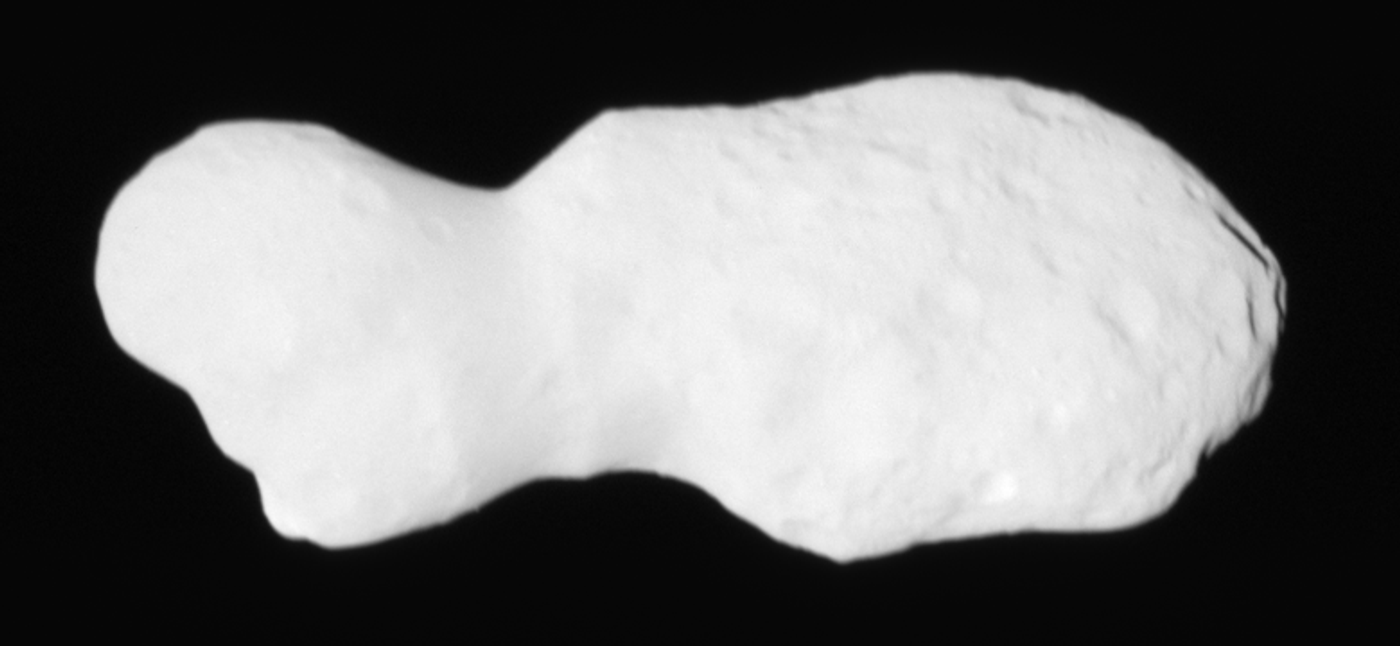
The L' instrument recorded high-resolution black-and-white images. They reveal two prominent lobes, a neck, craters and ridges. In some frames the asteroid overfilled the camera's field of view, so an image taken several minutes before closest approach is especially useful for seeing the whole body. Images from different viewpoints help researchers reconstruct a three-dimensional shape. Areas that were not seen clearly remain less certain, and scientific visualisations can mark where the model has weaker support from the observations.
What can changes in brightness tell us?
Before Lucy arrived, astronomers observed Donaldjohanson with telescopes on Earth. Its brightness rose and fell in a repeated pattern. When the long side of an irregular body faces us, it may reflect more sunlight than when we see a narrow side. A record of brightness over time is a . Its repeating peaks and valleys suggested that the asteroid was elongated and rotated slowly. A period of about 10.5 Earth days was an important clue.
A is not a photograph, however. Brightness also depends on surface roughness, lighter and darker patches, and the angle at which sunlight falls. Different shapes can sometimes create similar curves. Close-up images therefore tested a conclusion drawn from afar: Donaldjohanson really has two lobes connected by a narrow bridge. The images, earlier observations and a shape model together made a more detailed analysis of the motion possible.
Rotation that behaves like a wobbling top
A simple picture of asteroid rotation is a top turning about one axis that stays fixed relative to its body. Donaldjohanson behaves differently. According to the analysis, it turns end over end roughly once every 10.5 days and wobbles around its long axis in a cycle of about 26.5 days. This is called non-principal-axis rotation, or tumbling. The two numbers describe components of a complex motion, not two hidden motors inside the asteroid.
A short flyby video does not show the asteroid completing a full turn in seconds; its rotation takes days. Much of the apparent change in a rapid image sequence comes from the spacecraft racing past it. The conclusion about tumbling combines observations taken over longer periods, spacecraft images and computer modelling. That distinction matters when viewing a scientific animation. It helps us understand measurements, but it is not itself a camera film recorded over 26 days.
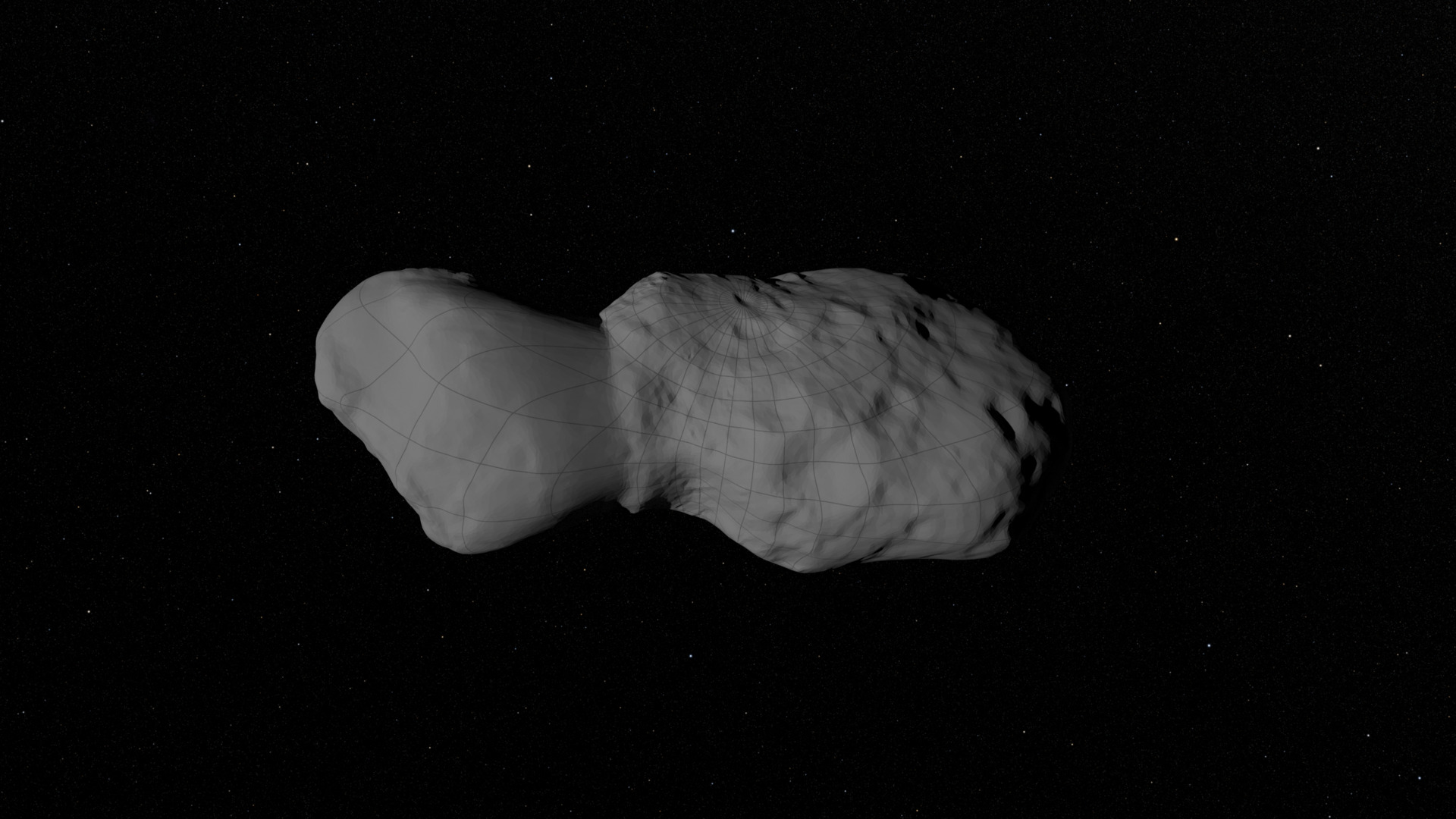
Kel Elkins/NASA Scientific Visualization Studio/DLR · Sources ↗ · Image terms ↗
Where did the peanut shape come from?
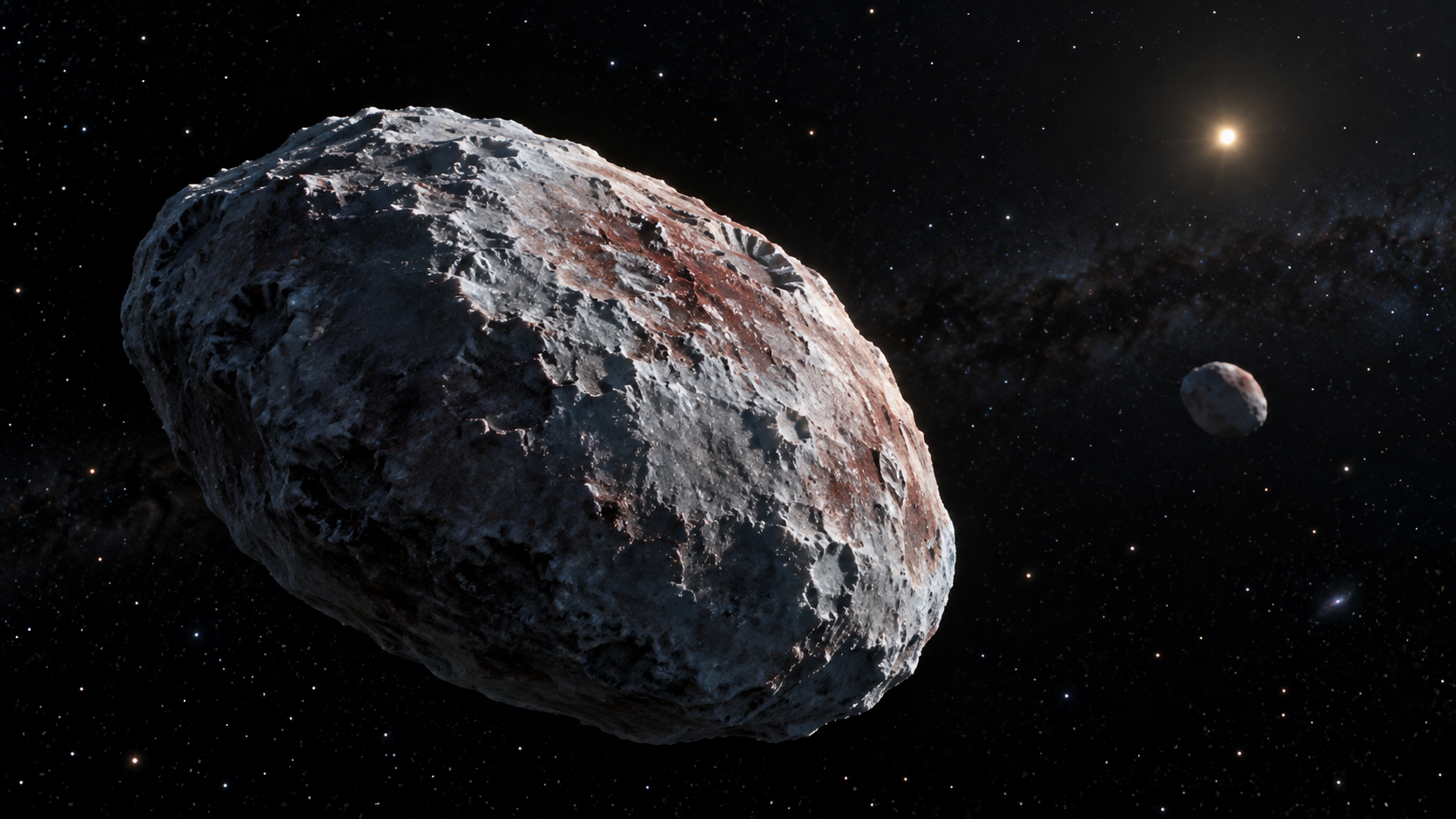
The team thinks two fragments drew together after a collision broke apart a larger asteroid, then gently joined under their mutual gravity. Such a two-lobed object is often called a . An estimated collision in this asteroid family around 155 million years ago does not mean that all its rock is only that old. The material can date back much further into Solar System history. We must distinguish the age of today's shape from the age of its ingredients.
Researchers estimate that Donaldjohanson may once have rotated at least ten times faster. As it slowed, the balance changed between the outward tendency felt by loose material on a rotating surface and the asteroid's weak gravity. Dust and small rocks could have moved down slopes and softened the outlines of some craters. This interpretation is based on models of shape and motion. Lucy did not directly watch a landslide during the flyby.
Can sunlight really alter a spin?
Sunlight does not strike every part of an irregular asteroid at the same angle. Warmed rock later returns energy to space as infrared radiation. Radiation carries momentum, so the surface experiences an extremely small recoil. On a perfectly regular sphere many such pushes would cancel. On an uneven body they can add up to a torque that changes the rotation over millions of years. This mechanism is called the , after the scientists who investigated it.
can either speed an asteroid up or slow it down, depending on its shape, orientation and distribution of heat. The paper's authors think it probably helped slow Donaldjohanson substantially over approximately the last 20 to 60 million years. That is not a measurement of a tiny force during a few hours of flyby. It is an inference connecting today's rotation with a model of long-term evolution. Collisions can also change spin, so researchers compare several possible events in the body's history.
Minerals that point to ancient water
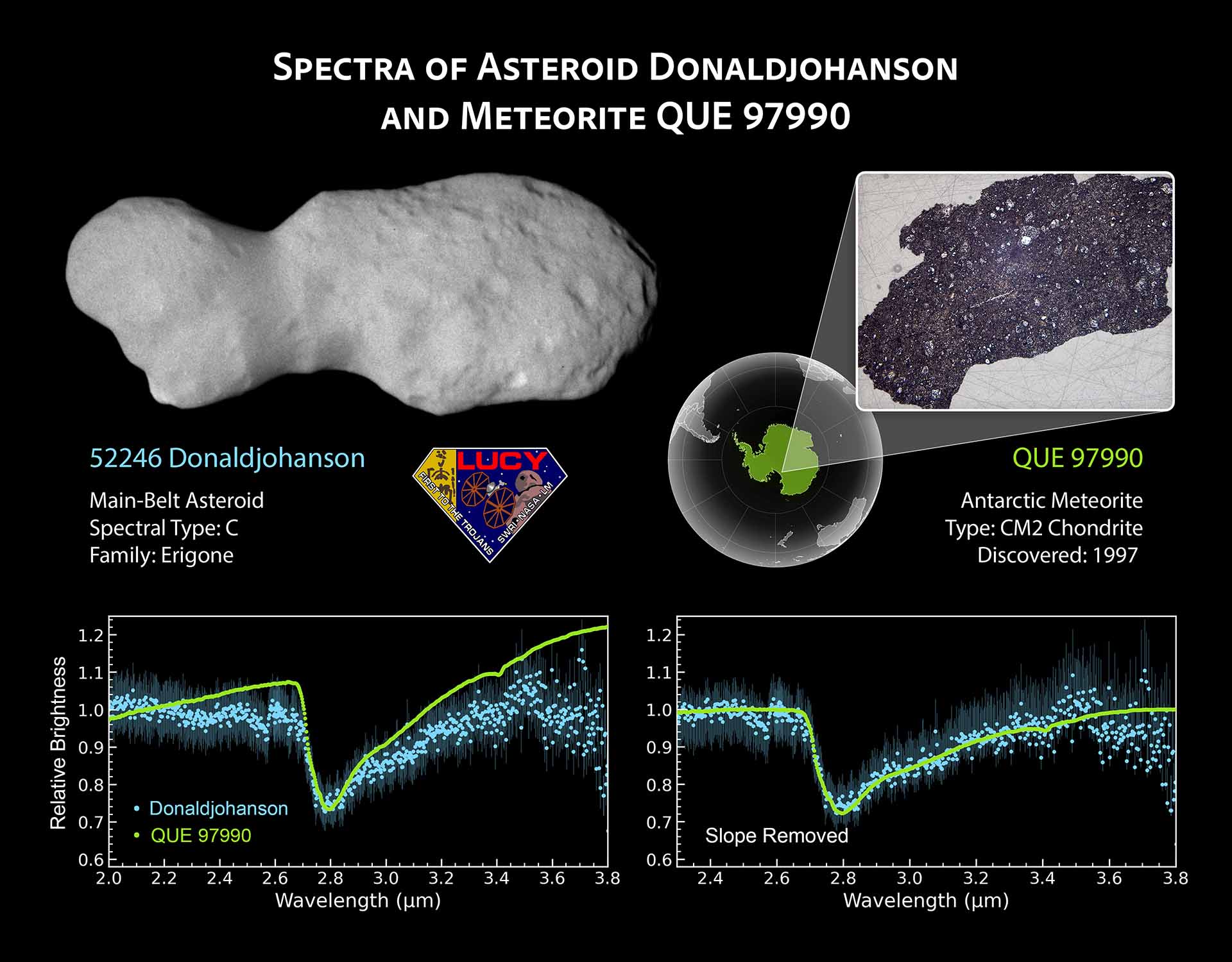
Lucy's infrared spectrometer detected the signatures of iron-rich clays. Such clay minerals form when water chemically alters original material. This does not mean liquid water flows across the small asteroid today, or that Lucy watched ice melting. More likely, water acted inside a larger parent body in the distant past and some altered fragments survived a later collision. A spectrum reveals something about the surface's composition; the time and circumstances of formation require comparisons with laboratory samples and other asteroids.
According to the team's interpretation, exposure to water was relatively brief. During more prolonged alteration, iron in some clays may give way to other elements, including magnesium. Bennu and Ryugu show signs of more magnesium-rich clays, consistent with longer-lasting water in their larger parent bodies. This is a clue to a material's history, not a simple clock that states precisely how many years water was present.
NASA/Goddard/SwRI/Dan Gallagher · Sources ↗ · Image terms ↗
Why compare Donaldjohanson with Bennu and Ryugu?
Like Donaldjohanson, Bennu and Ryugu are dark objects built from fragments of larger carbon-rich asteroids. Their paths and histories differ, however. Donaldjohanson has remained in the main belt, while Bennu and Ryugu moved into orbits nearer Earth's; that made them possible targets for missions that returned samples. 's account estimates about 155 million years for Donaldjohanson as a separate body, compared with roughly one to two billion years for Bennu and Ryugu.
Their rotation rates differ as well. Bennu turns in about four hours and Ryugu in about seven, whereas Donaldjohanson's complex cycles take days. Comparison is not a way to declare any one asteroid “typical”. Differences help researchers separate the effects of collisions, long-term solar heating, changing orbits and ancient contact with water. Lucy's future encounters with the Trojans will add very different examples, allowing present ideas to be tested against a broader collection of small worlds.
Key terms
— measured brightness plotted through time; — a body made of two joined lobes; — slow change of an asteroid's rotation caused by uneven sunlight reflection and thermal emission; — light separated by wavelength, carrying clues to surface composition.