Two types of similarity that should not be confused
Homo sapiens and Neanderthals descended from an older common population. That's why many of their genes were similar even before they met again. When scientists say that modern humans carry Neanderthal ancestry in part of their genome, they mean more specific clues: sequences of variants that, in some present-day humans, resemble sequences from Neanderthal fossils more closely than would be expected based on a long-ago common ancestor alone. This process of transferring variants between populations is called .
A genome is a complete set of hereditary information, and a is a group of closely related variants that are often inherited together. That is why the expressions "2% Neanderthal " and "2% genes" are not the same. It does not mean that one in fifty of our traits is Neanderthal, nor that the rest of the genome is "clean" of shared evolutionary history. The percentage refers to the part of the sequence whose more recent origin is attributed to admixture with Neanderthals.
How was the evidence found in the old bones?
The in the fossil breaks down into short pieces. Genomes of bacteria from the soil are mixed into it, and during excavation and work in the laboratory, the sample can be contaminated with modern human . Svante Pääbo's team developed methods for working with : clean rooms, control samples, recognition of damage characteristic of ancient molecules and comparison of large numbers of fragments with reference genomes. Material from Neanderthal bones found in, among other places, Vindija Cave in Croatia was key to the first draft of the Neanderthal genome published in 2010.
The comparison showed that people whose ancestors lived mainly outside of Africa carry, on average, about 1–2% Neanderthal sequences in their genome; the estimate depends on the population and the method. This finding was strong evidence that the ancestors of some modern humans and Neanderthals interbred. Peb has been awarded the 2022 Nobel Prize in Physiology or Medicine for his discoveries about the genomes of extinct human relatives and human evolution.
It is important to avoid a simplistic "Europeans have, Africans have not" map. The biggest legacy signal from that episode is found in populations whose ancestors left Africa, but the migrations lasted for tens of thousands of years and some people returned to Africa. Due to mixing between later populations, Neanderthal sequences can also be detected in some people with African ancestry. Genetic ancestry does not line up neatly with present-day states, languages, or social categories.
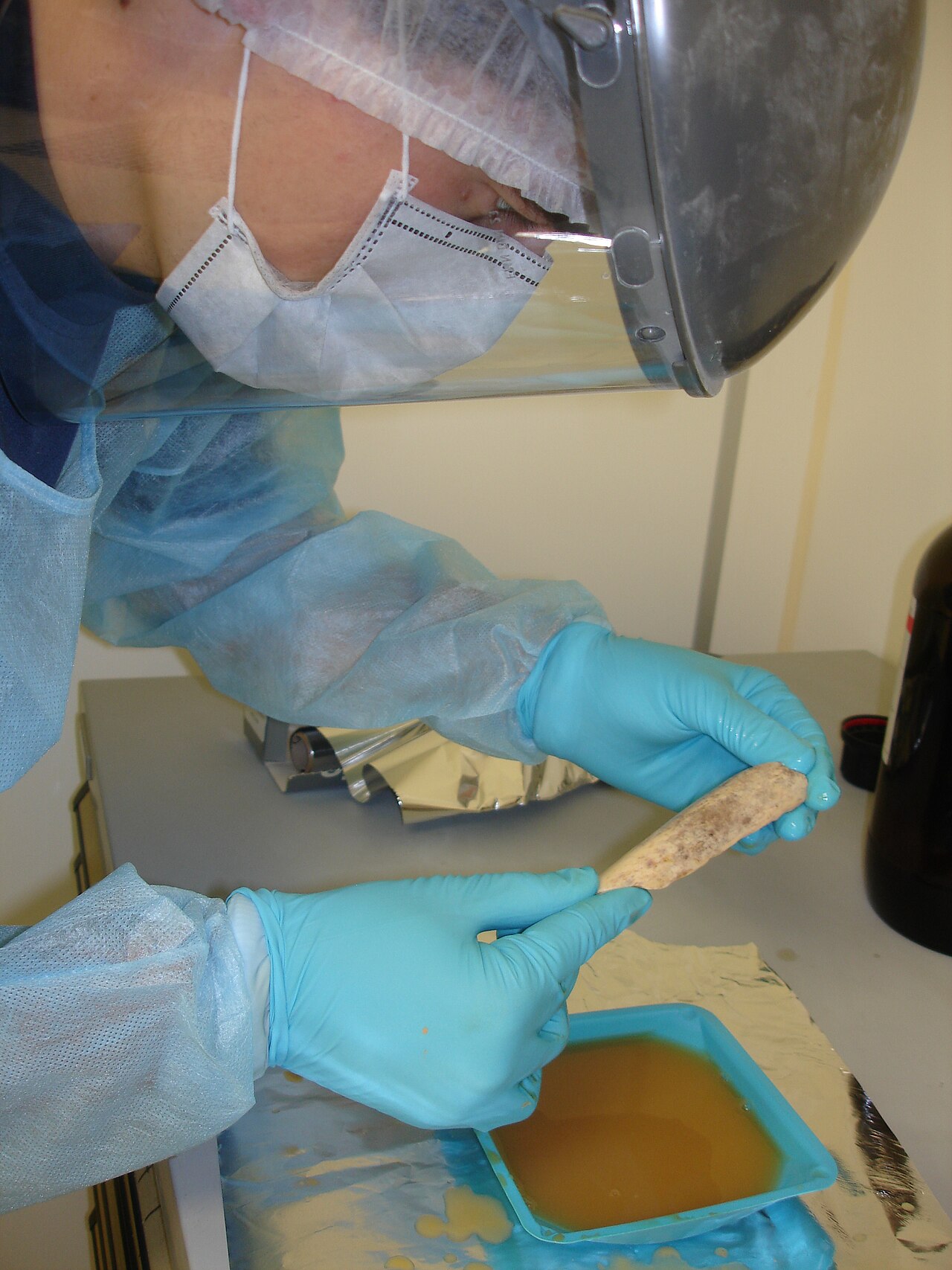
Max Planck Institute for Evolutionary Anthropology / NHGRI · Sources ↗ · Image terms ↗
When did they meet?
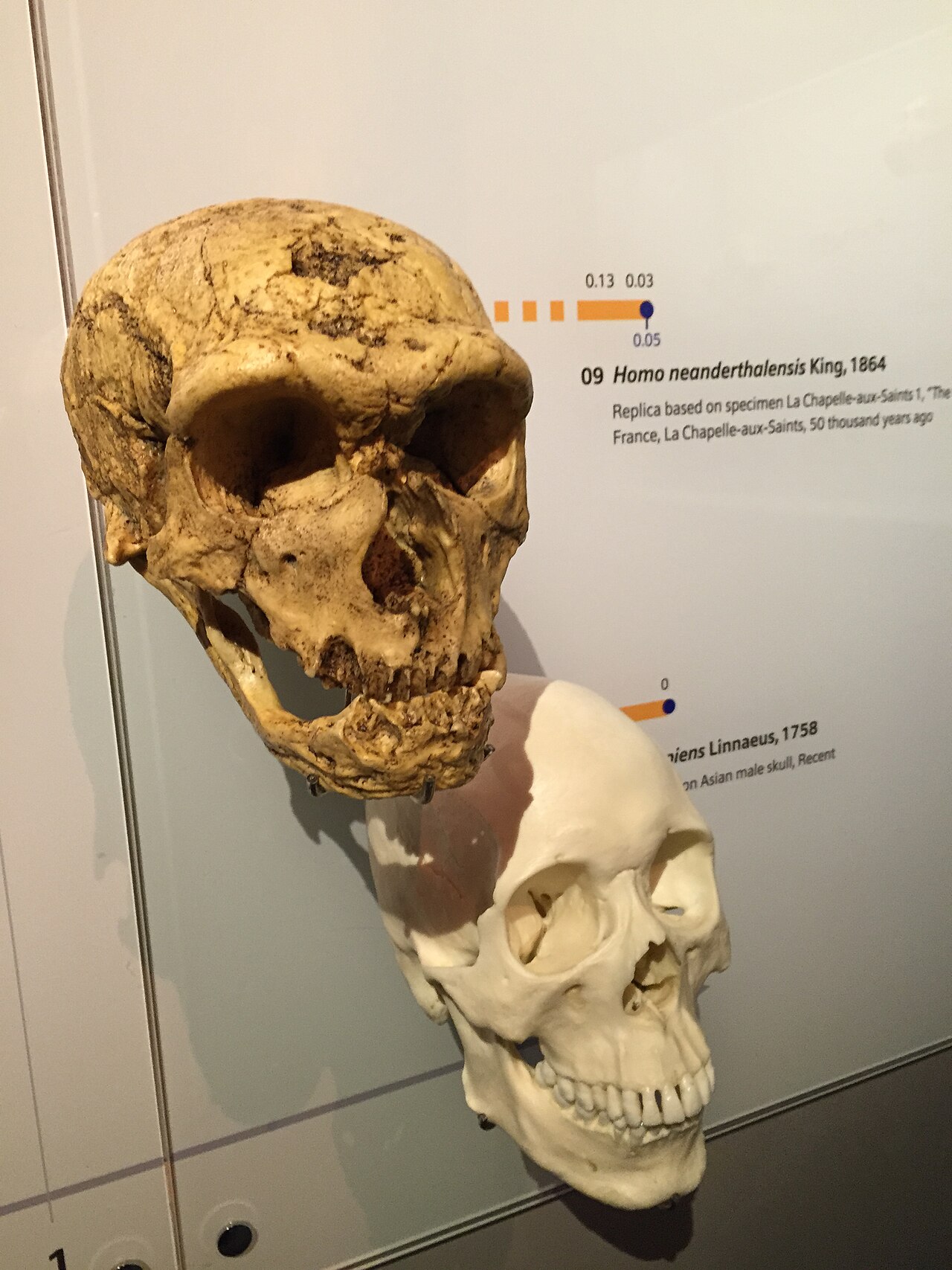
Neanderthals lived in Europe and Western Asia for a long time, while Homo sapiens populations spread from Africa. There were not just two individuals in one encounter. Data from ancient and modern genomes point to a more complex history, with admixture and subsequent natural selection. An analysis of the genomes of about 45,000-year-old humans from Ranis, Germany, and Golden Horse, Czech Republic, published online in December 2024 and in the 2025 issue of the journal Nature, dated an important admixture event shared by today's non-African genomes to approximately 45,000–49,000 years before present. Other research points to a period of mixing rather than a single magical date. We do not know the exact geographical point of all encounters.
After so many generations, the inherited pieces of become shorter and shorter as the chromosomes recombine during the formation of sex cells. Scientists use the average length of those fragments as one way to estimate when mixing occurred. From your results today, they can't point to a single Neanderthal ancestor by name. They can assess the history of populations and determine areas of the genome where such sequences are more or less common.
Do these variants change us?
Some Neanderthal variants are located near genes associated with skin, hair and immune system function. During expansion into new environments certain variants may have helped populations respond to local pathogens or climatic conditions. Others could be harmful or neutral. For example, the researchers recognized the Neanderthal origin of one set of variants on chromosome 3 associated with a higher risk of severe covid-19 in the studied populations, as well as another set in the OAS gene region on chromosome 12 associated with a lower risk. These are not "covid genes" in the simple sense: the outcome of the disease depends on many factors, and the alone does not prove the same biological mechanism in every person.
Part of the Neanderthal sequences disappeared from our ancestors over time. Of particular interest are large parts of the genome where Neanderthal ancestry is very rare or absent, sometimes called Neanderthal "deserts." A possible explanation is that some combinations were unfavorable and selection gradually removed them, but each such region requires a separate examination. Different people today carry different pieces of Neanderthal heritage; therefore collectively, across many people, we can find significantly more Neanderthal sequence than in a single genome.
The most important lesson is not the percentage on a commercial genetic test. shows us that human history is a web of encounters, separations and reunions. Neanderthals as a separate population disappeared, but part of their genetic variants remained in the descendants of the people they lived with. Knowledge of common ancestry tells us a lot about evolution and very little about the worth, ability, or identity of any person today.

Duncan.Hull / The Royal Society · Sources ↗ · Image terms ↗