


More actions do not necessarily mean more streams of thought
The brain performs many processes simultaneously: it regulates breathing, processes sounds and maintains posture. It is therefore too sweeping to claim that people can never do two things at once. Problems arise when two activities require the same limited resources, particularly for selecting responses, maintaining a goal or processing complex meaning. Conversation and solving an unfamiliar mathematics problem may consequently compete much more strongly than listening to gentle music while organising familiar objects.
Imagine a student writing an explanation of a chemistry experiment. A message about her training schedule arrives on her phone. She reads it, checks her calendar and returns to the experiment. Her hands have been busy almost the entire time, but her goal has changed several times. This is : deciding what to do now and subsequently re-establishing the rules and context of the previous task.

stereogab · Sources ↗ · Image terms ↗
How researchers measure switching costs
In a laboratory, participants can be asked to alternate between classifying shapes and solving simple arithmetic problems. Researchers compare reaction times when the same type of task repeats and when the rule has to change. The difference is called a . Accuracy matters too: a faster response with many more errors is not necessarily a better result.
In their 2001 paper, Joshua Rubinstein, David Meyer and Jeffrey Evans examined task changes and the roles of complexity and familiarity. They interpreted the results using processes of goal shifting and rule activation. Switching took time, particularly when the new set of rules was more demanding. This is evidence about particular experimental conditions, not a formula according to which every use of a phone reduces productivity by the same percentage. The frequently quoted figure of 40 percent should not become a universal measure for all people and all jobs.
Why returning does not simply mean picking up where we stopped
When writing or solving a problem, we hold several relevant pieces of information in : what we are trying to prove, which step we last completed and what to check next. A new activity can displace some of that content. Returning may therefore require rereading the previous paragraph or checking a calculation. This extra time in everyday work is different from the few tenths of a second measured in a simple laboratory task.
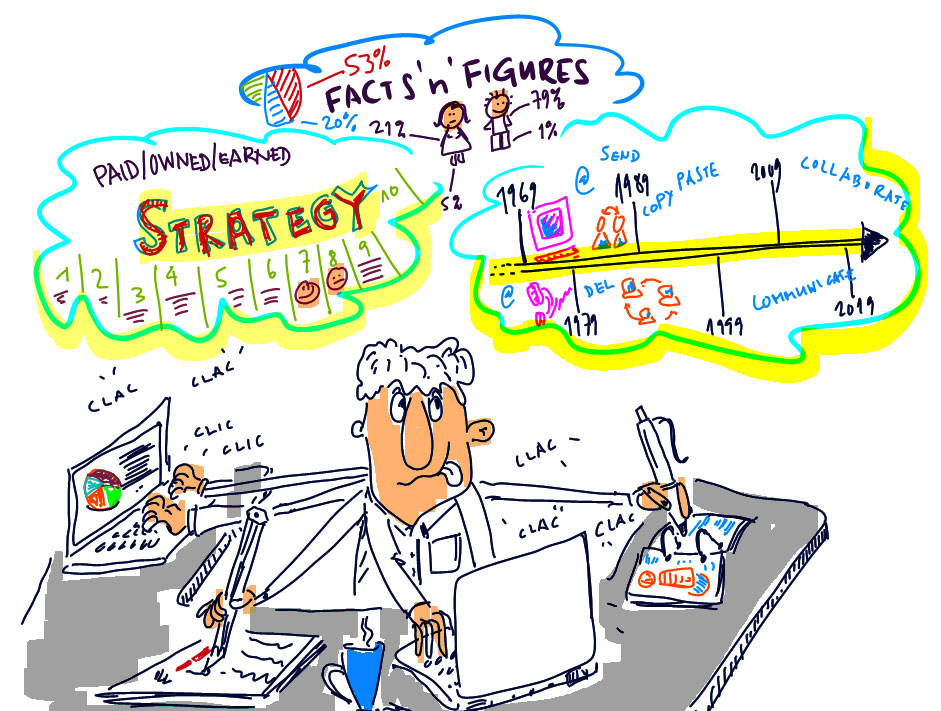
It helps to distinguish a useful interruption from one that interrupts the most demanding step. If we do not understand a term, opening its explanation contributes to the same goal. Switching to a group-chat argument halfway through a proof changes both the goal and the response rules. The number of open windows is therefore not an adequate measure of in itself. What matters is what we do between them and how often we change our mental context.
Urs Steiner · Sources ↗ · Image terms ↗
What a study of 80 young adults actually showed
In 2020 Kevin Madore and colleagues published a study of eighty young adults in Nature. During a memory task they monitored brain electrical activity with and changes in pupil size. Attention lapses just before attempted retrieval were associated with poorer recognition of previously seen images. More self-reported media was also associated with more frequent attention lapses and weaker memory performance.
This association is a . Participants were not randomly assigned to use many or few media for years, so the result does not prove that caused permanent damage to their memory. Existing differences in attention may contribute to habits, habits may influence attention, or additional factors may be involved. The sample’s age also does not justify automatically assigning the same result to all primary and secondary students. Science News Explores presents the topic to young readers, but our account must preserve the distinction between an interesting finding and a demonstrated cause.
Does combining media improve information filtering?
An earlier study by Eyal Ophir, Clifford Nass and Anthony Wagner, published in in 2009, compared people who combined media more and less often. In the tasks examined, heavier media was associated with greater sensitivity to irrelevant information. The finding did not support the simple assumption that everyday screen juggling automatically trains superior attention control. Here too, comparing existing groups is not an experiment proving how the habit developed or what will happen to every individual.
Language matters: a lower average score in one group does not mean every member has poorer attention. Averages can conceal large individual differences. A questionnaire about media habits also depends on participants’ estimates and recollection. A serious article about is therefore especially interesting when it explains how the research was conducted, rather than declaring devices a single cause of every learning difficulty.
A small demonstration you can repeat
Prepare two comparable sets of familiar tasks. Complete one in an uninterrupted block and the other with predetermined short breaks devoted to a completely different activity. Record total time and errors, then reverse the order on your next attempt. The sets must not differ so much in difficulty that this alone explains the result. Practice and fatigue can also change the outcome.
This is a demonstration for thinking about your own work, not a diagnostic attention test. One practical attempt is to protect a block of time for the most demanding study while checking messages between blocks. Before an interruption, write down the next specific step, such as checking the sign in the third line. On returning, you then need not reconstruct the whole plan. The aim is to see when changing activities helps and when it merely increases the time needed for the same result.