

What is infrasound?
Sound is a change in pressure travelling through a medium. tells us how many times a wave oscillates each second and is measured in hertz (Hz). refers to below about 20 Hz, the conventional lower limit of human hearing. That limit is not an absolute wall: whether a person hears or senses a sound also depends on its level, surrounding noise and individual sensitivity. “Below 20 Hz” therefore does not mean “impossible to perceive under any conditions.”
Volcanic and tectonic activity, storms, and moving masses of air or water can generate . Some engines, ventilation systems, traffic and other equipment can generate it too. Scientists measure these waves precisely because they carry information about events that hearing alone cannot reliably track. The existence of a low- source does not by itself show harm. The level, duration and conditions of exposure also matter.
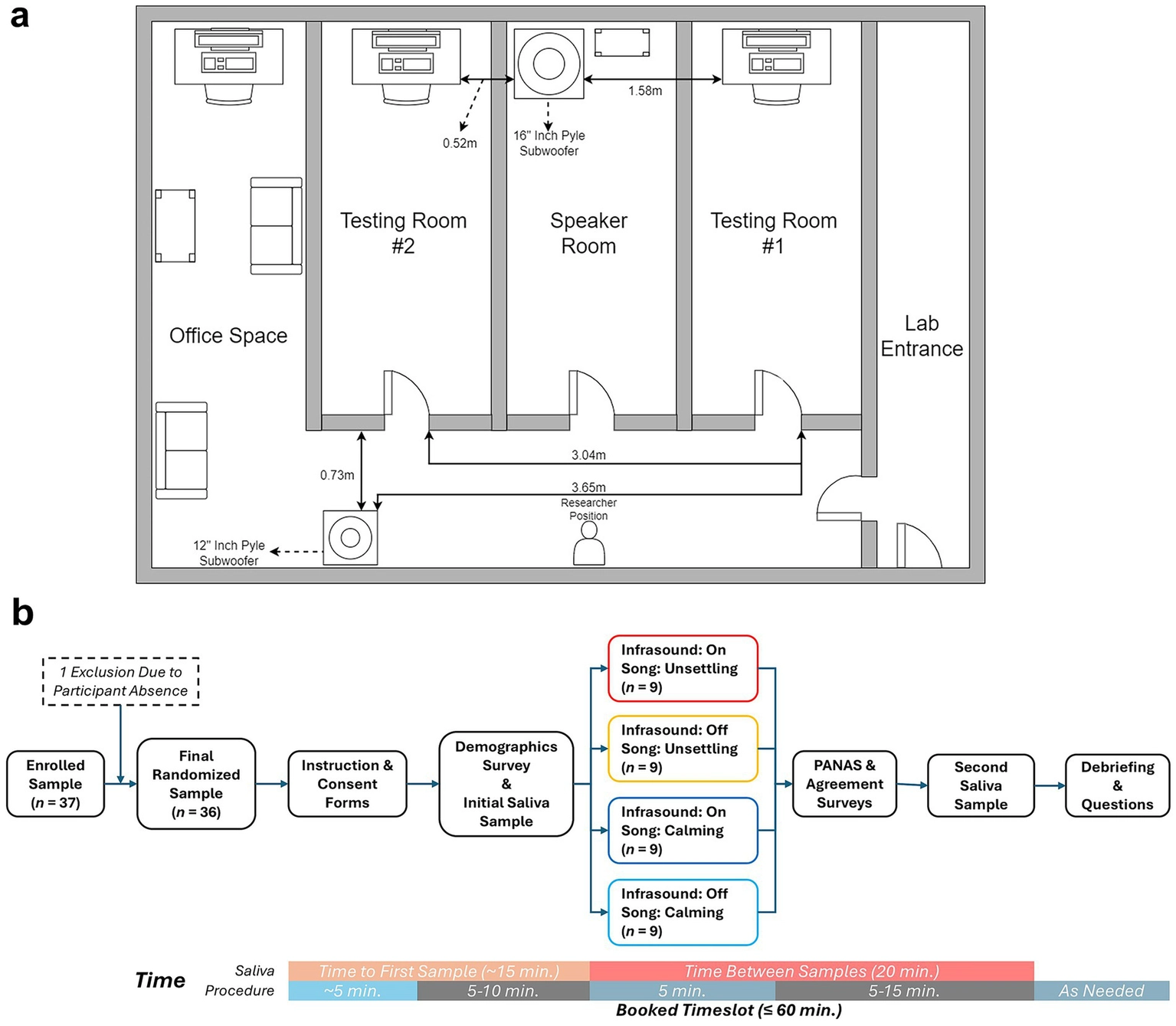
Low have long wavelengths. At 18 Hz, one cycle takes about 0.056 seconds and the wavelength in air is roughly 19 metres. A room's dimensions, its walls and a person's location can therefore affect the level measured at a particular place. The researchers could not rely solely on the loudspeakers' settings; they checked the signal with instruments where the participants were actually seated.
How did the experiment work?
Researchers at Canada's MacEwan University recruited 36 students and randomly assigned them to four groups. Everyone listened to a short piece of music, either calming or unsettling. In half the conditions, an approximately 18 Hz source was also switched on; in the other half, it was off. This design let the team compare both the type of music and the presence of the low- wave, instead of attributing every difference to an eerie melody.
Two subwoofers outside the participants' view produced the . The researchers measured a level of about 75–78 dB at that in the test rooms. Music and exposure lasted about five minutes. Participants immediately rated the music and their feelings. They also provided saliva immediately before exposure and about 20 minutes after it began. The team measured in those samples, a hormone involved in the body's response to many demands and challenges.
A decibel figure can mislead if read without context. A level measured at 18 Hz cannot simply be translated into the perceived loudness of conversation or ordinary music: human hearing is not equally sensitive at every . The instrument and measurement procedure matter as well. Here, the number describes a specific, controlled experimental signal. It is not a universal threshold above which becomes “dangerous.”
Scatterty i saradnici / Frontiers in Behavioral Neuroscience · Sources ↗ · Image terms ↗
What did the participants report?
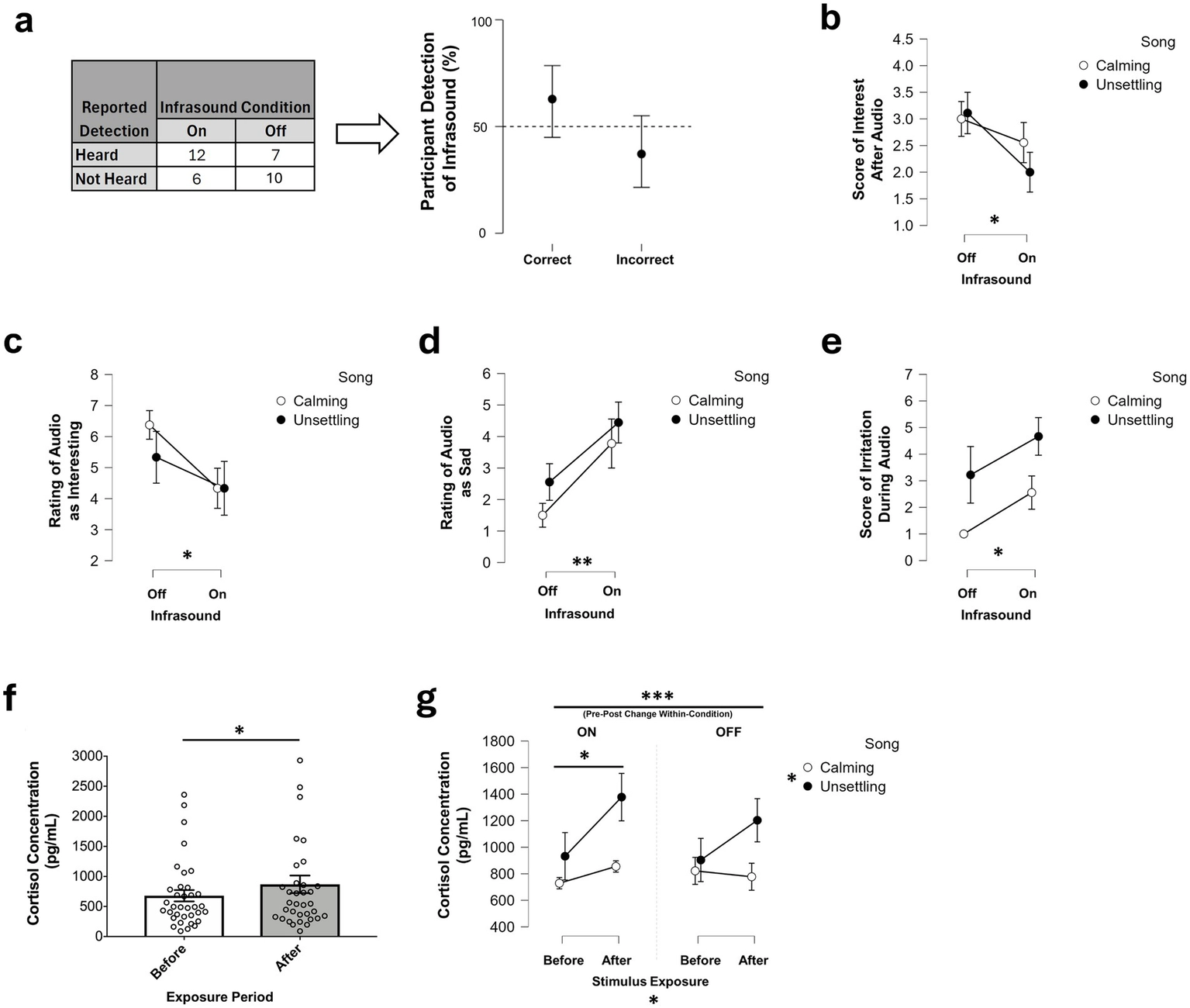
On average, those exposed to rated the music as sadder and less interesting. They also reported more irritability and less interest. These differences appeared with both the calming and the unsettling musical excerpts. Participants could not reliably tell whether the source was on. Their answers were no better than would be expected from chance guessing.
The researchers also recorded higher salivary in the condition. That is a measurable physiological difference, but is not a simple “fear meter.” It varies through the day and responds to several factors. The cautious conclusion is that, under these particular laboratory conditions, exposure was linked with less favourable ratings and a change in one marker of the stress response.
Comparing saliva before and after exposure is useful because each person's starting level is taken into account. Nevertheless, with only nine participants per group, individual differences can have a substantial effect on group averages. A statistically significant difference is a finding worth investigating, but it does not by itself establish how large an effect would be in daily life. That requires replication and careful comparisons with actual exposure outside the laboratory.
Crucially, the researchers did not find a convincing rise in reported fear or anxiety. Irritation, discomfort and fear are different psychological experiences. This is where the appealing headline about a “spooky sound” needs a clear boundary. A reliable account must say what was measured, what was found and what was not found.
Scatterty i saradnici / Frontiers in Behavioral Neuroscience · Sources ↗ · Image terms ↗
How could an unheard wave have an effect?
One possibility is that very low vibrations influence parts of our balance system or other bodily signals, even if we do not experience them as ordinary sound. The inner ear includes otolith organs that help us sense the position and movement of the head. This mechanism has been proposed as a hypothesis, partly from earlier animal work. The new study did not measure activity in those organs, so it cannot show that they caused the mood differences in its participants.
Different bodily or acoustic cues that the experiment did not fully separate are another possibility. The researchers tried to remove easily audible and visible clues about whether the subwoofers were operating. Even so, one small experiment cannot rule out every alternative explanation. That is why scientists repeat a study with new participants, equipment, and outcomes.
How far can we extend the conclusion?
The sample was small: nine people in each of four groups, mostly young university students. One saliva sample could not be analysed, leaving 35 people for the assessment. Only one approximate , one level range and a short exposure were tested. The study did not examine children, older adults, many everyday buildings or long-term living near a machine. It provides no basis for declaring every ventilation system or low vibration a cause of poor mood.
It is especially important to distinguish a laboratory effect from an explanation of ghost stories. Dim lighting, temperature, expectations, unfamiliar noises and stories we have heard can all contribute to unease in an old house. Even if later work found that can add to such a feeling, it would not make it the only cause. This experiment did not test supposedly haunted buildings and did not show that causes hallucinations.
Why is the study still useful?
It turns a tempting idea into a testable question. The team specified a , controlled whether the signal was present, compared groups and measured both subjective responses and a biological marker. Larger and more varied samples, several and levels, and replication in ordinary environments are sensible next steps. That is how science moves from an interesting signal toward a better understanding of how dependable a finding is and where its limits lie.
Key terms
— sound below roughly 20 Hz. — oscillations per second. — a hormone involved in responses to challenges. — the comparison group that did not receive the tested signal.