

Memory is not a recording
Imagine watching a traffic collision for a few seconds. You can later describe it, but your brain has not stored every frame like a camera. Attention selects only some of the available information while you watch. When you remember the incident, you connect those traces with your knowledge, expectations and anything you have heard in the meantime. An honest, coherent account can therefore differ from the event itself.
In a well-known series of experiments, Elizabeth Loftus and John Palmer showed volunteers films of car collisions. They varied a word in the question about how fast the vehicles were travelling. People given a more forceful verb, such as “smashed,” estimated higher speeds than those given gentler wording. In a later part of the research they were also more likely to report broken glass, although there was none in the film. The participants were not necessarily lying; the question asked after the event influenced what they subsequently reported as memory.
Psychologists call this the . It can be difficult to distinguish what we actually saw from what someone told us, what we read in a news story, or what we imagined while recounting the incident. This is a problem of : where did a particular piece of information come from? In ordinary life, the mistake may be trivial. In an investigation, the difference between “I saw it” and “I heard about it” can change somebody's life.
The experiments do not show that every detail we remember is false. They show that answers about particular details can shift when later information changes. A person might correctly remember two cars colliding but wrongly believe they saw glass on the road. That combination of a reliable core and a mistaken detail is a reason to examine a memory carefully, rather than accepting or dismissing an entire account at once.
An error can begin before remembering
A memory cannot be more precise than the perception on which it is based. A face seen from far away, in poor light or for a moment leaves fewer dependable clues. Stress, an obstructed view and attention drawn to another object can make the task harder still. Research also finds that, on average, people have more difficulty identifying faces from groups with which they have less experience. These are population-level patterns, not a verdict on any individual witness.
That is why investigators should record the viewing conditions early: how long the encounter lasted, the distance, the lighting and the witness's first description in their own words. A richer story told months later cannot improve the original view. It also matters whether a description was given before or after the witness saw photographs.
An open question such as “What happened next?” lets a witness supply what they recall. “Did the man in the red jacket have a knife?” already offers two details that may not have been part of the first observation. Recording the witness's first words without filling in the gaps preserves a trace of what they knew before another version of the story reached them.
How an identification procedure can change a memory
Suppose police first show a witness one person and, days later, a set of photographs containing that same face. It may now feel familiar because the witness saw the first photograph, not because they saw the person at the crime scene. This is a error: familiarity has been attributed to the wrong event. If an officer then says “you picked the right person,” initial uncertainty may grow into confidence that the witness genuinely feels in court.
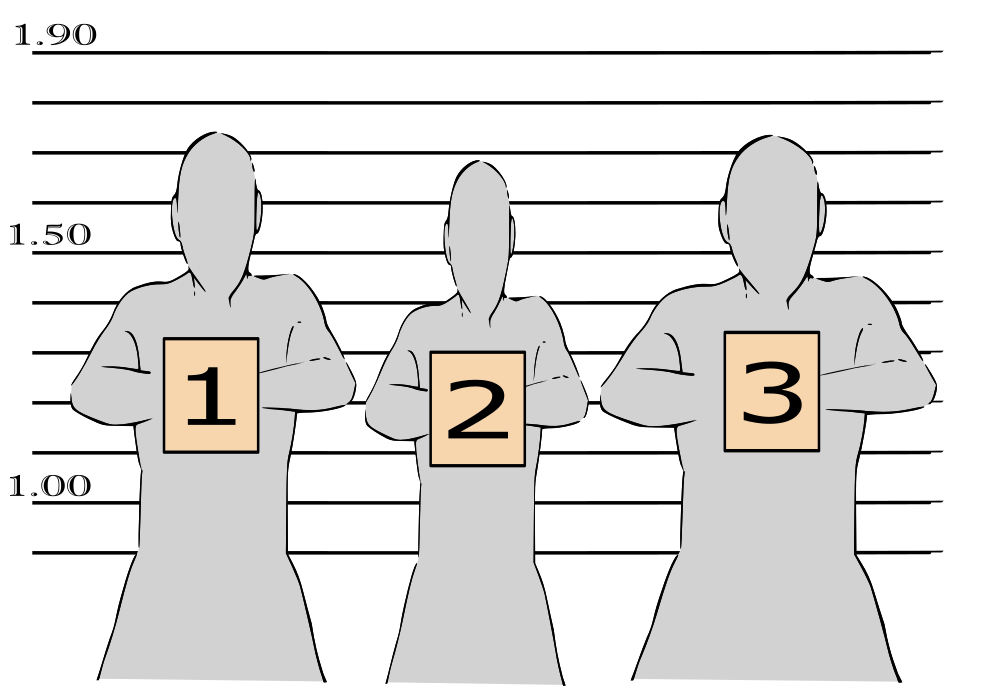
For that reason, evidence-based recommendations call for a fair lineup. People included as fillers should fit the witness's original description, so that one person does not obviously stand out. The witness should be told that the perpetrator may not be present at all. Ideally, the officer conducting the procedure should not know who the suspect is. This double-blind arrangement reduces the chance that a glance, tone of voice or other unintended signal will guide the answer.
The first identification should be preserved as faithfully as possible: whom the witness selected, when, and exactly how they expressed confidence in their own words. A decision that “none of these people is the person” also matters. Repeating identification tests or giving feedback changes the conditions under which later confidence can be interpreted.
A fair lineup does not require everybody to look identical. The point is that the description given before the procedure must not single out only the suspect. If the witness said “a young person with short hair,” for example, showing one short-haired young man among much older people would make the choice ambiguous. It might reflect the design of the lineup rather than recognition from the original event.
Chatsam / Wikimedia Commons · Sources ↗ · Image terms ↗
Can confidence still be informative?
It depends on when it was measured. Confidence recorded during the first identification, immediately after a fair procedure, can contain information about the likelihood of accuracy. Research does not support a simple rule that every confident statement is correct. Its value falls if the initial decision was preceded by a suggestive display, a prior encounter with the suspect, feedback or repeated tests.
Compare two statements: “The witness is completely certain in court” and “The witness was completely certain at the first unbiased identification.” The second is much more useful, but it does not decide a case by itself. Identification should be considered alongside independent evidence. A court needs to know how the testimony developed, rather than hearing only its polished final version.
What is happening in the brain?
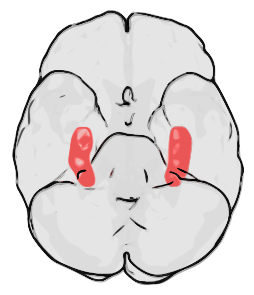
Memory formation and retrieval involve a network of brain regions. The hippocampus is particularly important for connecting aspects of an event, such as place, time and what we saw. But there is no single vault holding a finished video. When we remember, parts of an experience are reactivated and assembled. Later knowledge may influence that process. This does not mean that every memory necessarily changes each time it is recalled.
Washington irving / Wikimedia Commons · Sources ↗ · Image terms ↗
What should we take away?
Eyewitness testimony is neither infallible nor worthless. Its value depends on the quality of the initial observation and on how well the procedure protected the memory from later influences. The best question is not simply “Does this person sound convincing?” It is “What could they actually see, what did they say at first, and how was the first identification conducted?” Science helps investigators collect and assess this evidence more fairly without blaming witnesses for the way human memory works.
Key terms
— later information influencing reported memory. — judging whether a detail came from observation or another source. — the officer administering a lineup does not know who the suspect is.