

Bias is not the same as a deliberate lie
is a tendency to seek or interpret information in favour of an existing belief or assumption. It can begin before reading, when a search question already assumes the desired answer. It can also arise while evaluating evidence: a familiar explanation receives little scrutiny while we demand much stricter proof for its opposite. Raymond Nickerson’s 1998 review shows that the term covers several related patterns rather than one identical mistake in every situation.
Imagine a claim that a particular study technique always produces a better grade. Remembering only successful students who used it overlooks those who failed and those who succeeded another way. There need be no intention to mislead anyone. Collecting examples one-sidedly is enough. A speaker’s sincerity and confidence therefore cannot replace a procedure that includes inconvenient data too.
Three numbers concealing a broader rule
In 1960 Peter Wason gave participants the sequence 2, 4, 6 and asked them to discover the rule. They could propose new triples and receive feedback about whether these fitted. It is easy to assume the rule concerns even numbers increasing by two. Triples such as 4, 6, 8 and 8, 10, 12 then pass, but they do not distinguish this narrow idea from a much broader rule: the numbers increase.
The triple 1, 3, 9 would help distinguish these assumptions. If accepted, it shows that neither evenness nor a step of two is necessary. The purpose is not deliberately to choose a wrong answer but to offer an example for which competing ideas make different predictions. In Wason’s small original sample, only six of 29 participants reached the correct conclusion without a previous wrong conclusion. This is the outcome of a specifically designed task, not an estimate of how irrational all people are.
Four cards and a clue that could disprove the rule
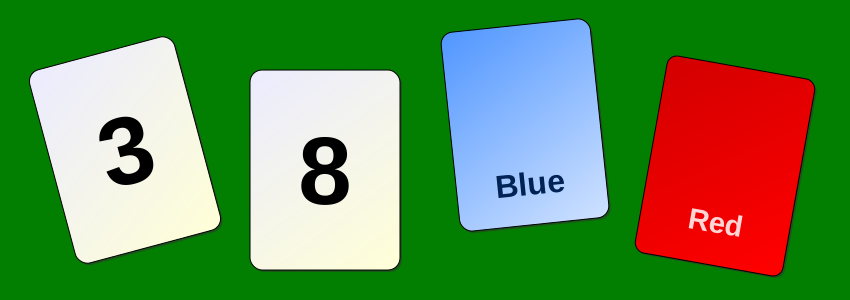
Another famous Wason task uses cards with a number on one side and a colour on the other. The illustration shows 3, 8, blue and red faces. Suppose the rule states that if a card has an even number on one side, its other side is blue. Which cards must be turned over to check for a possible violation? The 8, because a red reverse would violate the rule, and the red card, because an even number on its reverse would also violate it.
The blue card is unnecessary for this check: the rule does not say every blue side must have an even number. The 3 cannot violate the stated claim either, because its condition is not met. This example distinguishes looking for agreement from searching for a . Research on Wason tasks nevertheless shows that wording and context affect success. One mistake on an abstract card task is insufficient evidence that someone systematically ignores facts in every real decision.
User:Life of Riley User:Domdomegg · Sources ↗ · Image terms ↗
When a good first idea hides a better one
A related problem-solving obstacle is called the : an already familiar procedure can capture attention and make a better one harder to find. Merim Bilalić, Peter McLeod and Fernand Gobet studied chess problems containing both a familiar solution and a more efficient alternative. Eye tracking showed how the first idea can direct subsequent searches of the board. Knowledge is therefore a major resource, but the way it is activated can sometimes narrow what we consider.
Scientific American devoted an article to why a first idea can obscure a better one. and are not identical: the former particularly concerns attachment to a familiar solution method, while the latter also includes evaluating evidence about beliefs. Their shared lesson is that feeling we already have a solution can end scrutiny too soon. In a school task, ask whether an existing solution can be checked by another method rather than simply repeating the same calculation.
Why being objective is not a sufficient procedure
In 1984 Charles Lord, Mark Lepper and Elizabeth Preston investigated considering the opposite as a strategy. Instead of a general request for impartiality, participants received a more specific instruction to consider how the opposite judgement might be correct. In the situations studied this reduced certain biases. The result supports a testable procedure but does not promise that imagining the other side resolves every argument or removes every motive for defending a position.
A practical version asks what information would change your mind. If no answer is imaginable, perhaps you are defending an identity attached to a claim rather than testing it. A second question asks whether you would accept the same evidence if it supported the opposite side. A third asks whether all those websites independently checked the story or repeat the same press release. Ten repeated headlines can be a single clue displayed ten times.
Mohylek · Sources ↗
Scepticism does not give every position equal weight
Openness to contrary evidence does not oblige us to assign every claim the same probability. A good experiment with a clear procedure does not receive the same weight as an unverifiable anecdote merely because someone wants both sides. Many existing high-quality measurements change our starting judgement. Reasonable scepticism applies the same criteria to relevant claims rather than automatically trusting every source or automatically doubting everything.
We could make a table listing a claim, its predictions, supporting data and data it struggles to explain. An empty final column is not necessarily a victory: perhaps we have not searched enough. The table should also include the quality of the checks, sample size and possible alternative explanations. It does not guarantee impartiality but leaves a record of how we reasoned. Another reader can then check the steps instead of merely judging our confidence.
One habit for reading science news
Before sharing a story, separate its headline from its main claim and express the claim in one sentence. Then identify what was actually measured: behaviour, opinions, laboratory cells or a computer model’s output. Check whether the conclusion exceeds those measurements’ limits. If causation is discussed, look for how researchers separated possible explanations. If an expert is quoted, check whether the comment interprets data or introduces an assumption.
Finally, return to your starting judgement. It may be supported, weakened or left without enough information. Not knowing yet can be more precise than taking a side quickly. Critical thinking involves willingness to change our own procedure when it systematically selects comfortable evidence as well as finding other people’s mistakes. The best test of an idea is often an example that distinguishes it from a serious alternative rather than another example that fits.