
The Moon already has a name
When we say the Moon to mean Earth’s , we use the name of a particular celestial body. When we discuss Jupiter’s moons, the same word has a broader meaning: it refers to the natural companions of planets. Scientific writing often uses the term “”, which should be distinguished from artificial satellites built on Earth. The distinction between an individual object and a class of objects therefore exists even though the words look almost identical.
The , known by the abbreviation , uses the name Moon with a capital initial letter in English scientific usage. This does not mean every language must adopt the English word: in Serbian, Mesec is capitalized when it names this celestial body. Luna and Selene have important linguistic and cultural histories, but there is no need to use them to “repair” a supposedly incomplete name. The Moon has a name; it is so familiar that we often forget it is a name.
A calendar is hidden in the Serbian word
In Serbian, the same word names the celestial body and a division of the year. The sentences “Mesec se vidi iznad krova” — the Moon is visible above the roof — and “vratiću se za mesec dana” — I will return in a month — use two related meanings. Similar connections occur in other Slavic languages. The Slovenski etimološki slovar, published on the Fran dictionary portal, connects mesec with a Proto-Slavic form and lists related words, including Serbian mesec and Croatian mjesec. The connection did not arise by chance in modern speech.
studies the origins of words and changes in their forms and meanings. Here it leads us to much older linguistic stems associated with the Moon and the monthly period. A relationship between words does not mean one present-day people borrowed a word from another. Different languages may have inherited related words from a distant common language and then changed them in different ways over the centuries.
What do the English words moon and month reveal?
The English word moon comes from Old English mōna, while month names a unit of time. The Online Dictionary traces both names through older Germanic forms to a shared family of words for the Moon and the month. It also connects them with a root meaning “to measure”, in relation to using to keep track of time. The similarity between moon and month therefore has a historical explanation; it is more than a coincidence of sound.
The story needs to be told precisely. English moon did not simply arise by borrowing the Latin word for a month, and Serbian mesec did not derive from English moon. Latin mensis, meaning “month”, and the English forms have older linguistic connections. Reconstructions of the most ancient stems are conclusions linguists draw from comparing languages, rather than a surviving statement by someone who once decided what to call the Moon. We do not have a date for the first utterance of its name.
Why was the Moon a useful natural clock?
The Sun clearly separates day from night, but the Moon provides an additional, slower change that can be followed with the naked eye. A narrow crescent grows wider, then we see approximately half of the illuminated disk, followed by a full Moon; afterwards the illuminated portion decreases again. Approximately 29.5 days pass between one phase and its next recurrence. This cycle makes it possible to divide time into recognizable intervals longer than a day, even without a mechanical clock or printed calendar.
People did not need to understand what causes the phases before using their repetition. They could record the sequence of visible changes and compare it with events they wished to track. An astronomical explanation and a practical application did not have to emerge at the same time. The lunar cycle is not a perfect way to measure every individual day: clouds, position in the sky and the visibility of a thin crescent complicate observation. Nevertheless, its pattern provides much more information than a randomly changing light in the sky.
One Moon, two different “months”
In astronomy, it matters what we measure motion against. A , approximately 27.3 days, is the time the Moon takes to complete one around Earth relative to distant stars. A , approximately 29.5 days, measures the return of the same phase, for example from one new Moon to the next. The difference of a little more than two days is not an error in the data: it results from choosing a different reference.
While the Moon travels around Earth, Earth and the Moon together travel around the Sun. After one relative to the stars, the Sun’s position relative to the Earth–Moon system has already changed. The Moon must therefore continue moving before the arrangement that determines a phase repeats. distinguishes these periods for precisely this reason. When we ask how long a “lunar month” lasts, we first need to decide whether we mean the relative to the stars or the cycle of appearance observed from Earth.
Why does January not necessarily begin at new Moon?
Twelve cycles of approximately 29.53 days give about 354.4 days. A year that follows the return of the seasons lasts approximately 365.24 days, so the two rhythms differ by about eleven days. A calendar based solely on twelve therefore does not remain permanently aligned with the seasons. This calculation explains why reconciling and the Sun’s annual cycle was an important problem in the history of calendars.
A follows the Moon’s cycles, while a also tries to align them with the seasons, for example by occasionally adding another month. The civil most commonly used today follows the Sun’s annual cycle. Its months of 28, 29, 30 or 31 days do not exactly match successive . The word month remained in the language even as the organization of the calendar changed.
When did people realize that other moons exist?
In January 1610, Galileo Galilei observed Jupiter through a telescope and followed small bright points nearby. Their positions changed from night to night. Repeated observations showed they did not behave like distant fixed stars: they orbited Jupiter. Today we call them the — Io, Europa, Ganymede and Callisto. Natural companions of another planet had been discovered, and Earth’s Moon became a model for understanding a whole class of celestial bodies.
Discovery and naming, however, are different events. Simon Marius proposed the satellites’ present names in 1614, prompted by Johannes Kepler, while Galileo did not initially use those four names. Marius also observed the satellites at approximately the time of Galileo’s observations. New observations can change language too: the English word moon, previously associated with Earth’s companion, was extended to satellites of other planets. The dictionary records this usage in the seventeenth century.
Luna, Selene and names that describe light
The Romans used the name Luna, which was also the name of their goddess of the Moon. It gave rise to names in Romance languages, such as Italian and Spanish luna and French lune. The scientific adjective lunar has the same Latin connection. The Online Dictionary connects Latin luna with an older root for light or brightness. Names for the Moon therefore preserve more than the idea of measuring time: some emphasize its conspicuous light.
The Greek name Selene is associated with the Greek goddess of the Moon and a linguistic stem for light. The scientific term preserves a trace of that name: it refers to the study and description of the lunar surface. Different languages can emphasize different properties of the same body without making any name less real. A name tells us something about the people who use it, their language and their history of observation, as well as the object itself.
Why does the Moon have “seas” without seas?
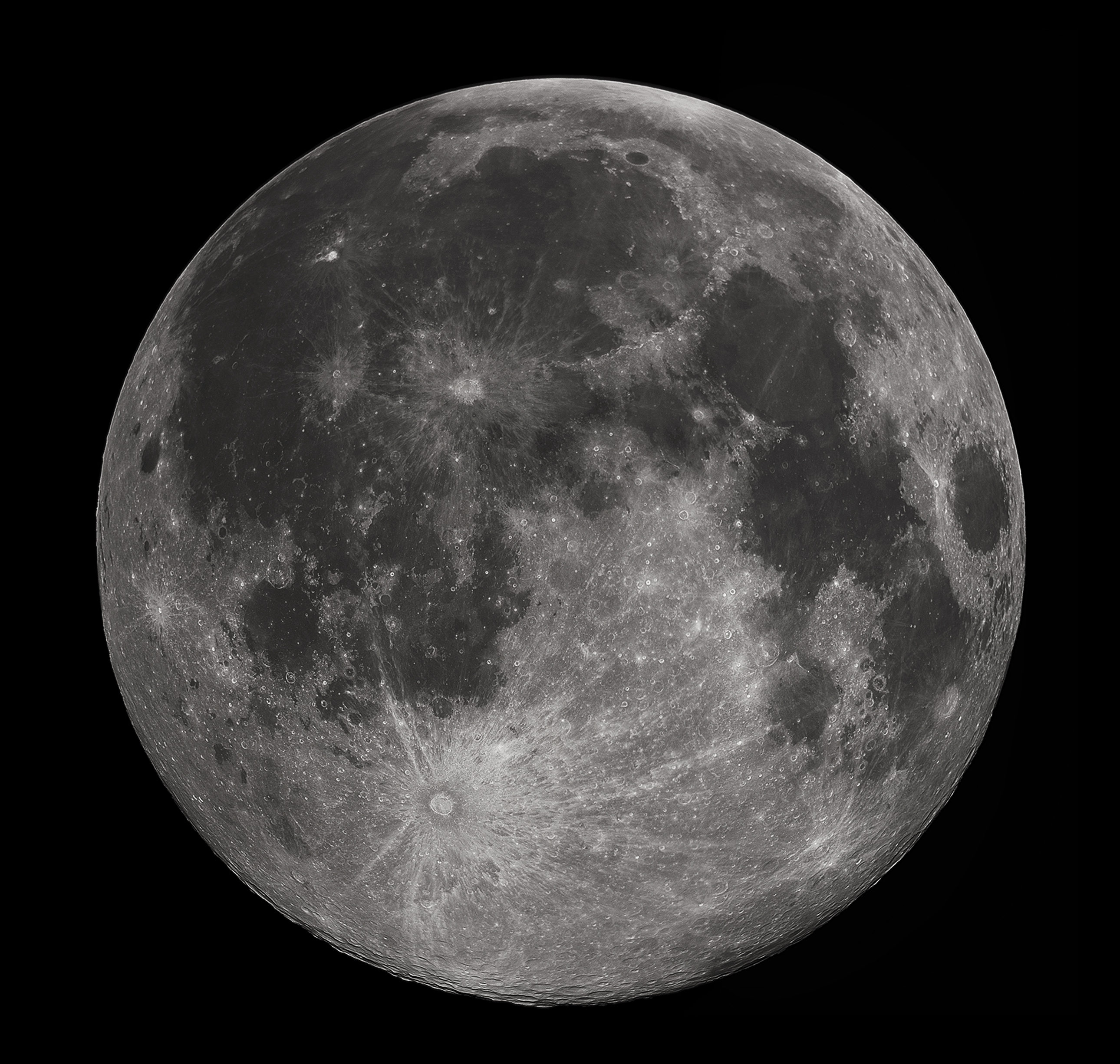
A photograph of the full Moon clearly shows darker and lighter regions. The dark plains are traditionally called lunar seas, or maria in Latin. The term comes from a period when dark regions were interpreted as bodies of water. Maps from the seventeenth century established names that are still used today. A surviving name does not mean that the old explanation survived with it.
We now know these are mainly plains of , a rock formed when lava solidifies. Names such as the Sea of Tranquility belong to the history of lunar mapping. The , the , maintains a register of planetary names in cooperation with the . It helps researchers when different teams use the same name for the same area. One celestial body thus has both an ancient name for the entire object and a system of names for individual craters, plains and other landforms.
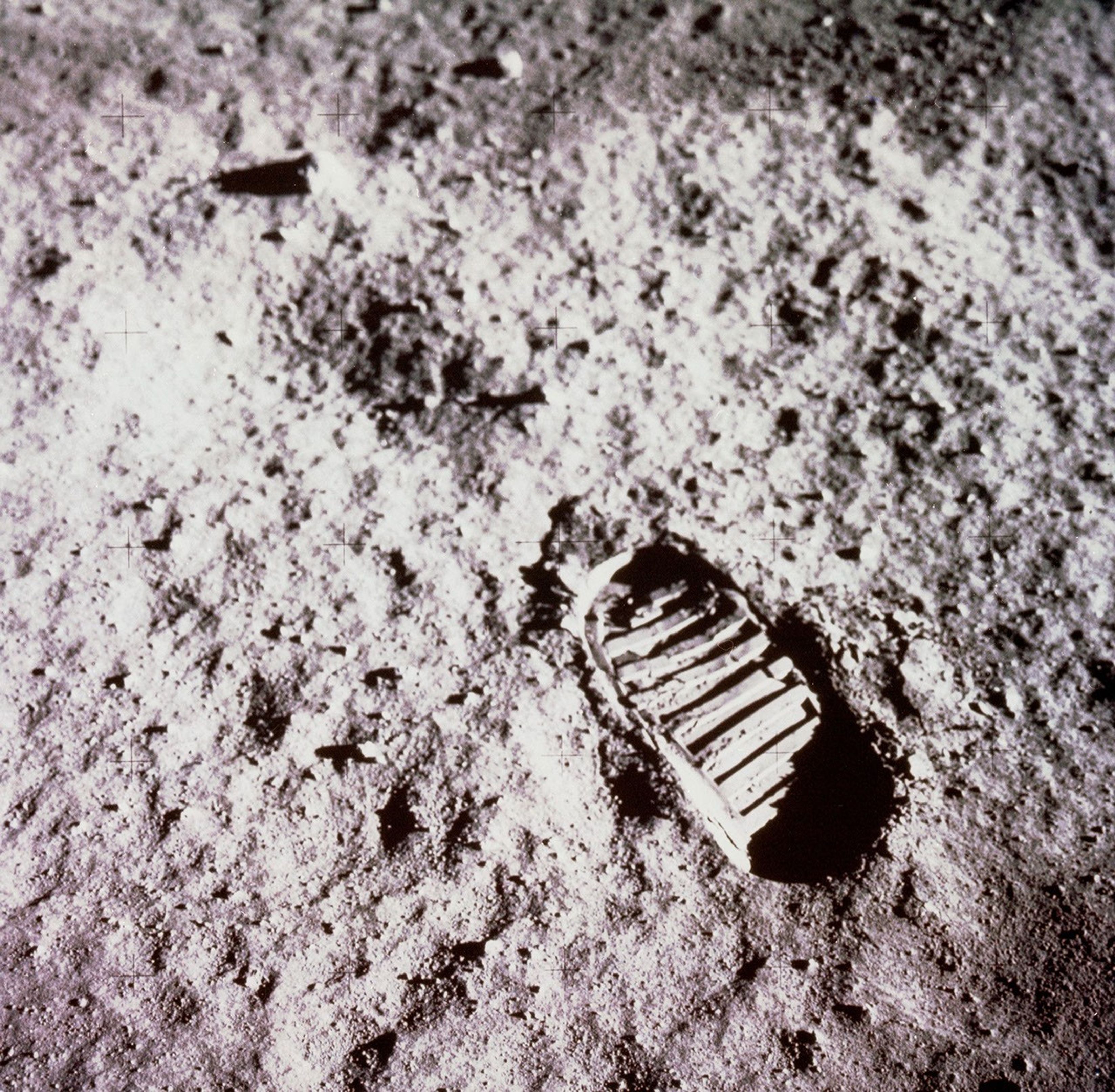
NASA / Baz Oldrin · Sources ↗ · Image terms ↗
Its name is old, but our understanding has changed
The Moon is approximately 3,475 kilometres in diameter and an average of about 384,400 kilometres from Earth. Its path is not a perfect circle, so its distance is not constant. It rotates on its axis in approximately the same time it takes to Earth. Because of this , essentially the same side faces us. The other side is not permanently dark: it too experiences alternating light and darkness.
Spacecraft and measurements have given us views unavailable to earlier observers. The photograph of Earth above the lunar horizon, taken by Bill Anders during Apollo 8, shows this familiar pair of bodies from an unusual direction. The Moon becomes a landscape in the foreground, and Earth a distant world. That change of perspective complements the story of names: the name Moon arose from human experience on Earth, while astronomy investigates this object regardless of our viewing position.
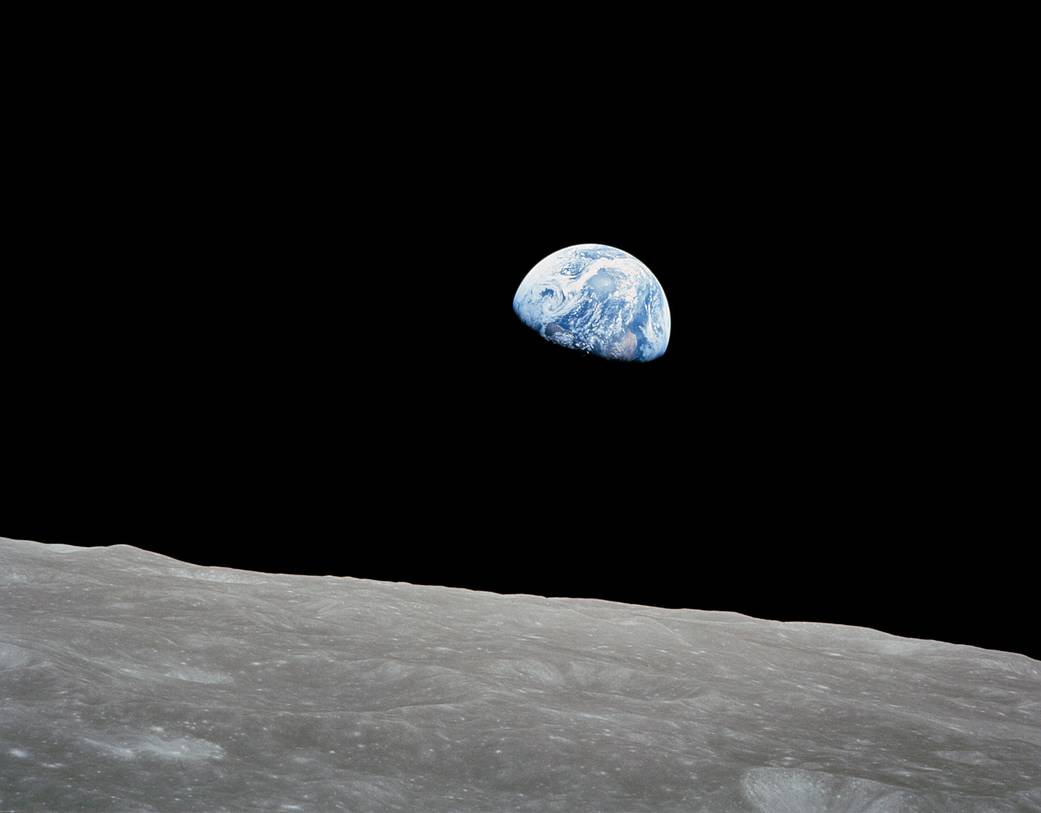
NASA / Bil Anders · Sources ↗ · Image terms ↗
A small investigation: keep your own Moon diary
A few weeks of observations are enough to test the basic idea. Whenever the Moon is visible, record the date, time, direction in which you see it and approximate shape of the illuminated portion. Draw it inside a circle of the same size for every entry. It may not be visible at the same time every evening; try observing during the day too when conditions allow. Your sequence of observations will show how its phase changes and when it can be seen in the sky.
The diary will not immediately produce a precise , but it can clearly separate an observation from an assumption. Write down what you actually saw and what you think explains it, then compare the entries with a reliable representation of . Recognizing repetition is at the heart of the connection between a celestial body and a unit of time. The answer to the opening question therefore goes beyond one word: the Moon’s name preserves a trace of humanity’s long attempt to find a measure of time in the regularities of the sky.